
Navigation
Install the app
How to install the app on iOS
Follow along with the video below to see how to install our site as a web app on your home screen.
Note: This feature may not be available in some browsers.
More options
You are using an out of date browser. It may not display this or other websites correctly.
You should upgrade or use an alternative browser.
You should upgrade or use an alternative browser.
How did the WWII mine sweeping aircraft work?
- Thread starter MG3
- Start date
More options
Who Replied?
The object was to fly low enough such that the magnetic field generated around the ring would trigger the magnetic circuit in the mines causing them to blow up.
Type 418 Wellington DWI (Detonation Without Impact) Mark IConversion of four Wellington Mark IAs to minesweeping aircraft for exploding magnetic mines. Fitted with Ford V-8 petrol engine and Mawdsley electrical generator to induce magnetic field in a 48 ft (15 m) diameter loop mounted under fuselage. They had a solid nose with a bracket supporting the loop, which was also supported under the rear fuselage and the wings, outboard of the engines. DWI was also known as "Directional Wireless Installation" – to mislead the true purpose of the loop.
Type 419 Wellington DWI Mark IIDWI Mark I aircraft upgraded by installation of de Havilland Gipsy Six engine for increased generation power. 11 aircraft were converted to this standard. They were operated by No. 1 General Reconnaissance Unit, RAF, sweeping mines in the Thames Estuary for a short time until the Royal Navy had an equivalent capability to sweep magnetic mines. The unit was transferred to Egypt for use in the Suez Canal.[56]
The Luftwaffe also operated a version of the Ju 52/3m with similar equipment.

 historynet.com
Development of the LL magnetic mine sweep on minesweepers proved a more reliable method of tackling the magnetic mine. That involved the use of multiple ships in a variety of formations to sweep a path.

Wellington DWI
The Wellington DWI was a response to the German use of magnetic mines early in the Second World War.
www.historyofwar.org
Type 418 Wellington DWI (Detonation Without Impact) Mark IConversion of four Wellington Mark IAs to minesweeping aircraft for exploding magnetic mines. Fitted with Ford V-8 petrol engine and Mawdsley electrical generator to induce magnetic field in a 48 ft (15 m) diameter loop mounted under fuselage. They had a solid nose with a bracket supporting the loop, which was also supported under the rear fuselage and the wings, outboard of the engines. DWI was also known as "Directional Wireless Installation" – to mislead the true purpose of the loop.
Type 419 Wellington DWI Mark IIDWI Mark I aircraft upgraded by installation of de Havilland Gipsy Six engine for increased generation power. 11 aircraft were converted to this standard. They were operated by No. 1 General Reconnaissance Unit, RAF, sweeping mines in the Thames Estuary for a short time until the Royal Navy had an equivalent capability to sweep magnetic mines. The unit was transferred to Egypt for use in the Suez Canal.[56]
The Luftwaffe also operated a version of the Ju 52/3m with similar equipment.
Aerial Minesweeping: Ingenious Solution to a Hidden Undersea Menace
When Germany deployed magnetic mines early in the war, Britain countered with aircraft that could explode them by mimicking a ship’s magnetic signature.
historynet.com
Development of the LL magnetic mine sweep on minesweepers proved a more reliable method of tackling the magnetic mine. That involved the use of multiple ships in a variety of formations to sweep a path.
MOTOR MINESWEEPERS
www.wildfire3.com
- Thread starter
- #3
Thank you for the reply. That's what I was thinking but wasn't sure which was why I wanted to ask knowledgeable people here. What I'm wondering is why we can't use that old technology today in clearing the straight of Homuz of mines combined with under water drones. Maybe I'm missing something...?The object was to fly low enough such that the magnetic field generated around the ring would trigger the magnetic circuit in the mines causing them to blow up.
Wellington DWI
The Wellington DWI was a response to the German use of magnetic mines early in the Second World War.www.historyofwar.org
Type 418 Wellington DWI (Detonation Without Impact) Mark IConversion of four Wellington Mark IAs to minesweeping aircraft for exploding magnetic mines. Fitted with Ford V-8 petrol engine and Mawdsley electrical generator to induce magnetic field in a 48 ft (15 m) diameter loop mounted under fuselage. They had a solid nose with a bracket supporting the loop, which was also supported under the rear fuselage and the wings, outboard of the engines. DWI was also known as "Directional Wireless Installation" – to mislead the true purpose of the loop.
Type 419 Wellington DWI Mark IIDWI Mark I aircraft upgraded by installation of de Havilland Gipsy Six engine for increased generation power. 11 aircraft were converted to this standard. They were operated by No. 1 General Reconnaissance Unit, RAF, sweeping mines in the Thames Estuary for a short time until the Royal Navy had an equivalent capability to sweep magnetic mines. The unit was transferred to Egypt for use in the Suez Canal.[56]
The Luftwaffe also operated a version of the Ju 52/3m with similar equipment.
Aerial Minesweeping: Ingenious Solution to a Hidden Undersea Menace
When Germany deployed magnetic mines early in the war, Britain countered with aircraft that could explode them by mimicking a ship’s magnetic signature.
Development of the LL magnetic mine sweep on minesweepers proved a more reliable method of tackling the magnetic mine. That involved the use of multiple ships in a variety of formations to sweep a path.
MOTOR MINESWEEPERS
www.wildfire3.com
- Thread starter
- #4
Wondering too that maybe we just don't have many mine sweeper ships and planes because the threat hasn't been a factor in decades? I would think as fast as they created the WWII mine sweeper aircrafts we could fab up some old existing planes relatively quickly in this case?
Thank you for the reply. That's what I was thinking but wasn't sure which was why I wanted to ask knowledgeable people here. What I'm wondering is why we can't use that old technology today in clearing the straight of Homuz of mines combined with under water drones. Maybe I'm missing something...?
The problem is that "minesweeping" in the traditional sense (i.e. sweeping an area with ships to cut mine cables or blow up mines) ceased to be a viable option a long time ago.Wondering too that maybe we just don't have many mine sweeper ships and planes because the threat hasn't been a factor in decades? I would think as fast as they created the WWII mine sweeper aircrafts we could fab up some old existing planes relatively quickly in this case?
The RN introduced the magnetic mine in Aug 1918, towards the end of WW1. WW2 saw the introduction of acoustic mines (triggered by the sound of a passing ship) in 1940 and the pressure mine (triggered by the pressure wave of passing vessel as it passed through the water) in 1944 (by Germany off Normandy). Then come the complications developed in WW2. Mines with magnetic / acoustic or pressure / magnetic or pressure / acoustic fusing that required both circuits to be triggered before they would explode. Mines with fuses designed to be triggered after several ships might had passed over (ship counters. So a channel needed swept on multiple occasions before it could be considered clear). Mines with different magnetic or acoustic settings to target either merchant or warship targets passing overhead. Mines with snaglines that would be triggered when a ship caught the floating line. Mines that would lie dormant for a period of time after being laid before becoming active. Some mines were laid with sterilisation circuits that stopped them being active after a period of time (useful if the country laying them expected to occupy that area of sea soon after) which did not always work as designed. Then there were mine obstructors designed to damage sweep gear.
All this occupied large numbers of minesweepers of various sizes and capabilities with huge manpower requirements. Clearing the Scheldt to Antwerp in 1944 couldn't begin until both sides of the river and its approaches had been cleared of enemy shore batteries. It then took a month and required the services of 162 minesweepers at its peak, ranging in size from landing craft to ocean going minesweepers like the Algerine class. That operation cleared nearly 300 mines.
Since WW2 we have seen "homing" mines appear like the US CAPTOR.

Mark 60 CAPTOR - Wikipedia
The USN began using minesweeping sleds towed by helicopters in the 1950s.

A Brief History of USN Helicopter Minesweeping
Many of the problems that the helicopter was the solution for were identified in the decade or so after Larry Bell and Igor Sikorsky were su...
 tailspintopics.blogspot.com
Today they use the MH-53E Sea Dragon

Sikorsky CH-53E Super Stallion - Wikipedia
The RN moved to "minehunting" in the 1960s. Improved sonars allowed individual mines to be located after which divers would be put down to fix explosive charges to blow them up. Divers were replaced by remotely operated vehicles in the 1970s.
Today's Minehunting Technology | TON Class Association
 tcaminesweepers.co.uk

Hunt-class mine countermeasures vessel - Wikipedia

Sandown-class minehunter - Wikipedia
The USN is retiring its Avenger class MCMV (3 were withdrawn from the Gulf in Jan) and replacing them with kits that can be put aboard the LCS.
Navies still employ Mine Countermeasure Vessels (MCMV) but the scene is now shifting to the use of remote controlled "drone" craft.
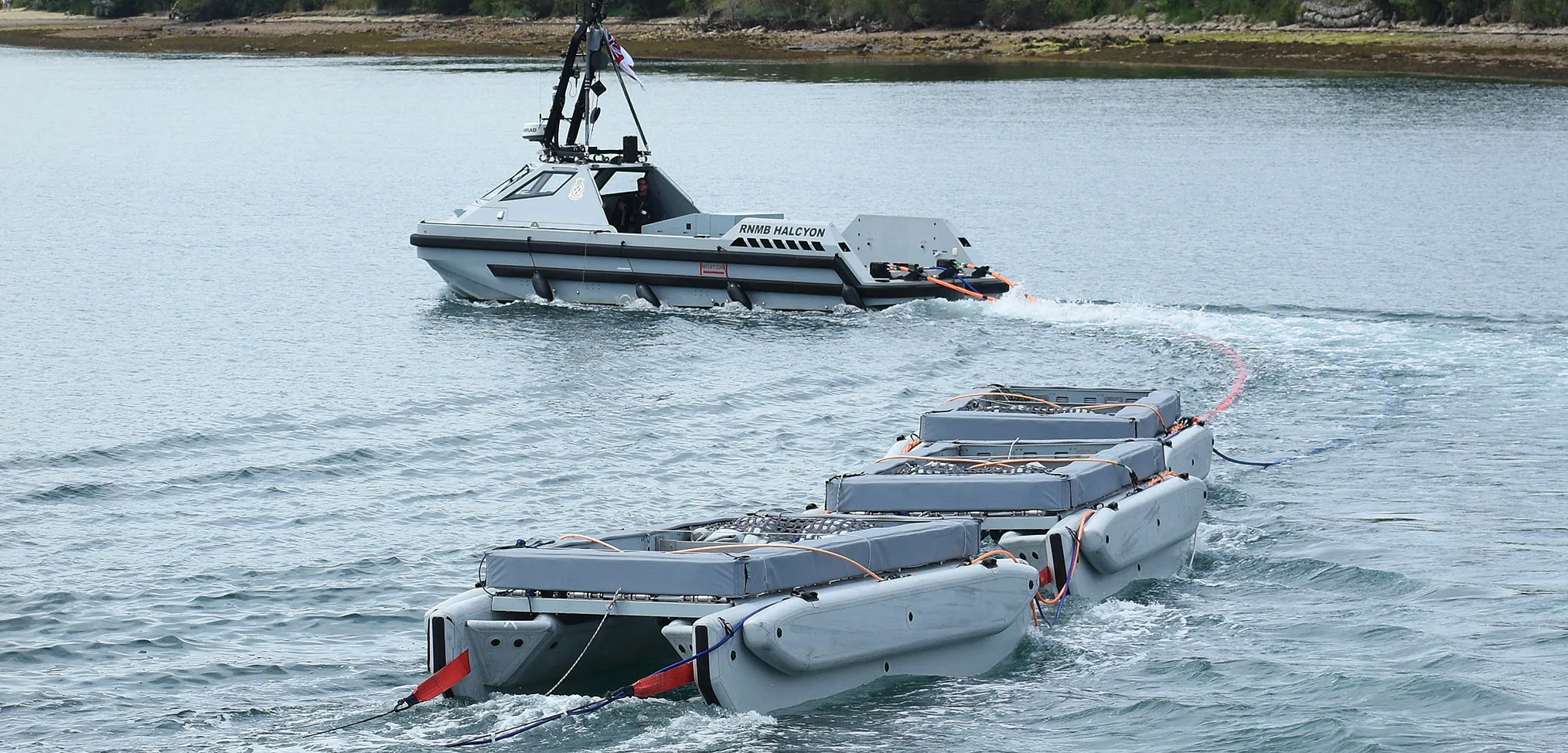
In focus: Royal Navy minesweeping capability restored - Navy Lookout
The RN has re-established a minesweeping capability for the first time in nearly two decades with the acceptance of three USV-based autonomous Combined Influence Sweep systems, developed and delivered under the Mine Hunting Capability (MHC) Block 1 programme. Old threat, new tools Traditional...
 www.navylookout.com

City-class mine countermeasures vessel - Wikipedia

Flurry Of Navy Minesweepers Appear To Be Heading Toward The Middle East
A surge in minesweeper movements comes as the U.S. says an operation to clear Iranian mines from the Strait of Hormuz is taking shape.
 www.twz.com

swampyankee
Chief Master Sergeant
- 4,307
- Jun 25, 2013
Mine technology has changed a lot. Modern mines can be triggered acoustically, magnetically, or by pressure waves from a ship's passage. That last is hard to simulate, hence the use of ROV and divers to disable mines. Modern mines can also count, so the may ignore the first ship or sweep that passes.Thank you for the reply. That's what I was thinking but wasn't sure which was why I wanted to ask knowledgeable people here. What I'm wondering is why we can't use that old technology today in clearing the straight of Homuz of mines combined with under water drones. Maybe I'm missing something...?
This is a truly excellent playlist covering the history and technical details using a lot of primary documents. I suggest jumping to the 7th video, which covers US Navy minesweeping in Japanese waters after WWII. The US-laid mines were extraordinarily difficult to sweep.I've seen many pics of WWII mine sweeping aircraft with huge rings around them. How did they work? Did they simply locate underwater mines or did they blow them up using magnetics?
View: https://www.youtube.com/playlist?list=PLO7SMfMqEYq6-i8ac6jvHpb2mZsYBotvK
The Wellingtons didn't have to worry about flying into a SAM zone.Thank you for the reply. That's what I was thinking but wasn't sure which was why I wanted to ask knowledgeable people here. What I'm wondering is why we can't use that old technology today in clearing the straight of Homuz of mines combined with under water drones. Maybe I'm missing something...?

SaparotRob
Unter Gemeine Geschwader Murmeltier XIII
This is a truly excellent playlist covering the history and technical details using a lot of primary documents. I suggest jumping to the 7th video, which covers US Navy minesweeping in Japanese waters after WWII. The US-laid mines were extraordinarily difficult to sweep.
View: https://www.youtube.com/playlist?list=PLO7SMfMqEYq6-i8ac6jvHpb2mZsYBotvK
I subscribe to this channel.
- Thread starter
- #10

yosimitesam
Senior Airman
The above posts have covered the subject pretty well. I'll just add a couple of notes, concerning only the WWII era mines. With regard to pressure mines, they have a "range of depths" requirement to be effective. Plant them in water too deep and not enough pressure differential above the mine is created by the ship and it won't trigger. Plant them in water too shallow and the wave action from a storm could trigger them. (The Japanese made note of this in interviews after the war, i.e. mines exploding in shallow waters when there were no ships around. Since we dropped most mines via aircraft at night it is not surprising that some were misplaced, so to speak.) After the British counter to purely magnetic mines was developed, the Germans (and other mine laying nations) started using "two factor authentication": both an acoustic signature as well as a magnetic signature was necessary to trigger the mine. This resulted in magnetic sweeps that also used some sort of noise-making equipment to trigger the mines. There were also acoustic plus pressure mines, and so on. Measures and counter-measures throughout the conflict. The "trigger counters" on mines (no explosion until triggered a settable number of times) made sweeping a resource and time consuming endeavor. Mine warfare had (and still has) a very good military "return on investment." The costs to the enemy to counter them far exceeds the cost of building and planting them.
- Thread starter
- #12
In WW2 pressure mines proved virtually unsweepable. The only solution was for speed limit through an area thought to be "infected" by them with the speed being driven by the depth of water and size of the ship..
Their appearance was prediced by the RN in 1943 which built two "displacement sweep" craft as an experiment in countering them.
 en.wikipedia.org
Other "solutions"
1. monitoring the sea swell off Normandy, which rendered the pressure circuit null, and allowing them to be swept as ordinary magnetic / acoustic mines
2. steaming destroyers, steam gunboats or multiple Fairmile D Type MTB/MGB at high speed to create the pressure wave and hopefully escape the subsequent blast
3. "Egg crates" another form of displacement sweep towed by a pair of specially converted Bangor class minesweepers. Designed by BuShips in the USA, the first arrived in British waters in Aug 1944
4. Concrete barges, again as displacement sweeps designed to be expendable. Proved disappointing in several ways and discontinued by end of 1944.
5. Use of large vessels as guinea pigs to check out areas of sea.
I've read somewhere that the post war problems of sweeping US mines in Japanese waters was that numbers of them were not fitted with sterilisers when dropped to deactivate them after a period of time. So at least partly a problem of their own making.
Their appearance was prediced by the RN in 1943 which built two "displacement sweep" craft as an experiment in countering them.
Cybele-class mine destructor vessel - Wikipedia
Other "solutions"
1. monitoring the sea swell off Normandy, which rendered the pressure circuit null, and allowing them to be swept as ordinary magnetic / acoustic mines
2. steaming destroyers, steam gunboats or multiple Fairmile D Type MTB/MGB at high speed to create the pressure wave and hopefully escape the subsequent blast
3. "Egg crates" another form of displacement sweep towed by a pair of specially converted Bangor class minesweepers. Designed by BuShips in the USA, the first arrived in British waters in Aug 1944
4. Concrete barges, again as displacement sweeps designed to be expendable. Proved disappointing in several ways and discontinued by end of 1944.
5. Use of large vessels as guinea pigs to check out areas of sea.
I've read somewhere that the post war problems of sweeping US mines in Japanese waters was that numbers of them were not fitted with sterilisers when dropped to deactivate them after a period of time. So at least partly a problem of their own making.
SaparotRob
Unter Gemeine Geschwader Murmeltier XIII
The attempt at secrecy for the Cybele class seems pretty successful to me. Then again, I'm not as serious a student of history as some might think.
swampyankee
Chief Master Sergeant
- 4,307
- Jun 25, 2013
"Cybele" may have been one of the less appropriate names for a ship, considering what was needed to join her priesthood.The attempt at secrecy for the Cybele class seems pretty successful to me. Then again, I'm not as serious a student of history as some might think.
Users who are viewing this thread
Total: 1 (members: 0, guests: 1)
Similar threads

- Replies
- 157
- Views
- 24K


