180-190 mph is about 300 km/h, and we know that going slow is greatly benefiting the range.
See here for Bf 110C doing 1040 km at ~520 km/h with full internal tankage.
Thanks for that, interesting how an aside gains a life of its own, but alongside the C-2 doing 1,040 km is the C-1 doing 780 km, with a lower fuel load, yet there were few changes between the two. Also the speed quoted is almost the reported top speed of the type, which should give an economic cruise well beyond the 1,500 km mark on internal fuel. My German is not good enough to deal with the font and abbreviations to clarify things.
The RAF calculated fighter ranges by deducting the fuel needed to run the engine at full power for 15 minutes, the rest being available for cruise, result being Spitfire official economic cruise ranges at 15,000 feet were I 575 miles, II 530 miles, V 480 miles, IX 434 miles.
P-47C: 305 US Gallons internal, 13,500-lbs take-off weight,
650-miles range at Maximum Cruise power, or
400-miles at Maximum Continuous power (
325-milesat low altitude)
If we compare to the contemporary P-40 series (excluding the P-40L and P-40N-1, since both are assuredly inferior in range due to their ~20% reduction in internal fuel capacity). we have the following information

-40F: 157 US Gallons internal, 8,850-lbs take-off weight,
600-mile range at Maximum Cruise power,
425-miles at Maximum Continuous power (
375-miles at low-altitude).
P-40K: 157 US Gallons internal, 8,800-lbs take-off weight,
600-miles range at Maximum Cruise power,
350-miles at low-altitude Maximum Continuous (no data-point for high-altitude)
P-40M: 157 US Gallons internal, 8,800-lbs take-off weight,
550-miles range at Maximum Cruise power,
475-miles at Maximum Continuous power (
325-miles at low-altitude).
Thanks for the range charts, firstly it is interesting how the economic cruise ranges of the various P-40 were compared to the Spitfire I. Staying with economic cruise how Francis Dean picked up on the gap between the P-47 and P-40 range, if the aircraft were in the Pacific this is the key range. Moving to the European Theatre the maximum cruise power would be more appropriate, with the P-47 having a 50 to 100 mile advantage, then comes maximum continuous power, the P-47 being equal worst.
It says something about the engines that the P-47 has a big range advantage at economic cruise, still an advantage at maximum cruise but is equal worst at maximum continuous power. While the Merlin was as good as the Allison but faster at economic cruise, gap closing at maximum cruise, and slightly better at maximum continuous at about the same speed.
Finally dividing the range by endurance throws up some interesting results, P-40M 10,000 feet economic cruise 700 miles at 195 mph, 25,000 feet maximum cruise 550 miles at 205 mph. I suspect a few of the numbers.
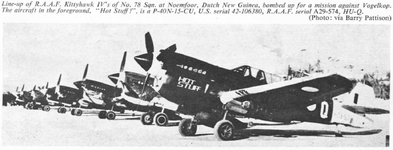
For "contemporary" the major theatre where the P-40 and Spitfire served together was in the Mediterranean, as of end December 1943 the RAF in theatre had 25 Spitfire mark I, 1,718 V, 6 VI, 398 VIII, 764 IX, 43 PR.IV, 51 PR.XI along with 153 Kittyhawk I, 155 IA, 165 IIA, 217 III and 135 IV, end June 1944 it was 18 Spitfire mark I, 1,347 V, 5 VI, 262 VIII, 879 IX, 32 PR.IV, 76 PR.XI along with 56 Kittyhawk I, 91 IA, 123 IIA, 158 III and 360 IV. The 456 Kittyhawk IV allocated to the RAF were 56 N-1, 150 N-5, 50 N-15 and 200 N-20. So as of 1943 the majority of Kittyhawk IV were short ranged, by the looks of things the 100 P-40L/mark II had been removed from inventory. It is really easy to choose say Spitfire VIII versus P-40N-1, Spitfire longer range, or Spitfire IX versus P-40M, P-40 longer range.
In numbers terms the P-40L and N-1 were about 8% of production, while the Spitfire IX was around 29% but from the second half of 1944 more internal tankage was fitted, deducting these leaves say 15% of Spitfire production, throw in Seafires and it becomes 13%. If we are to ignore the shorter range P-40 versions we can ignore the shorter range Spitfire versions for comparison purposes. Types like the P-40 and Spitfire came in a large number of versions with different capabilities, selecting which versions to compare therefore tends to say more about the author than the aircraft. Similar for what conditions.
Yes, there is subject to fine interpretation with each of these individual values, but I believe it does relay my position of "about on-par" adequately. While reasonable minds can disagree on where the line is for "about on-par", or what meets that metric, in my perception of the ranges of both aircraft are within a fairly narrow margin of difference--
To conclude "about on par" requires operations run at maximum continuous power as that is where the P-40 and P-47 ranges converge or the P-40 is superior, going to maximum cruise the P-47 range is 50 to 100 miles longer, economic cruise over 100 miles more, which means at economic cruise the Spitfire I range is "about on par" to the P-40 at 125 miles shorter. How many fighter missions were run at maximum continuous power versus at maximum and economic cruise?
before later P-47 models are introduced, and become prolific in their carriage of large underwing tanks.
More the extra 25% or so internal fuel.
Still interested in the MTO fighter bomber operations using 1,000 pound bombs, the P-38 units regularly used them.