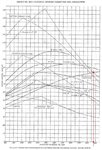
Oh now I see it ! Theres two P-51's on the graph.
Still doesnt agree with other tests though, and certainly not pilot accounts !
-------------------------------------------------------
Anyway we were talking the 109 and Spitfire.
The myth that the Spit was a better T&B fighter is bollocks, and there's alot of evidence to back this up.
One claim is that the Spitfire has eliptical wings. That means that the lift is spread elipticaly over the wings... Therefore it is "THE most effecient wing configuration possible".
However the elliptical planform has very small theoretical advantage, but only "theoretical", and only valid if the planform is truely elliptical. Spitfire's planform is only approximating elliptical, and what is left has been sold out by the aerodynamic twist it's wing has.
It has effect on just one of several factors of wing efficiency, causing only 0.05 improvement in comparison to a trapezoidal planform used on for example the Bf 109, that is, "IF" Spit's wing were truely elliptical...
You also have to take into account the fact that the profile thicknes ratio of Spit's wing is VERY thin, both in maximum and in average. This in turn leads to the small coefficient of lift. This pretty much takes away the advantage of the large wing area.
BTW, ever wondered where did all the elliptical wings go?
If they are so magically efficient, why nobody uses them anymore?
The answer is simple, later aerodynamic research has proven that most of the benefits of elliptical wing were a fallacy created by insufficient or faulty research methods. They simply were not worth the trouble.
Even the developements of Spitfire, Spiteful and Seafang gave up on the elliptic planform and went to normal trapezoid form. Wonder why?
Only thing special in it is the elliptic planform, that dropped of favour just after it, when it was found out that the theoretical benefits of elliptic planform were actually only theoretical, and practical applications did not yield benefits that would justify the almost astronomical manufacturing difficulties and costs.
In Spitfire's case the benefits of elliptic planform (even lift distribution along the span) are nullified by the 2 degree twist (washout) that was needed for at least partially taming the nasty and violent stall behaviour of such wing.
Besides, wing aspect ratio has larger effect on the lift/drag characteristics than the Oswald efficiency factor (where the theoretical difference between Spit's and Bf 109's wing is only in a magnitude of 0.05), and the Bf-109's wing has higher aspect ratio than the Spit's...
Spit's wing uses the exact same NACA 2300 root profile as Bf 109's wing, but with only 13 % thickness ratio, while Bf 109 has 14.2 % thickness ratio. Lower thickness ratio translates to lower Cl max. Bf 109 uses the same NACA 2300 with thickness ratio of 11%, but Spit's wing profile gradually changes along the span to NACA 2200 (more symmetric profile with smaller Cl max) with thickness ratio of only 9 %.
All the above leaves the Spit's lower wingloading as the only even theoretical advantage for Spit's wing, but even that is somewhat negated by wingprofile that has less Cl max and Cl in general.
Now to add even one more disadvantage to the Spit, "It has NO wing-slats", wich the 109's already superior wings have. So whenever a turn of sufficient AoA is made, low or high speed, the slats deploy on the 109 and it turns even tighter. (Some novice LW pilots didnt know this though)





 As if the Germans did not fly older a/c or put a/c that had been damaged back into combat.


