KC-135 Lost over Iraq

Ad: This forum contains affiliate links to products on Amazon and eBay. More information in Terms and rules


I don't want to denigrate any heroics or disagree out of hand, but here are 'facts' from my fallible memory, six decades later with some Internet backup that reinforces:
Edited from https://www.nationalmuseum.af.mil - "The Air Rescue Service (later the Aerospace Rescue and Recovery Service) first used Kaman HH-43 Huskie helicopters, unofficially known as "Pedro" from their radio call sign. They later added larger Sikorsky HH-3 "Jolly Green Giant" helicopters, with greater range, and Grumman HU-16B Albatross amphibians to rescue Airmen who went down in the Gulf of Tonkin.
Air operations over dangerous enemy territory forced Search and Rescue (SAR) to evolve into Combat Search and Rescue (CSAR) teams. A major improvement came in November 1965, when the Sikorsky HH-53E "Super Jolly Green Giants" arrived. Capable of being refueled in flight, the HH-53E helicopters could reach any point in the Southeast Asia theater.
During the Southeast Asia War, CSAR personnel had a significant impact and lived up to their motto: "That Others May Live." They saved a total of 4,120 people, including 2,780 in combat situations. Their individual achievements earned them two Medals of Honor, 38 Air Force Crosses, and numerous other awards. However, the cost was high as 71 U.S. rescue personnel were killed and 45 aircraft destroyed during the war."

​

For some reason I was, and am, remembering Gary telling me "UH-1". I appreciate the correction and apologize for my misremembering.
 
I don't want to denigrate any heroics or disagree out of hand, but here are 'facts' from my fallible memory, six decades later with some Internet backup that reinforces:
Edited from https://www.nationalmuseum.af.mil - "The Air Rescue Service (later the Aerospace Rescue and Recovery Service) first used Kaman HH-43 Huskie helicopters, unofficially known as "Pedro" from their radio call sign. They later added larger Sikorsky HH-3 "Jolly Green Giant" helicopters, with greater range, and Grumman HU-16B Albatross amphibians to rescue Airmen who went down in the Gulf of Tonkin.
Air operations over dangerous enemy territory forced Search and Rescue (SAR) to evolve into Combat Search and Rescue (CSAR) teams. A major improvement came in November 1965, when the Sikorsky HH-53E "Super Jolly Green Giants" arrived. Capable of being refueled in flight, the HH-53E helicopters could reach any point in the Southeast Asia theater.
During the Southeast Asia War, CSAR personnel had a significant impact and lived up to their motto: "That Others May Live." They saved a total of 4,120 people, including 2,780 in combat situations. Their individual achievements earned them two Medals of Honor, 38 Air Force Crosses, and numerous other awards. However, the cost was high as 71 U.S. rescue personnel were killed and 45 aircraft destroyed during the war."

​
In addition, though not as organized or armed (!!), Navy carriers sometimes used their Tonkin Gulf plane guard helicopters, nicknamed "Angels," to rescue pilots downed during launch or recovery. They were Sikorsky SH-3 Sea Kings, Kaman UH-43C Huskies, and Piasecki H-25 Retrievers that were occasionally called upon to chase downed crews into hostile coastal waters, even into Haiphong and other harbors.

This is not to overlook the heroic Army UH-1 dust off/Medevac choppers, and some may have been used in crew rescues, but in my limited experience, the Air Force bigger SAR helos and occasionally Navy Plane Guard craft did the work outside of South Vietnam. Of course, with a flight crew down, EVERY ordinance carrying craft from O-1 Bird Dogs to A-1 Sandies to B-52 Buffs participated on occasion to suppress hostile capture.

Not SAR related, but in '63-4 when I did an enlisted tour with MACV in the Iron Triangle and highlands, I often flew as door gunner in a RVN H-34, with a M-60, firing 7.62×51mm NATO cartridges from a disintegrating belt mounted in various ways as we tried them out. This seemed to be the norm for all door gunners until the later Gatling guns, which only Sylvester and Dolph were capable of demounting and using as a personal weapon.

Finally, regarding cargo/tanker personal chutes. As an AF dependent in '55, we flew in a MATS C-118 across the Atlantic in stages from Rhein Main to McGuire. We had inflatable life preservers in the seat backs, and were afforded a pre takeoff demo, BUT I noted a large pile of parachutes in an aft compartment, seemingly enough for all souls, and they were NOT MENTIONED. I later rode as a CAP cadet in C-46s, C-47s, C-54s and KC-97s, and for a while, fresh chutes were loaded without mention to match people, but that practice ceased without notice. I do recall a C-119 incident about then where it lost an engine, descended into icing over TN, and all on board successfully bailed out, including a neighbor, but that was the last I know of.

While A CAP Cadet, 1955-59, we flew several times on C-119s, to National drill competitions & summer camps. Every time we wore back pack chutes and were taught proper attachment, both male and female cadets. A few years later while in USAF, another guy and I caught a space available from Tucson to Barksdale in a C-97. I have figured now, that this C-97 most probably was coming from storage to Barksdale to go on exhibit. The clues were the pilot (1st Lt.) and copilot (2nd Lt.) looked our age (19) while the crew chief was old enough to be their father. Our pre flight was, "We have no fire bottles for engine fires as no knew how to charge them and the intercom is not working. So if you see the three of us running to the rear, jump up and follow us." We, two passengers, had back pack chutes same as the ones we had on the 119s. I showed my fellow passenger how to pull the straps tight.
A sort of funny thing happened as a CAP cadet on a return flight from encampment at night on a C-119. After settling in, one cadet discovered that the D ring and cable seemed to have an excess of cable longer that his arm before any resistance was felt. It was reported to the crew chief that his arm would not be able to open the chute. Sarge looked at and said don't worry about it. We cadets decided the one with the chute was to put his foot in the D ring if needed. We solved the problem after landing by stringing the long cable between the seats in the aisle. The crew chief tripped on the cable after we were out, opening the chute and solving the problem.
 
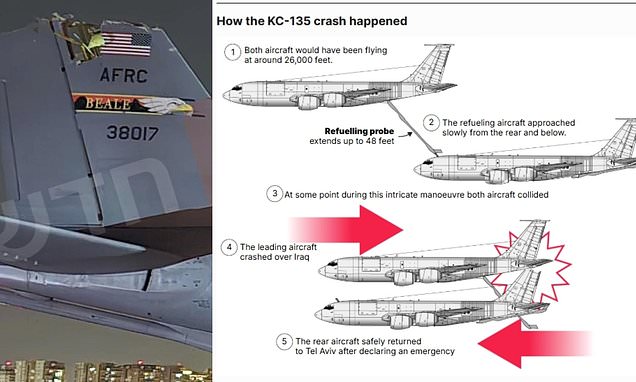
The latest news is 4 of the crew are dead. The article has pictures showing the vertical tail damage to the other.

Was that involved in the loss of the one ? 5 other 135s were damaged by a missile strike on their base in Saudi. Photo on news I saw looked more like fragment damage than a mid-air. News idiots wouldnt know a Wright Flyer from a stealth fighter..... (F-21 crashed at NAS Fallon. News had footage of F-15E. On a NAVY base??)
 
I'd say the vertical stab damage is more consistent with a mid-air. Any explosion flak/missile/artillery damage I've seen had multiple shrapnel holes and scrapes, and I've seen a lot. Sorry.

While smaller birds, may drop back from boom/probe, and then peel off, big iron tends to clear and drop down before turning. IMHO, that's indicative of not clearing the tanker and impacting per the DailyMail drawing ... even a boom impact would cause that damage, but affect the tanker more.
 
Was that involved in the loss of the one ? 5 other 135s were damaged by a missile strike on their base in Saudi. Photo on news I saw looked more like fragment damage than a mid-air. News idiots wouldnt know a Wright Flyer from a stealth fighter..... (F-21 crashed at NAS Fallon. News had footage of F-15E. On a NAVY base??)

Looks nothing like a missile strike. Damage to the Vertical Stab looks consistent with a mid-air collision.

IMG_7433.jpeg
 
PM note to Thumpalumpacus: My Chinook pilot friend bitches that most people think the ONLY VN helo was the Huey. My first tour was an 'advisor' to RVN, flying 'their' birds, a real hodge podge of recip H-19s, H-21s, and H-34s, plus a LOT of small stuff. Per UN/State edicts for "Limited War" pretense, turbines were verboten. Somehow, Air Force H-43s were in theater, and used for SAR and firefighting. Hueys were only rumors in '64 when I left.

When Johnson let the dogs loose in '65, SEAsia became the testing ground for EVERYTHING!!

I'm sorry to hijack the Tanker thread with Chopper stuff.
 
PM note to Thumpalumpacus: My Chinook pilot friend bitches that most people think the ONLY VN helo was the Huey. My first tour was an 'advisor' to RVN, flying 'their' birds, a real hodge podge of recip H-19s, H-21s, and H-34s, plus a LOT of small stuff. Per UN/State edicts for "Limited War" pretense, turbines were verboten. Somehow, Air Force H-43s were in theater, and used for SAR and firefighting. Hueys were only rumors in '64 when I left.

When Johnson let the dogs loose in '65, SEAsia became the testing ground for EVERYTHING!!

I'm sorry to hijack the Tanker thread with Chopper stuff.

Replied via PM.
 
PM note to Thumpalumpacus: My Chinook pilot friend bitches that most people think the ONLY VN helo was the Huey. My first tour was an 'advisor' to RVN, flying 'their' birds, a real hodge podge of recip H-19s, H-21s, and H-34s, plus a LOT of small stuff. Per UN/State edicts for "Limited War" pretense, turbines were verboten. Somehow, Air Force H-43s were in theater, and used for SAR and firefighting. Hueys were only rumors in '64 when I left.

When Johnson let the dogs loose in '65, SEAsia became the testing ground for EVERYTHING!!

I'm sorry to hijack the Tanker thread with Chopper stuff.

As a rotor head guy myself, I don't mind… ;)
 
The few that can receive inflight fueling are designated KC-135RT.
As someone ignorant of refuelling systems, I don't understand AR of a tanker. Can it not drink its own, uh, liquid effluent? I thought turbine fuel was all the same (except for SR71s). Seems to my ignorant self that enabling drinking from your own tank would be easier and cheaper than drinking from someone else's tank. If a tanker is so low on fuel for the mission that it can't sip a little itself, wouldn't it be better to swap it with a full one than refuel it from a full one?
 
As someone ignorant of refuelling systems, I don't understand AR of a tanker. Can it not drink its own, uh, liquid effluent? I thought turbine fuel was all the same (except for SR71s). Seems to my ignorant self that enabling drinking from your own tank would be easier and cheaper than drinking from someone else's tank. If a tanker is so low on fuel for the mission that it can't sip a little itself, wouldn't it be better to swap it with a full one than refuel it from a full one?
It can "drink" its own fuel, but sometimes that fuel is needed over target.

The KC-135 holds approx. 200k lbs of fuel. Lets say the mission requires 150k lbs of fuel to be available for aircraft refuelling over a designated area. That leaves 50k lbs of fuel for the KC-135 to use itself for the mission. If your closest airport is more than 50k lbs of fuel away (takeoff/landing, etc.) you need to refuel so that you still have the required 150k for distribution to the other aircraft over target.

The aircraft in Iraq were not capable of refuelling each other. They were not KC-135R(RT's). Wiki says there are only 8 capable of taking on fuel. Why they had a mid-air has not been established yet.

Here's how the RAF accomplished bombing the Falkland Islands.

1773809252975.png
 
Last edited:

Users who are viewing this thread

Back