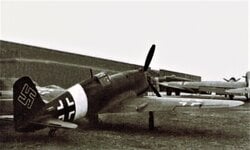
- Thread starter
- #121

Not impossible indeedI have found out that tapared swept wings made of wood are somewhat tricky to make. Not impossible.


Follow along with the video below to see how to install our site as a web app on your home screen.
Note: This feature may not be available in some browsers.
Not impossible indeedI have found out that tapared swept wings made of wood are somewhat tricky to make. Not impossible.

They did?
Yeah funny enough...I am making brackets for my 7 degrees swept wind turbine blades.Not impossible indeed

Which air foil was it to use ?Not quite. There were several iterations of different concepts for the aircraft, the fastest of which had a theoretical calculated max. speed in level-flight of 682 kmh. See also my post on the project on page 5 of this thread here.
View attachment 901185
Source: Jukka Raunio (2007): Valtion Lentokonetehtaan Historia, Osa 2: Tampereella ja sodissa 1933-1944, pp. 237-240.
Considering the mid-air disintegrations that plagued the Myrsky project, which were a result of Finland lacking the capability to produce high-grade adhesive film, among other things, it's difficult to imagine the Puuska would've faired any better.

I am reading back through the early messages of this thread. We are having difficulties defining lightweight fighters.I don't have time to wade into this now, but I can roughly sketch out a premise:
We have the assumption in the Anglophone world (and the multi-lingual but Anglophone adjacent worlds) that more power, more guns, more armor was the only way to victory in WW2. I don't think that is necessarily the case though, and a let's say 'revisionist' approach to the history of aircraft like the A6M, Ki-43, MC 202, Yak-1B, Yak 3, La 5FN etc., and then by contrast the P-47, Typhoon, Bf 110 / 210 / 410, Ki-45, yes even the Corsair and P-38 based on their operational histories, tells us that perhaps there was another way- a lighter way.
Operational history tells us that lighter aircraft with fewer guns and a bit less speed or high altitude dominance could also be effective. Whether you needed to be highest and fastest in every scenario depended a lot on the nature of the battlefield and the Theater. Strategic bombing campaigns were not the only way to victory, and where there was a big ground war (or a naval war) going on below the skies, tactical bombers and attack aircraft were much more important (arguably) than big high flying heavy bombers. Which meant that fighters needed to be able to perform better down low, and needed to be agile enough to win sustained fights around the smaller tactical dive bombers and attack planes.
So there are two tiers to this perhaps. First, we have the known to be successful 'lighter fighters', then we have the more experimental truly 'light fighters' with smaller engines, less guns, maybe non-strategic materials etc., which for the most part, never got real investment or were abandoned by the later war. These would generally be under 3,000 kg gross weight, mostly not used or saw minimal action during the war, mostly using smaller than typical engines (sometimes really achieving a lot in terms of speed with quite small engines ~500 hp etc.) and with small production ranging from just a prototype to maybe 300 or 400 produced. There is obviously some overlap between the two groups, as anything which saw widespread military service goes in the first group.
I probably missed quite a few but I'm out of time ... this gives us something to think about though.
Lighter Fighters might include:
A5M
...
Which air foil was it to use ?
I'd share your doubts about that turn of speed, especially since the similar SAI.207 did only 575 km/h (under 360 mph).Nobody has mentioned the Ambrosini SAI.403. This was lightweight by mid-war standards and made of wood. The Germans and Japanese were impressed by its performance, although I have my doubts about a war-ready aircraft doing 403mph.
The single prototype (MM.518) was seized by the Germans and evaluated by the Luftwaffe at Vergiate. Japanese pilots then stationed in Germany were also given a chance to fly the aircraft, with the result that it was ordered into production by both Heinkel and Mitsubishi.[citation needed] None of these flew before the end of the war.I'd share your doubts about that turn of speed, especially since the similar SAI.207 did only 575 km/h (under 360 mph).
Also, stuff coming from Green of the 1960s/70s is another red flag.
Your AI is hallucinating. 870kph is 545mph, faster than any piston engined aircraft has ever gone in level flight.The single prototype (MM.518) was seized by the Germans and evaluated by the Luftwaffe at Vergiate. Japanese pilots then stationed in Germany were also given a chance to fly the aircraft, with the result that it was ordered into production by both Heinkel and Mitsubishi.[citation needed] None of these flew before the end of the war.
I tried with help of the AI construct a plane that would propel itself into 870 km/h speed at high. According to AI and my calculations of the drag it was 675 hp...the need for HPs....so Ambrosini at 750 hp was plenty to go 650 km/h. My design was way more streamlined than that Dardo was....with a TIO -550 it could do 680 km/h. With a souped up Corvair on supercharger (180 hp) 450 km/h. 275 hp engine gave top speed of 550 km/h.

Notice that caption "citation needed" in the first paragraph? That's because the author is full of fantasy. The SAI.207 was a failure.The single prototype (MM.518) was seized by the Germans and evaluated by the Luftwaffe at Vergiate. Japanese pilots then stationed in Germany were also given a chance to fly the aircraft, with the result that it was ordered into production by both Heinkel and Mitsubishi.[citation needed] None of these flew before the end of the war.
I tried with help of the AI construct a plane that would propel itself into 870 km/h speed at high. According to AI and my calculations of the drag it was 675 hp...the need for HPs....so Ambrosini at 750 hp was plenty to go 650 km/h. My design was way more streamlined than that Dardo was....with a TIO -550 it could do 680 km/h. With a souped up Corvair on supercharger (180 hp) 450 km/h. 275 hp engine gave top speed of 550 km/h.
As noted by the above posters, AI and Wikipedia is meh.The single prototype (MM.518) was seized by the Germans and evaluated by the Luftwaffe at Vergiate. Japanese pilots then stationed in Germany were also given a chance to fly the aircraft, with the result that it was ordered into production by both Heinkel and Mitsubishi.[citation needed] None of these flew before the end of the war.
I tried with help of the AI construct a plane that would propel itself into 870 km/h speed at high. According to AI and my calculations of the drag it was 675 hp...the need for HPs....so Ambrosini at 750 hp was plenty to go 650 km/h.
I have my copy of William Green's War Planes of the Second World War -- Fighters Volume_2 (sorry Tomo Pauk), with its article on he calls the S.A.I.403 Dardo. The top speed is quoted as 403mph at 23,620ft. This converts to 645kph at 7,200m. Green did not understand decimal accuracy.
Sure it is faster than any piston aircraft....and why ?Your AI is hallucinating. 870kph is 545mph, faster than any piston engined aircraft has ever gone in level flight.
I have my copy of William Green's War Planes of the Second World War -- Fighters Volume_2 (sorry Tomo Pauk), with its article on he calls the S.A.I.403 Dardo. The top speed is quoted as 403mph at 23,620ft. This converts to 645kph at 7,200m. Green did not understand decimal accuracy. I see that the earlier S.A.I.207 did 398mph at 14,765ft (635kph at 4,500m). These numbers are truly spectacular for 750hp. I wonder if the 7200m altitude is a typo. Wikipedia's article on the Isotta Fraschini Delta engine says it got 750hp at 4,000m (13,000ft), which makes sense with its single stage supercharger.
The Isotta Fraschini Delta was an inverted V12, and it was air cooled. Meredith effect requires a liquid radiator. The de Havilland Albatross had some clever jiggerypokey with its inverted, air cooled V12s sucking air in at the wing roots and feeding it forwards. I don't know how well this worked. The Dardo had its cooling duct at the front. Successful air cooled engines were bigger than the successful liquid cooled engines during WWII, probably due to cooling.

 www.destinationsjourney.com
A non existing aircraft has a speed of exactly zero km/h.Sure it is faster than any piston aircraft....and why ?
Cause no one has designed such...and build one.
'Who knows' is the equivalent of 'trust me, bro'.Dardo may have hit 650 in a tail wind or shallow dive...who knows.
Source?Stenautti was ahead of his time anyway....the designer.
Sergio was a know canard aeroplane designer.A non existing aircraft has a speed of exactly zero km/h.
'Who knows' is the equivalent of 'trust me, bro'.
Source?

Very true, at this point the books are useful as a starting point.Also, stuff coming from Green of the 1960s/70s is another red flag.