Fast bombers alternatives for 1939-40

Ad: This forum contains affiliate links to products on Amazon and eBay. More information in Terms and rules

So what? The French interest preceded their order (in spite of one of the French purchasing agents dying in a prototype crash while illegally onboard). It was in fact the French interest which caused the US and British to take another look.
Hi
I think you will find that the French officer, Capt. Maurice Chemidlin, survived the crash badly injured. It was the Douglas pilot, John Cable, who was killed. The pilot was demonstrating the aircraft's engine-out capability when the running engine failed.

The prototype and what it was originally going to look like:
Scan_20251104.jpg

It was redesigned after the crash.

Mike
 
Last edited:
Hi
I think you will find that the French officer, Capt. Maurice Chemidlin, survived the crash badly injured. It was the Douglas pilot, John Cable, who was killed. The pilot was demonstrating the aircraft's engine-out capability when the running engine failed.

The prototype and what it was originally going to look like:
View attachment 854854
It was redesigned after the crash.

Mike

I stand corrected, i forgot who died exactly and who almost died.

The US put out a spec in 1937, of which Douglas, North American, Stearman, and Martin all submitted designs. Bell Aircraft also drew one up but didn't build it. The Martin design was the Martin 167 / Maryland, which is another type saved by the French having been declined for service by the US.

The first flight of the Douglas model 7B was in January 1939. The French placed their first order for 100 aircraft in February 1939, then another order for 170 in October.

Ed Heinemann did substantially revise the design of the plane after that crash and upon receiving the initial French order. The revised version with the was the DB-7, flew on 17 August 1939. These had the R-1830s with 1,000 hp.

The first American order for 186 aircraft was placed in June 1939. These were for another modified version using Wright R-2600 with 1,600 hp called DB-7A and a longer nose version, DB-7B. The DB-7B (also DB-73) was equivalent to the A-20A. These handled very well and test pilots raved. France ordered 100 of the DB-7A in February 1940, and 480 DB-7B in April 1940, and Britain then ordered 300 DB-7Bs also in April 1940.

So the French order was first, and the design was really saved by the French, IMO.
 
he Mustangs and Apaches illustrate this point perfectly. You can add bombs for ground attack, or big fuel tanks for long range escort, without slowing the planes to the point that the enemy can manage them.
Not true. Fighter bombers with external loads could only operate fully effectively where escorted and/or where air supremacy or at least superiority had been achieved. Escorting fighters also often faced exactly the same difficulty that they did escorting standard bombers - the speed difference due to the drag of external ordinance and carriage devices was significant.
 
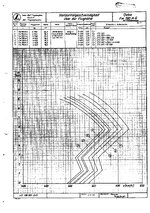
FWIW, here is the speed chart for a Fw 190 under the different conditions - from a clean aircraft down to when a 500 kg bomb was carried on a rack:

fw190 performance19.jpg

Speed loss for the draggiest & heaviest payload there is about 60 km/h at the 2nd rated altitude, and about 45 km/h down low, or about 40+ and 30+ mph, respectively - we can probably round this out at 10% high up, and 12% also about 10% down low?
 
Last edited:
Not true. Fighter bombers with external loads could only operate fully effectively where escorted and/or where air supremacy or at least superiority had been achieved. Escorting fighters also often faced exactly the same difficulty that they did escorting standard bombers - the speed difference due to the drag of external ordinance and carriage devices was significant.
You are missing my point. They installed bombs, rockets, and 40mm cannons onto Hawker Hurricanes. These aircraft required escort even without stuff hanging off of them. A P51 Mustang could be encumbered up a point, and still be difficult to intercept. Mustangs and some other aircraft were versatile because they had a gross performance advantage. That advantage could be compromised by bombs or whatever, and the aircraft would still have the advantage. Obviously, this puts an upper limit on your unescorted bomb load.
 
Not true. Fighter bombers with external loads could only operate fully effectively where escorted and/or where air supremacy or at least superiority had been achieved. Escorting fighters also often faced exactly the same difficulty that they did escorting standard bombers - the speed difference due to the drag of external ordinance and carriage devices was significant.

Those A-36s, as well as P-40s, Fw 190s, Mosquitos and a lot of other fighter-bombers routinely operated without escorts in very high threat areas. Interception would usually mean they had to prematurely jettison their bombs, but not necessarily that they would be massacred.

The A-36s in particular had a very high cruising speed which makes them harder to intercept and to identify in time to arrange intereception. Also helps against flak.
 
Last edited:
You are missing my point. They installed bombs, rockets, and 40mm cannons onto Hawker Hurricanes. These aircraft required escort even without stuff hanging off of them. A P51 Mustang could be encumbered up a point, and still be difficult to intercept. Mustangs and some other aircraft were versatile because they had a gross performance advantage. That advantage could be compromised by bombs or whatever, and the aircraft would still have the advantage. Obviously, this puts an upper limit on your unescorted bomb load.

Exactly
 
Those A-36s, as well as P-40s, Fw 190s, Mosquitos and a lot of other fighter-bombers routinely operated without escorts in very high threat areas. Interception would usually mean they had to prematurely jettison their bombs, but not necessarily that they would be massacred.

The A-36s in particular had a very high cruising speed which makes them harder to intercept and to identify in time to arrange intereception. Also helps against flak.
As I understand, not 'routinely' without established air superiority - and not 'routinely' (if that had not been established), without escort against interception. A minor (in terms of raids and numbers deployed) exception would be the FW190 'tip and run raids' of the south east coast of the UK - but which were little more than nuisance operations. Later on, daylight precision Mosquito FB deep raids into occupied territory happened, but again, they were highly planned operations and very much not routine - and when they happened, even then, it was often with some kind of long range escort. If you know otherwise, I'd be interested to where you've picked that up - because in all my years of reading, described fighter bomber missions are usually mid to late war, most seem to describe the importance of coordination with escort fighters.

The entire point of a bombing mission is completely negated if the attacking aircraft has to jettison its bombload in order to survive. It might be acceptable if you're ripple firing off your RPGs or dropping a couple of 500lb bombs as you turn into bandits on a tactical ground attack mission in 1944/5 (If you're statistically unlucky enough to run into some of the few remaining Luftwaffe fighters on the western front) but its not what any of the terms of the OP refers to: A 1939/40 scenario. Later dedicated Fighter bombers were primarily ground attack and strafing targets of opportunity, launched from forward airfields - and when perfected, using cab-rank style OPs.
 
You are missing my point. They installed bombs, rockets, and 40mm cannons onto Hawker Hurricanes. These aircraft required escort even without stuff hanging off of them. A P51 Mustang could be encumbered up a point, and still be difficult to intercept. Mustangs and some other aircraft were versatile because they had a gross performance advantage. That advantage could be compromised by bombs or whatever, and the aircraft would still have the advantage.
I'm not convinced by that claim. What contemporary Luftwaffe interceptors did a Mustang carrying 2 x 500lbs 'still have the advantage' over in either speed, turn, or climb...?

I don't doubt that when the Luftwaffe was attrited back to a shadow of its former self in both airframe numbers and competent pilots, the performance penalty was relatively unimportant and the risk of interception and a dog-fight consequently small, compared to the risk of ground fire. But I'm afraid I have to pour deep scepticism on your premise that an externally bomb encumbered aircraft 'would still have an advantage' over the majority of contemporary unencumbered opponents. Aside from weight and drag, external carriage also increased wing loading and restrictions on handling, stall speed, stablity etc... (Even more so, if we drag this back to the OP and 1939/40)
 
I'm not convinced by that claim. What contemporary Luftwaffe interceptors did a Mustang carrying 2 x 500lbs 'still have the advantage' over in either speed, turn, or climb...?
Maybe we are restricted to a pair of 250lb bombs. We don't need superior turn or climb. We outrun the defenders, who also failed to deploy large amounts of high octane gasoline, which enhances performance at low altitude.
 
As I understand, not 'routinely' without established air superiority - and not 'routinely' (if that had not been established), without escort against interception. A minor (in terms of raids and numbers deployed) exception would be the FW190 'tip and run raids' of the south east coast of the UK - but which were little more than nuisance operations. Later on, daylight precision Mosquito FB deep raids into occupied territory happened, but again, they were highly planned operations and very much not routine - and when they happened, even then, it was often with some kind of long range escort. If you know otherwise, I'd be interested to where you've picked that up - because in all my years of reading, described fighter bomber missions are usually mid to late war, most seem to describe the importance of coordination with escort fighters.

Yes I'm talking about North Africa, Sicily and Italy, and also in New Guinea and the Solomons, and in China, Burma, and India.

Those A-36 for example routinely flew strike missions without escorts.

The entire point of a bombing mission is completely negated if the attacking aircraft has to jettison its bombload in order to survive.

That's true. Whether such a tactic is viable, which it often was again with Mosquitos, FW 190s (and not just in 'tip and run' raids into Southern England by any means), P-40s, Corsairs, P-38s, P-51s, P-47s and a variety of other fighters, hinges partly on how often they were intercepted and how high priority their targets were compared to the opportunity to destroy enemy aircraft. Sometimes the target was high priority sometimes they were just as happy to engage with the enemy fighters.

It might be acceptable if you're ripple firing off your RPGs or dropping a couple of 500lb bombs as you turn into bandits on a tactical ground attack mission in 1944/5 (If you're statistically unlucky enough to run into some of the few remaining Luftwaffe fighters on the western front) but its not what any of the terms of the OP refers to: A 1939/40 scenario. Later dedicated Fighter bombers were primarily ground attack and strafing targets of opportunity, launched from forward airfields - and when perfected, using cab-rank style OPs.

Cab rank goes back to 1943 in the Med
 
Maybe we are restricted to a pair of 250lb bombs. We don't need superior turn or climb. We outrun the defenders, who also failed to deploy large amounts of high octane gasoline, which enhances performance at low altitude.

German C3 was actually quite decent, though the composition varied over the war, towards the end of the war the rich rating was estimated to be around 140 or so. Of total aviation gasoline production C3 made up about 20% in 1941, steadily rising to around 60% at the end of the war. See Luftwaffe with just B4 fuel

The big problem the Germans had was that their engines weren't able to take advantage of all this octane. Valves due to their strategic material shortages, but also spark plugs and bearings were issues.
 
Maybe we are restricted to a pair of 250lb bombs. We don't need superior turn or climb. We outrun the defenders, who also failed to deploy large amounts of high octane gasoline, which enhances performance at low altitude.
A what candidate are you offering in 1939/40, as per the terms of this entire thread? Let me remind you the context of what we're supposed to be discussing:

-------------------------------------
Fast bombers alternatives for 1939-40

"Bombers that might've been actually fast :)
1-engined, 2-engined, 3-engined, 4-engined - whatever is your cup of tea. Please, look beyond of just 'make an early Mosquito'; not that aircraft is a bad role model, but some variety is good. Cancel the actual bombers being produced, in order to free up the factory floor, materials, engines and manpower required.

Some sort of the bomb bay is required, or the bomb(s) might be faired in or 'semi-buried' in the airframe in order to cut the drag and thus keep the speed up. Aircraft can have some guns' armament. Engines for them - whatever a respective country can get, but preferably what was made domestically. Bombs used - the historical types; bomber will need to do better than just to carry 50-100 kg types in order to be useful.
Bombers still need to have an useful range/radius, so just attaching the bombs on a Spitfire or Bf 109E will not cut it. ......."
-------------------------------------


Even ignoring the timeframe, the effectiveness of fighter bombers in europe post D-Day were down to near complete air supremacy - and being deployed near the front line. Losses to interception were small to non existent, principally down to the lack of fighter opposition, not because fighter bomber aircraft 'outran' the opposition. The losses to flak - especially at low level - were horrendous, however.
 
Last edited:
Cab rank goes back to 1943 in the Med
Yes.

Which is three years after the time period of this thread.

It required FOOs, coordination, developed tactics and aircraft located near the front line.

Cab rank by its very nature, required air superiority to have already been established. Again, none of which applies to the context proposed by Tomo.
 
To further the above post by SplitRz we can look at a 1943 fighter bomber (service use) that has been held up as example.

A-36 with two 500lb bombs, Gross weight as per load and weight chart in manual. 180 US gals (150 imp) full internal tanks.
1325hp for take-off vs your favorite 1939-40 fighter engine/s ????
232sq ft wing
Now for the interesting part.
Manual says on a sod runway it needs with zero wind, 2400ft (800yds) to lift off and 3200ft (1066yds) to clear 50ft.
However that is at 0 degrees C. Manual says add 10% for every 10 degrees C higher than zero degrees so add 15% for 15 degrees C (59 degrees F)
so 3620 ft (1206yds) just to get off the run way. Adjust further for summer days (or warm spring and fall)
Head winds help but what size were the 1939-40 airfields/runways?

Some lists of the 4 greatest American weapons of WW II some times include the bulldozer ;)
There were reasons why the single engine "bombers" of the 1930s and 1940 used either large wings or small bomb loads (or both). They had to operated out of existing airfields using engines that were limited in power compared to the engines that would be available in 1942-43.

Trying to backdate a late 1942/early 1943 aircraft to 1939 by just saying "use lower powered engine and bit less gas and even two 250lbs bombs" may still leave you with a plane that cannot get out of a standard 1939 airfield except on a windy winter day.
For the A-36 we can go to a pair of 250lb bombs, take out two .50 cal guns and associated ammo and take out about 40 gal US gas and get the plane down to 9000lbs.
Still needs 1900ft (633yds) to get off the run way and and 2600ft (866yds) to get to 50ft at zero wind and zero degrees.
Now take out the 1325hp engine and replace with a 1040hp engine (or 1939-40 Merlin, DB 601, Jumo 211, HS 12Y or 1939 M-105) of your choice.

 
Last edited:
Speaking of the drag of external bombs, is there a free, or at least cheap, lunch available in more streamlined bombs?

For comparison, a US Mk 82 bomb, taken into service in the 50'ies and still used.
Mk-82_xxl.jpg
 
Speaking of the drag of external bombs, is there a free, or at least cheap, lunch available in more streamlined bombs?

For comparison, a US Mk 82 bomb, taken into service in the 50'ies and still used.
View attachment 855577
Thats actually any interesting thought! At what point did engineers, aerodynamicists and manufacturers start to address the issue of bombs design from the perspective of the drag induced by externally mounted munitions?

Barnes Wallis and others designing specialist bombs obviously looked at it from more than a 'chuck some fins on a tincan / spare shell' perspective - but who specified design criteria beyond dimensions and capacity? Who made late 30's bombs and what were the evolutionary criteria?
 
To further the above post by SplitRz we can look at a 1943 fighter bomber (service use) that has been held up as example.

A-36 with two 500lb bombs, Gross weight as per load and weight chart in manual. 180 US gals (150 imp) full internal tanks.
1325hp for take-off vs your favorite 1939-40 fighter engine/s ????
232sq ft wing
Now for the interesting part.
Manual says on a sod runway it needs with zero wind, 2400ft (800yds) to lift off and 3200ft (1066yds) to clear 50ft.
However that is at 0 degrees C. Manual says add 10% for every 10 degrees C higher than zero degrees so add 15% for 15 degrees C (59 degrees F)
so 3620 ft (1206yds) just to get off the run way. Adjust further for summer days (or warm spring and fall)
Head winds help but what size were the 1939-40 airfields/runways?

Some lists of the 4 greatest American weapons of WW II some times include the bulldozer ;)
There were reasons why the single engine "bombers" of the 1930s and 1940 used either large wings or small bomb loads (or both). They had to operated out of existing airfields using engines that were limited in power compared to the engines that would be available in 1942-43.

Trying to backdate a late 1942/early 1943 aircraft to 1939 by just saying "use lower powered engine and bit less gas and even two 250lbs bombs" may still leave you with a plane that cannot get out of a standard 1939 airfield except on a windy winter day.
For the A-36 we can go to a pair of 250lb bombs, take out two .50 cal guns and associated ammo and take out about 40 gal US gas and get the plane down to 9000lbs.
Still needs 1900ft (633yds) to get off the run way and and 2600ft (866yds) to get to 50ft at zero wind and zero degrees.
Now take out the 1325hp engine and replace with a 1040hp engine (or 1939-40 Merlin, DB 601, Jumo 211, HS 12Y or 1939 M-105) of your choice.

A lot of hyperventilating about the A-36 here is based on a very false premise that anyone was actually suggesting it for 1939-1940.

Let me remind you and SplitRz of the context - the conversation drifted into the potential capabilities of fighter-bombers in general, since the original discussion was hinging on the use of aircraft like Henleys and adapting them to fighter bomber or dive bomber roles. It was alleged that fighter-bombers could not operate without air superiority, which isn't actually true. I brought up the A-36 to point out a particular, glaring, obvious example of a fighter bomber which was used in a very dangerous environment without escort.

This is also true, incidentally, for CAS by fighter bombers (even though this is another discursion and may not really be germane to the original discussion). Even when Cab Rank and it's various precursors were being used in North Africa, the DAF did not, in fact, have air superiority. Early precursors to Cab Rank were already being used at a large scale at 2nd El Alamein in late 1942 and the air above it was very much heavily contested. The DAF took a lot of losses, as did the Luftwaffe, but they (DAF) made it work. And it played an important role in the battle. And in battles prior to that one.

Circling back, the A-36 and other aircraft mentioned were simply part of a discursion into the debate about the capabilities of fighter bombers and dive bombers in general. The "What If" aspect of this thread, going back to the OP, hinges on whether something available could be adapted to the role, which may or may not have required using the aircraft in different ways than it was historically. Nobody is going to win a battle by flying a better target tug. The A-36 was brought up as one example of an effective fighter-bomber adaptation, albeit later in the war.

I hope that clears it up gentlemen.
 
A what candidate are you offering in 1939/40, as per the terms of this entire thread? Let me remind you the context of what we're supposed to be discussing:
I brought up Mustangs because when they appeared, their performance exceeded that of the aircraft that had to deal with them. The A36 worked because the Mustang could be encumbered to some extent.

Mustangs were not available in 1939/40, so you are right. They do not count. Mosquitos don't count either, for the same reason. Nothing in 1939 had performance that was grossly excessive to the point that it could be compromised for an alternate mission.

Let's look at the Zerstorer concept executed by the Messerschmitt Bf110. The Bf110s were unsuccessful during the Battle of Britain due to the presence of high performance enemy fighters. The long range and extra crew of the Bf110 were a liability in a dogfight with Spitfires. The Bf110 was successful on the continent up against whatever Poland, Norway, Holland, Belgium, France, and the RAF threw at them. Hurricanes in France had fixed pitch two-blade props, and they ran mostly on 87_octane gas. Up against a Gloster Gladiator, the Bf110s superior performance more than made up for what I regard as a bad tactical concept. The Bf110 would have made a good fast bomber under those conditions, even without a bomb bay. When Spitfires, Hurricanes, three blade constant speed propellers and 100_octane fuel show up, all bets are off.
 
Last edited:
I still say push Handley Page's unarmed high speed bomber proposal from 1937.

3 crew, no defensive guns, maximum bomb load 8,000lb for shorter raids.

Vulture engines are a week point, but the bomb load could be reduced to suit reduced power.

Quite a bit lighter and aerodynamically efficient than the Manchester.
 

Users who are viewing this thread

Back