This is nonsense, as official records show. For example, a memorandum from General Arnold on 28 June 1943 (this is before the first Schweinfurt mission):
This brings to my mind very clearly the absolute necessity for building a fighter airplane that can go in and out with the bombers. Moreover, this fighter has got to go into Germany. Perhaps we can modify some existing type to do the job. The P-38 has been doing a fine job from North Africa in escorting our B-17's 400 miles or more. Whether this airplane can furnish the same close escort against the GAF on the Western Front is debatable. Our fighter people in the U.K. claim that they can't stay with the bombers because they are too slow and because they must have top speed by the time they hit the coast. The P-38 is notable for its poor acceleration, so perhaps it too will not be able to furnish close escort and be able to meet the FW's and 109's. About six months remain before deep penetration into Germany begins. Within the next six months, you have got to get a fighter that can protect our bombers. Whether you can use an existing type or have to start from scratch is your problem. Get to work on this right away because by January, '44, I want a fighter escort for all our bombers from U.K. into Germany.
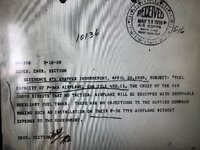
Developing an entirely new aircraft in six months was obviously impossible, so modifying existing types would have to be the solution. And that modification meant increasing the internal fuel supply and developing drop tanks suitable for combat operations.
Drop tanks were already been looked at by the AAF in early 1942. From Development of the Long-Range Fighter Escort (p.113):
The quest for fighter range received early attention from the highest level of the AAF. At a conference in General Arnold's office on 20 February 1942 several cablegrams from various theaters of operation asking for increased range of aircraft then in use were presented for discussion. Following the conference, instructions to begin immediate study of means to extend the range of fighters were transmitted by telephone to Materiel Division at Wright Field. Within a week, on 28 February, Materiel Division issued technical instructions initiating action for procurement of 52-gallon tanks for P-40's at the rate of 6 for each airplane. Materiel Division also asked for production of these tanks in sufficient quantities to meet needs of forces in the Far East and England. The tanks were to be increased to a maximum consistent with the structural and flight limitations of the fighter plane for which they were intended.
As it happened, bureaucratic inertia, production delays in the U.S. and Britain, and wrangling over the proper techniques for drop tank operational usage, resulted in slow entry into service in the ETO.
75-gallon drop tanks did not become available in numbers until August 1943, and the 108-gallon paper tank not until September 1943. The former pushed the P-47 radius out to 230–250 miles, while the latter increased it to 275–300 miles, depending on the source. (The P-47Ds with 370 gallons of internal fuel, did not arrive until May 1944.)