I'm not an expert, but one, I do know what I'm talking about, and two, when I do have questions or curiosities, I ask, and I do know that a lot of people here know a lot more than I do.
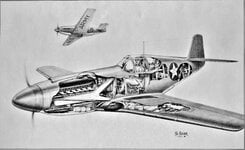
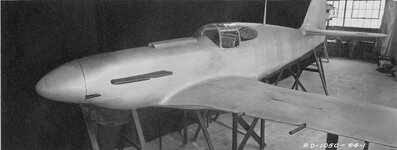
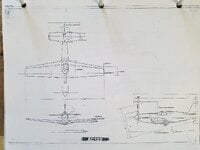
There was never (at least known) a Mustang with a chin radiator. Going back to the P-509 (which evolved into the NA-73X), all Mustang developments had a ventral radiator. The closest was the Rolls-Royce Mustang X Merlin engine test beds that were converted from RAF Mustang Is. The "chin" intake housed the intercooler and supercharger intake.
The Spitfire IXe and XIVe had 2 .50 Browning MGs and 2 20mm Hispano cannons. Spitfires from the Mk V onwards that were fitted with the "C" universal wing (of which the "E" was a variant of) could house 4 20mm cannons (not standardized until the Spitfire 21).
And the Hispano cannon was much larger than the .50 MG. The numbers I've seen for the .50 Browning aircraft model ranged between 52-65 lbs, the Hispano Mk II/M2 was 100-110 lbs, the Mk V/M3/M24 was 83-88 lbs. Numbers probably vary due to presence of extra equipment vs the basic weapon. Not to mention that it was quite a bit longer.
Also, until the XP-51F/G and P-51H, the Spitfire could easily outclimb the Mustang (better power to weight ratio due to being built to lower max load standards, which means lower weight), and should've been more maneuverable (especially at lower speeds) due to lower wing loading (again related to weight, though the P-51 could easily out roll the Spitfire unless the Spitfire had clipped wings until the Mk 21).
With the XP-51F/G (which weighed roughly the same as a Spitfire IX, though it carried more than twice the fuel), you had a plane with similar wing loading to the Spitfire and combined with improved control surfaces should've been more agile than a P-51D even with the D "flying light". The P-51H (production evolution of the F/G models) was comparable in weight to the Griffon Spitfires, with a similar power to weight ratio and wing loading. Of course, no comparative flights with the F/G/H was never done against the Spitfire.
Also, for extra credit, those aforementioned planes (as well as the XP-82/P-82B at least, and maybe the Allison powered P-82E/F/G/H and XP-51J) did have a radiator design that produced a positive thrust to drag ratio (so it actually produced more thrust than drag).
Otherwise, all I can say (not being an insane expert), is, paging drgondog...


 ww2aircraft.net