P-63: real performance? (1 Viewer)

Before S Shortround6 comments...
It is unfortunate - but not unusual - for Greg to choose and pick stuff. The ~430 mph speed figure for the P-63C seems to be from the Bell preliminary estimates. The seasoned scholars (not me) dealing with Bell pre-1950 aircraft will recall that Bell's figures need to be taken with a truckload of salt. We can see one such chart here, where the P-63A was advertised as a ~425 mph fighter, only to be tested at around 400 mph (here). So if the -A was slower by some 25 mph than it was advertised, there is a lot of the reasoning that the -C is also much slower than 430 mph at it's best altitude.
Then we have a comparison of the engine from the P-63C vs. the Merlin that was phased out from the production, the V-1650-3. The 1st P-63C was delivered on December of 1944 ( half a year after that performance chart is dated), by what time Allies were flush with the -7 powered P-51s. These engines were a tad worse at very low altitudes and at about 15k ft than the V-1710-117 engines, but far better at other altitude bands, and especially above 17-18 kft. Above 20 kft, there is really no competition. Pour in the 150 grade fuel, and the Merlin is better at any altitude.

For an american company that delivered on promises, see NAA.
 
America's Hundred Thousand by Francis Dean has 21 "Best" categories in the fighter comparison section, the top 5 to 8 usually mentioned per category, the P-63A is mentioned in 7, best finish 3rd for engine controls. First P-63C accepted in November 1944, first of the XF8F-1 in February 1945 if it comes to best US WWII dogfighter. The P-63A top speed is generally given as 410 mph

First of what the reports call V-1710 2 stage built in December 1942, a month after the first Merlin 2 stage by Packard, like Packard single figure monthly production until April 1943. Merlin production takes off from there, Allison tries to but is back to 1 in September, production builds to 300 in January 1944, peak of 363 in May, back to 11 in September and 12 in October 1944, hits a peak of 362 in January 1945, down to 3 in July.

2 Stage engines, 1942: 1 Allison, 5 Merlin, 1943: 514 Allison, 2,792 Merlin, 1944: 2,867 Allison, 15,736 Merlin, Jan to Aug 1945: 1,628 Allison, 12,885 Merlin.

 
First of what the reports call V-1710 2 stage built in December 1942, a month after the first Merlin 2 stage by Packard, like Packard single figure monthly production until April 1943. Merlin production takes off from there, Allison tries to but is back to 1 in September, production builds to 300 in January 1944, peak of 363 in May, back to 11 in September and 12 in October 1944, hits a peak of 362 in January 1945, down to 3 in July.

2 Stage engines, 1942: 1 Allison, 5 Merlin, 1943: 514 Allison, 2,792 Merlin, 1944: 2,867 Allison, 15,736 Merlin, Jan to Aug 1945: 1,628 Allison, 12,885 Merlin.
Thank you for the figures.

It was too bad that powers that were didn't insisted on the P-51 powered by the 2-stage V-1710 until it was too late to matter.
 
Not really.
The 2 stage Allison was not ready for prime time until around 1 year after the 2 stage Merlin ( US production).
The lack of intercooler was a really handicap for high altitude operation. Water injection was useful but not complete substitute.
Without a a major change in R&D to change the time line you are going to get a 6-9 month delay in P-51s escorting thr 8th air force
 
Not really.
The 2 stage Allison was not ready for prime time until around 1 year after the 2 stage Merlin ( US production).

I'm fine for the 2-stage V-1710 P-51s to be coming from the production line at Bell from the late 1943.

The lack of intercooler was a really handicap for high altitude operation. Water injection was useful but not complete substitute.

We'd still be much better than any Fw 190A, and at least as good as the Fw 190D-9, and a full year earlier than the D-9.
1944 will see a bit of improvement with the -101 and -121.

Without a a major change in R&D to change the time line you are going to get a 6-9 month delay in P-51s escorting thr 8th air force

The Merlin Mustang is still on as per historically.
 
Whatever it did back in the day, today it makes for a very cool warbird...


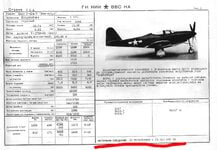
R02    NN  348  copy.jpg
 
Приведено техническое описание с некоторыми данными испытаний самолета П-63А в СССР.
 

Attachments

  • IMG_20260529_082448.jpg
    IMG_20260529_082448.jpg
    371.4 KB · Views: 30
Last edited:
America's Hundred Thousand by Francis Dean has 21 "Best" categories in the fighter comparison section, the top 5 to 8 usually mentioned per category, the P-63A is mentioned in 7, best finish 3rd for engine controls. First P-63C accepted in November 1944, first of the XF8F-1 in February 1945 if it comes to best US WWII dogfighter. The P-63A top speed is generally given as 410 mph

First of what the reports call V-1710 2 stage built in December 1942, a month after the first Merlin 2 stage by Packard, like Packard single figure monthly production until April 1943. Merlin production takes off from there, Allison tries to but is back to 1 in September, production builds to 300 in January 1944, peak of 363 in May, back to 11 in September and 12 in October 1944, hits a peak of 362 in January 1945, down to 3 in July.

2 Stage engines, 1942: 1 Allison, 5 Merlin, 1943: 514 Allison, 2,792 Merlin, 1944: 2,867 Allison, 15,736 Merlin, Jan to Aug 1945: 1,628 Allison, 12,885 Merlin.
Those number are very much more tied to orders rather than capability. Allison was a relatively small company compared with Packard, and could not produce engines to sit around and wait for orders. They made what they contracted for.
 
Last edited:
2 Stage engines, 1942: 1 Allison, 5 Merlin, 1943: 514 Allison, 2,792 Merlin, 1944: 2,867 Allison, 15,736 Merlin, Jan to Aug 1945: 1,628 Allison, 12,885 Merlin.

Those number are very much more tied to orders rather than capability. Allison was a relatively small company compared with Packard, and could not produce engines to sit around and wait for orders. They made waht they contracted for.
Just about all engine makers built only engines that were contracted for.

Allison was also making engines for P38s in 1944-45. P-38s used two stage supercharging by using the turbo.
Their business for single stage engines for P-39s and P-40s had dropped to zero by mid/late 1944.
Late P-38 engines used a lot of the same parts as the P-63 engines, like the counter-weighted crankshaft and new piston rings and whatever else was needed to stand up to 1600-1750hp power levels.
Allsion built around 5400 V-1710 engines in Jan to Aug 1945.
Allison also built just over 300 jet engines in Jan to Aug 1945.
 
All Allison crankshafts had counterweights. Some had six and later they had twelve. The 12-counterwight crankshaft was better, but even the early crankshafts were good for WAY more rpm than the engine was turning. It was more a question of making it smoother (4.5 and 6-order vibrations) than anything else. The dynamic balancer helped a lot.
 
You are right. The late P-38Ls had the 12 counter-weight cranks like the P-63s (or late P-63) and many of the other internal changes. It was fairly easy to change P-39/P-63 engine to a P-38 engine (0r P-40 engine) by changing the gear box/front cover as you well know. It was possible to change the of the engine out to make it a single stage or two stage engine. You cannot change a single single speed Merlin to a two stage two speed engine without changing the block.
 

Users who are viewing this thread

Back