Picture of the day (general).... (12 Viewers)

Canadian Aeroplanes Ltd. F-5L BuNo A-3355 one of 29 Felixstowe Model F-5s developed by Naval Aircraft Factory the net
View attachment 902090
On the Felixstowe F.5 and American F5L), those vertical structures sticking on top of the upper wings are aerodynamic balances for the ailerons. Specifically, they are horn-balanced ailerons (or inverse/overhung balances).
Because the Felixstowe F.5 was a massive, heavy flying boat with an immense wingspan, the aerodynamic forces acting on the wing's control surfaces were incredibly strong. Without physical assistance before boosted controls, it would require superhuman strength for a pilot to turn the control wheel and roll the aircraft.
The vertical panels extend upward past the hinge line of the aileron. When the pilot deflects the aileron downward, this vertical panel rotates into the oncoming airflow in the opposite direction via the visible horns and wires. The rushing wind pushes against the vertical panel, acting like a vane that naturally "helps" push the aileron into place, significantly reducing the physical force needed at the cockpit controls.
 
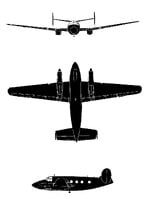
MD 315 Flamant Prototype the net
View attachment 901757

Awesome looking Supaelectra copy.

Khmer Rouge was figting with quality products.

s-l1200.jpg
 

Attachments

  • Dassault_Flamant_silhouette.jpg
    Dassault_Flamant_silhouette.jpg
    59.9 KB · Views: 1
Potez 631 1938 the net
Potez 631 1938 the net.png
 
On the Felixstowe F.5 and American F5L), those vertical structures sticking on top of the upper wings are aerodynamic balances for the ailerons. Specifically, they are horn-balanced ailerons (or inverse/overhung balances).
Because the Felixstowe F.5 was a massive, heavy flying boat with an immense wingspan, the aerodynamic forces acting on the wing's control surfaces were incredibly strong. Without physical assistance before boosted controls, it would require superhuman strength for a pilot to turn the control wheel and roll the aircraft.
The vertical panels extend upward past the hinge line of the aileron. When the pilot deflects the aileron downward, this vertical panel rotates into the oncoming airflow in the opposite direction via the visible horns and wires. The rushing wind pushes against the vertical panel, acting like a vane that naturally "helps" push the aileron into place, significantly reducing the physical force needed at the cockpit controls.

I found that very interesting but to me, as an aircraft maintenance technician, that photo shows those "fins" are fixed and cannot move as they are rigidly mounted and wire braced. I decided search for a manual for that aircraft to study that in more detail. I found a copy of the US built version of the aircraft at the Library of Congress and it calls them stabilisers and describes fitting them and their wire bracing. They appear to have had the same purpose as a dagger board on a small sailing boat.

You are correct about most of the rest of your post (the part I highlighted) and half right about the horn balanced ailerons. These are shown on the diagram below from page 87 of the manual. The horn is that part that extends forward on the aileron and in to the airflow and was the most common method of reducing control loads before servo tabs were invented..

1794098224894.png


The manual can be downloaded from https://tile.loc.gov/storage-servic...lyingboathan00unit/f5lflyingboathan00unit.pdf
 
Fokker C.I 1923 the net
View attachment 901957
Training for instruments only.
 
I got info by searching, and the Instagram site came up.
Scotty was the most prominent resident of Death Valley, his "Castle" providing shelter for travelers to the forsaken location.
https://en.wikipedia.org/wiki/Walter_E._Scott
https://en.wikipedia.org/wiki/Scotty%27s_Castle
I'm all but certain he's the one in this pic with a welcome harem:
1794106457091.png

....The other is the tandem seating Taylorcraft D, which was ordered in quantity as the L-2.
Don't mean to question your authority sir, but are you sure that's a Taylorcraft?
Here's Wiki's pic from their page on the L-2...
1794106119605.png

...notice how large the radius is on top of the rudder.
In contrast, the picture you provided shows a rather pointy top to the rudder.
I suspect that could be an Interstate Cadet, i.e., Interstate L-6...
1794106363139.png
 
Don't mean to question your authority sir, but are you sure that's a Taylorcraft?
Here's Wiki's pic from their page on the L-2...
View attachment 902252
...notice how large the radius is on top of the rudder.
In contrast, the picture you provided shows a rather pointy top to the rudder.
I suspect that could be an Interstate Cadet, i.e., Interstate L-6...
View attachment 902253

I agree with you that it is not a Tcraft but I do not think it is an Interstate either.

The Tcraft has a full height rudder with no horn balance.

The Interstate has a full height rudder with a horn balance

The aircraft in that photo has a rudder that does not extend full height. Unfortunately I cannot identify it,

1794126942473.png
 
IMG_20261108_114106.jpg


IMG_20261108_114212.jpg
 
Jacqueline Cochran inspecting fresh WASPs cadets at Camp Davis the net
Jacqueline Cochran inspecting fresh WASPs cadets at Camp Davis the net.png
 
I agree with you that it is not a Tcraft but I do not think it is an Interstate either.

The Tcraft has a full height rudder with no horn balance.

The Interstate has a full height rudder with a horn balance

The aircraft in that photo has a rudder that does not extend full height. Unfortunately I cannot identify it,

View attachment 902267
This particular a/c is shown on several photos in the same collection, especially with the girls digging a fire pit (as I mentioned before). Its civil registration is NC25559. IMHO it's a Porterfield CP/LP-65.
06fddd7f826e5731_large.jpg

fa6b085148922b09_large.jpg

eb52b0419b7cdf09_large.jpg

1c5d8f6e8b290cc0_large.jpg

170092c4696a58e8a_large.jpg

Check photos of modern flying planes here.
 
Last edited:
Good detective work, I was attempting to track down the type by the Partial NC number visible on the A/C, but strangely the complete NC number did not cross on this site

Ist time I have not been able to track a registration using that site, they don't seem to have any listings for that manufacturer, strange.
I'm using a different site but this particular registration doesn't give you a model of a plane. I tried the surrounding registrations/models and had luck with one of them.
P.S. Another photo shows the airfield with several planes parked. The nearest one (in the back) has civil registration NC25557. As per the above site it's a Porterfield CP-55.
aa6cd5c3c8d6ced5_large.jpg
 
Last edited:
Good detective work, I was attempting to track down the type by the Partial NC number visible on the A/C, but strangely the complete NC number did not cross on this site

Ist time I have not been able to track a registration using that site, they don't seem to have any listings for that manufacturer, strange.
That would be a tough ID to make. Porterrfield was a rare make.
 

Users who are viewing this thread

Back