Propeller detail for the Alfa-Romeo RA1000 RC41 "Monsone" (5 Viewers)

Propeller on the Macchi C.200 Saetta at the NMUSAF, Dayton, OH, USA. The pitch change motor is at the top.
Thanks Tom,
Actually, you can just see the end of the pitch change control assembly showing there, the assembly is about 18 inches long and sits transversely across the top rear of the pitch change gearbox, which is inside the large circular silver cover fitted just behind the prop.

Thanks for posting the pics

Eng
 
Stanley VDM mechanism.webp


This diagram from Tom's post can give some help with understanding the type of pitch changing gear operation. I will add that the small planet type gears are mounted on bearings on the small axles shown so that they can turn. A main factor is that gears J, K and M are cut on the same diameter but with different numbers of teeth that are designed with profiles and clearances that allow the planet teeth to engage with both at the same time.
If we consider the action of adjusting pitch, it is achieved by turning gear C, which rotates gear G and its joined axles carrying planet gear H which in turn moves gear K by 4/86 for every full revolution of gear G. In turn, gear K turns planet gear L and so turns gear M through a total of 4/86 x 86/82 = approx 1/25 of a revolution for each revolution of gear G, regardless of direction or speed of the propshaft or the input. The gear M is linked to gear N which inputs the pitch change gear P at a ratio of around x4 and so the blade pitch is adjusted.
There are two points to note from the diagram notes. Firstly, none of the gears are "free to spin", they are all permanently engaged but the whole gear train from C to P can vary its relative position to gear J.
Secondly, I was not aware that the patent by Robert Stanley applied and I have not seen that before!

Also, the pic on the RHS is of the early type of VDM mechanism and hub, fitted to a JUMO 211 engine.

Cheers

Eng

 
I'm currently printing up one of these little masterpieces.

Video of VDM model in operation:

View: https://youtu.be/WIBZOmQqVAA

Files available from:
Téléchargement Electric Propeller, VDM type par Motoo Kondo


Yes, that is a very nice working scale model. The real thing is good to work with!

Cheers

Eng
 
View attachment 901952


This diagram from Tom's post can give some help with understanding the type of pitch changing gear operation. I will add that the small planet type gears are mounted on bearings on the small axles shown so that they can turn. A main factor is that gears J, K and M are cut on the same diameter but with different numbers of teeth that are designed with profiles and clearances that allow the planet teeth to engage with both at the same time.
If we consider the action of adjusting pitch, it is achieved by turning gear C, which rotates gear G and its joined axles carrying planet gear H which in turn moves gear K by 4/86 for every full revolution of gear G. In turn, gear K turns planet gear L and so turns gear M through a total of 4/86 x 86/82 = approx 1/25 of a revolution for each revolution of gear G, regardless of direction or speed of the propshaft or the input. The gear M is linked to gear N which inputs the pitch change gear P at a ratio of around x4 and so the blade pitch is adjusted.
There are two points to note from the diagram notes. Firstly, none of the gears are "free to spin", they are all permanently engaged but the whole gear train from C to P can vary its relative position to gear J.
Secondly, I was not aware that the patent by Robert Stanley applied and I have not seen that before!

Also, the pic on the RHS is of the early type of VDM mechanism and hub, fitted to a JUMO 211 engine.

Cheers

Eng
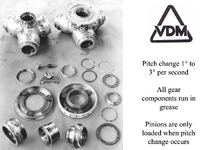
 
Last edited:
Yes, that is a very nice working scale model. The real thing is good to work with!

Cheers

Eng
All fun for me. I've attached the Stanley patent and an article from The Aeroplane, April 12, 1939, which states the VDM was licensed in the UK and passed its Type Test on a Merlin!
 

Attachments

Users who are viewing this thread

Back