"pulling through" a propeller

Ad: This forum contains affiliate links to products on Amazon and eBay. More information in Terms and rules

Joe Broady

Airman 1st Class
112
178
May 30, 2019
I've been reading the report on the 2015 T-28 crash that killed David Tokoph. Shortly after takeoff from Las Cruces the engine failed and the plane went down in a field. It looks like a survivable crash: no fire, wreck is upright, and cockpit appears intact. However, Tokoph sustained serious head injury and died four days later. The NTSB report notes the shoulder harness had no inertial lock. It had to be operated manually.

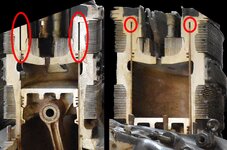
Internally the engine was a mess. One cylinder had to be pried off to inspect the crankcase. Metal fragments had torn up the rods, pistons, and cylinder skirts. The no. 6 rod was broken. According to the report, the crash was due to "failure of the No. 6 cylinder connecting rod, due to improper rotation of the propeller during a previous hydraulic lock."

One of the witness statements in the accident docket came from the fueler, who "observed Mr. Tokoph trying to turn the 'prop' but it was not turning." It's not clear if he was pulling the prop through or trying to crank the engine with the starter. (The statements were taken by a cop, not an accident investigator.) Tokoph asked for a ground power unit. After it was hooked up, it took three attempts to keep the engine running. The fueler said the first two attempts, the engine died about 10 seconds after the GPU was unplugged. Also, its sound was different between GPU plugged in vs. unplugged. I have a hard time understanding why external power would make a difference once the engine was running.

Another Interesting observation by the fueler was that the engine would "piss a lot of fuel" during the start attempts. Could that have been due to excessive priming draining from the blower?

The NTSB docket contains a 2000 Avweb article, "Radial Engines and Hydraulic Lock" by Rick Durden. I already knew about removing a plug from each of the lower cylinders, but I had never heard of running the engine briefly with plugs out.

NTSB accident report
accident report docket
 
Most modern (ie since late 70s) rebuilds include a "clean kit". The main component is an electric shut off valve on the bottom of the oil tank to prevent oil draining down in to the engine thereby minimising the chance of hydraulic lock. The system is such that the start circuit is disabled until the SOV is fully open.
A very small price to pay for almost completely eliminating the lock problem and all its massive costs. You must still do a pull through but will very seldom need to pull a plug.

Like you I have never heard of trying to run an engine with the lower plugs removed. Yes it would work in theory but I would not do it because often oil is trapped in the induction system and running the engine will suck that oil in in one gulp and cause a hydraulic lock that will definitely do what happened to this guy.

I would be very surprised if Tokoph's engine made rated rpm when he did his 30" check and that should have told him that his engine was too sick to fly.

As for the different sounds when the start cart was attached there are a couple of possibilities. If it was a powered generator the refueller may not have mentally separated out the generator noise. If it was a battery cart he may not have mentally sorted out the echo or sound deflection or sound reduction that the cart provided until it was pulled free.
 
Turning the engine over with one spark plug removed per cylinder (front or rear, it doesn't matter) is a classic procedure to "un-flood" an engine from extra oil or gasoline. It is particularly important in engines with inverted cylinders, such as true inverted engines such as Gipsy, or lower cylinders in radial engines, where the cause of the hydraulic lock may have remained trapped in the induction circuit behind the intake valve.

Really too bad that in this specific case the connecting rod breakage occurred too late to really prevent takeoff.
 
A deadly trap for many engines.

The big Daimler-Benz 605 did not have a hydraulic lock habit but, we always pulled it through if it had not run before on that day. There was a tendency for oil to pool in the lowest point of the supercharger boost-pipe and the German documentation lists this. An open 4mm drain union was introduced (by DB) at the lowest point of the boost pipe and always dripped oil. The documentation surprisingly listed the oil in the boost pipe as a problem because it could cause a fire inside the inlet and heat-damage the temperature probe in there.

Eng
 
AAF Manual 51-126-6, "Pilots' and Flight Engineers' Training Manual for the Superfortress" (1945) says: "Airplane commander will enter the airplane, see that all ignition switches are off and signal the other crew members or the ground crew to pull the props through, provided the engines have been cut more than 30 minutes. Props should be pulled through at least 12 blades, with not more than two men to a blade. If prop seems to stick, remove plugs from bottom cylinders, pull the prop through to remove excess oil from the cylinders, install plugs, and pull prop through 12 blades. (Do not attempt to remove a liquid lock by applying pressure or by pulling prop backwards.) NOTE. Prompt discovery of a liquid lock may prevent a late takeoff. The first crew members to reach the airplane will (after checking all ignition and battery switches OFF) pull each prop through four blades. This is merely a preliminary inspection and does not replace the procedure explained above. Each prop will be pulled through 12 blades immediately before crew inspection."
 
Although I have quoted some of the precautions that were taken with the inverted V-12 DB 605 against hydraulic lock, I am also aware of possible problems with upright V-12 engines having similar problems. The RR Kestrel did sometimes suffer from internal coolant leak into a cylinder if the wet liner developed a leak past the top of the liner. This could hydraulic lock a cylinder and fail the engine with conrod damage. RR improved the wet liner joint but, this problem did sometimes remain with the Peregrine and Merlin until the two-piece cylinder blocks were introduced on the Merlin. This is described by A A Rubbra in his book Rolls-Royce Piston Aero Engines (RRHT). Another unusual hydraulic lock was found on some early Hercules radial sleeve-valve engines. Here, the sleeve could cause hydraulic lock after start if the drain from the space in the junk head where the sleeve traveled was not drained of oil pre-start. In this case, the problem was known, but the operating orders for the draining procedure were omitted from some manuals, by mistake.

Eng
 
Last edited:
Although I have quoted some of the precautions that were taken with the inverted V-12 DB 605 against hydraulic lock, I am also aware of possible problems with upright V-12 engines having similar problems. The RR Kestrel did sometimes suffer from internal coolant leak into a cylinder if the wet liner developed a leak past the top of the liner. This could hydraulic lock a cylinder and fail the engine with conrod damage. RR improved the wet liner joint but, this problem did sometimes remain with the Peregrine and Merlin until the two-piece cylinder blocks were introduced on the Merlin. This is described by A A Rubbra in his book Rolls-Royce Piston Aero Engines (RRHT). Another unusual hydraulic lock was found on some early Hercules radial sleeve-valve engines. Here, the sleeve could cause hydraulic lock after start if the drain from the space in the junk head where the sleeve traveled was not drained of oil pre-start. In this case, the problem was known, but the operating orders for the draining procedure were omitted from some manuals, by mistake.

Eng

For the Hercules... hard to believe that such a small gap could cause an hydraulic lock. But it's true!

Don't forget that the machining tolerances were very tight. And the sleeve driving system was less resistant than a connecting rod.

I think this small space was fitted with a drain (at least for lower cylinders), right?
 

Attachments

  • hydro lock hercules.jpg
    hydro lock hercules.jpg
    284.5 KB · Views: 25
Last edited:
It is normal to pull through a propeller as part of preflight on a light aircraft, even with horizontally opposed engines. You'd really like to find out if something is binding in there and it also gives you a a simple compression check. But it is normal procedure on light aircraft to pull through the propeller backwards, in the reverse direction of normal rotation, so to prevent accidentally starting the engine. And accidental start on larger engines is much less likely and they always seem to pull the prop through in the forward direction.
 
Tech and Operating manuals for any engine should always be followed. Very generally, turning engines in the normal direction of rotation is good practice as components and pumps etc will be performing in their correct sense. However, there may be specific engines that may be prone to drawing-in fuel, which may be a risk and so they may be safer turned backwards. That said, turning engines is never a good thing if they are at all warm, where the risk of a kick or accidental firing is greater.
Correctly shutting-down engines with fuel cut-off and doing confirming dead-mag checks before shutdown every use is important for safety. A positive Mag-safe check before turning any prop is critical safety culture.
Magneto theory is important. Magnetos are made safe by earthing the LT winding, and made live by isolating that earth , so disconnected magneto wires make the mag live!
Some good Magneto's have self-earthing wiring to make them safe if the wiring plug is disconnected.
Impulse starting magneto's have a type of "wind-up" drive to flick the mag quickly when turned slowly for start. These are not unknown to sit on the cusp of flicking after shutdown, and if the mag is live, they can suddenly flick with any slight movement and potentially fire the engine. There are tales of aircraft starting themselves in this way!
Treat every prop as potentially live and ALWAYS check "switches-SAFE".

Eng
 
For the Hercules... hard to believe that such a small gap could cause an hydraulic lock. But it's true!

Don't forget that the machining tolerances were very tight. And the sleeve driving system was less resistant than a connecting rod.

I think this small space was fitted with a drain (at least for lower cylinders), right?

Yes. In this case it could damage the Junkhead, the sleeve or the sleeve drives.

Eng
 
generally, turning engines in the normal direction of rotation is good practice as components and pumps etc will be performing in their correct sense.
he lady I bought my Ercoupe from told me to first pump in a few shots of primer and then pull the prop through backwards. After a while I realized that made no sense because the engine was not going to draw the fuel into the cylinders when being turned backwards.

Then one day I wondered if all this precaution against the engine starting unexpectedly was warranted. So I did not prime it, turned the mag switch to "Both" and simply flipped the prop without trying to get a lot of energy into it. On the third flip it fired right up.

Think it has ever started that easily when I had a dead battery and needed to hand prop it?
 
he lady I bought my Ercoupe from told me to first pump in a few shots of primer and then pull the prop through backwards. After a while I realized that made no sense because the engine was not going to draw the fuel into the cylinders when being turned backwards.

Then one day I wondered if all this precaution against the engine starting unexpectedly was warranted. So I did not prime it, turned the mag switch to "Both" and simply flipped the prop without trying to get a lot of energy into it. On the third flip it fired right up.

Think it has ever started that easily when I had a dead battery and needed to hand prop it?

The purpose of hand stirring is not to facilitate starting, but to "feel" the engine's rotation in order to detect a possible hydraulic lock. And if resistance is felt, the operation continues by removing one spark plug per cylinder (and if the resistance persists, the problem lies elsewhere!).
 
I personally never turned a prop backwards during preflight as I was taught that many hydraulic locks occur when oil is sucked in to the cylinder on the intake stroke. Turning backwards will force any pooled oil into the induction system so that when the starter engages the pooled oil will be pulled in as a large gulp and your engine just became a time bomb.
 

Users who are viewing this thread

Back