Question about drag: wing tip tanks, vs. underslung tanks? (4 Viewers)

tomo pauk

Creator of Interesting Threads
15,914
5,849
Joined
Apr 3, 2008
The wing tip tanks were somewhat popular during the cold war, while the underslung drop tanks were popular like forever.
In the context of ww2 and the speeds & drag of the era, how big - if any - might be the difference in drag? Assumes just the location where the drop tank is attached is changed, plus there is no underwing pylon; let's forget the under-fuselage and other drop-tank placements for now.

drgondog drgondog & Aeroweanie Aeroweanie mostly, but any good infor from other people is welcomed, of course.
 
The tuna tanks on the 310 act like end boards to control spanwise flow. Later upswept tanks performed more like the winglets in modern airliners.
These are apples and oranges to underslung tanks, as most of them can be jettisoned for combat and tip tanks are on to stay.
 
Interesting thing about the F-80 and T-33A tip tanks. They featured a pressure regulator that reduced engine bleed air pressure down to 13 PSI. But the tip tanks had "sniffle" valves that acted like the pressure caps on automobile radiators. If the tank pressure got too high, then the sniffle valve would open and allow some air and a little liquid to bleed overboard.

But everything has tolerances, both the regulators and the sniffle valves. And a long standing problem even recognized in the F-80A-1 flight manual, was tanks that fed unevenly as a result. If one tank was about full and the other one ended up about empty, level flight became difficult and landing became highly hazardous. 230 gallons in a tip tank equates to over 1300 lb.

In 1977 OC-ALC got into an argument with SM-ALC over this long standing problem. SM-ALC said that OC-ALC should tighten up the tolerances on the regulator output. OC-ALC replied that the sniffle valves had a range of operating pressures and the answer was to be sure to match the two sniffle valves operating pressure. Of course, the SM-ALC solution required no work on their part, and probably would do no good anyway. The OC-ALC solution required no work on their part and probably would fix the problem. It was more than a bit absurd that two USAF organization were still disagreeing on how to fix a problem that had been around for over 30 years.

Hawk T-33-P1sm.jpg
 
I agree with the comments regarding 'end plate' and induced drag reductions. As always there are trade offs.

Droppable tanks are superior with respect to high(er) roll rates essential in ACM. While producing higher drag on pylons, as well as possible airflow interference issues at low speed (with landing gear), the drop tanks are jettisonable - both reducing weight of unused fuel and parasite drag at high speeds compared to end pylons.

There is no question that tip tanks are superior with respect to drag at cruise speeds.
 
IMO - better for tactical aircraft for the reasons I stated about roll.
Yes, certainly drop them off before combat.
 
drgondog probably knows much better than I do but are there strength considerations for using tip tanks?
The same weight on the tip of the wing needs a stronger wing structure than the same weight located 1/2 way out on the wing?
As aircraft speeds increased the wing structure had to be made stronger to handle the flight loads so perhaps the later high speed wings had enough strength either way?
Some fighters were speed restricted when carrying drop tanks. Structure or mounting point/rack restriction?
Yes. Particularly for high angle of attack loads such as pull out from a dive. Not to mention potential torsional loads created by tip tanks at various CL.
 
drgondog probably knows much better than I do but are there strength considerations for using tip tanks?
The same weight on the tip of the wing needs a stronger wing structure than the same weight located 1/2 way out on the wing?
As aircraft speeds increased the wing structure had to be made stronger to handle the flight loads so perhaps the later high speed wings had enough strength either way?
Some fighters were speed restricted when carrying drop tanks. Structure or mounting point/rack restriction?
I would certainly not suggest that the biggest drop tanks are to be carried on the tips.
On a P-51, P-38 and P-40, perhaps the 75 US gal type would be still practical there, the Spitfire start out with the 45 imp gal type? German fighters with the 66gal/300L tank, the P-47 with the 75 gal and move to 108/110 US gal tank?
It should free the belly or the wing position for a good-sized bomb(s) to be carried, and without the bombs the drag of the set-up would've been lower both when the tanks are attached, and without them since there is no extra rack present.

Yes. Particularly for high angle of attack loads such as pull out from a dive. Not to mention potential torsional loads created by tip tanks at various CL.
Hopefully, the people will be jetisonning the drop tanks before the combat, dives etc.
 
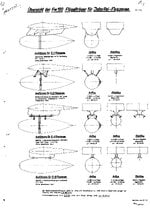
Speed loss on the different payload configuration and type of racks on the Fw 190:

tanksracks.jpg

The best of the lot is the belly rack ETC 501, with speed loss when installed being 12 km/h (on the bottom of the pic). The best wing racks cost 18 km/h for the pair; the worst 40 km/h(!). Obviously, the speed loss with the racks carrying the payload (doh), is substantial, up to 90 km/h if three racks are carrying stuff.
The much higher drag will also cost the range, to nobody's surprise.

On the US aircraft, the P-51D and later were with perhaps the best of the lot, cost of only 4 mph for a pair; the earlier Mustangs' racks were of different design with cost being 12 mph.
 
So we have one on paper.
Two in the late 50s or 1960s with beefed up wings and 10 years or more of knowledge on jets of what worked?

WWII fell in the middle of wings falling off in highspeed flight in the early 30s due to wing flutter (or aileron flutter) and the late 40s and early 50s with tip tanks becoming safe.
 
WWII fell in the middle of wings falling off in highspeed flight in the early 30s due to wing flutter (or aileron flutter) and the late 40s and early 50s with tip tanks becoming safe.
These are drop tanks. As a rule, drop tanks are to be used when aircraft are cruising, IOW they are not trying to be fast. FLutter happened at high speeds.
There is nothing that prevents the companies giving the different ideas a shot. Usually the companies that were afraid to risk it were the ones making the ducks, note eagles.
 
drgondog probably knows much better than I do but are there strength considerations for using tip tanks?
The same weight on the tip of the wing needs a stronger wing structure than the same weight located 1/2 way out on the wing?
As aircraft speeds increased the wing structure had to be made stronger to handle the flight loads so perhaps the later high speed wings had enough strength either way?
Some fighters were speed restricted when carrying drop tanks. Structure or mounting point/rack restriction?

Interestingly, since the fuselage is hanging from the wing, tip tanks may actually reduce the bending loads on the wing. This is one reason why large airliners usually don't have engines mounted on the fuselage: the wing-mounted engines reduce the bending moments the wing spars have to deal with.

On the other hand, they may increase stresses on the wing structure during landing.
 
^
You'll notice that most tip tanks are located forward of the center of the wing, which is more in line with the center of lift. In this manner, fuel burn off does not move the CG adversely.
Internal wing tanks do not behave that way and you can fly right out of CG.
So the tip tanks are lined up with center of lift. But the landing forces are farther aft in tricycle gear so those forward tanks impose a twisting force on the main spar.
The Cessna tip tanked twins have great roll acceleration, not particularly great roll rates. Once the mass gets moving out there on the ends of the wings it is a little more difficult to stop.
The short bodied early 310 would get into a PIO on final with adverse yaw due in part to that weight out there. it was easy to control but new pilots would get frustrated until they figured it out.
 
Speed loss on the different payload configuration and type of racks on the Fw 190:

View attachment 904428

The best of the lot is the belly rack ETC 501, with speed loss when installed being 12 km/h (on the bottom of the pic). The best wing racks cost 18 km/h for the pair; the worst 40 km/h(!). Obviously, the speed loss with the racks carrying the payload (doh), is substantial, up to 90 km/h if three racks are carrying stuff.
The much higher drag will also cost the range, to nobody's surprise.

On the US aircraft, the P-51D and later were with perhaps the best of the lot, cost of only 4 mph for a pair; the earlier Mustangs' racks were of different design with cost being 12 mph.
Tomo - with respect to the B/D, the major drag contributions were the schemes to connect from the fuel lines to the tanks. In the B and D through the D-20 the fuel and pressure lines emerged parallel and close to the center of the rack - they had to connect to the aft supply/feed location of the 108-gal tank (required for P-38 and P-47 schemes in which the fuel and pressure lines emerged closer to the rear of their pylons). So the schemes to secure the longer hoses while in flight were a direct addition to parasite drag.

The D-25 and last block of D-20 placed the fuel and pressure lines at the leading edge, and the late 110-gal steel tank had their fuel and pressure connections on the top front of the tank. Absent the fuel/pressure line schemes the racks, per se, were pretty close in actual drag contributions.
 

Users who are viewing this thread

Back