R-2600 powered fighter?

Ad: This forum contains affiliate links to products on Amazon and eBay. More information in Terms and rules

Re: F6F - given the choice between available engines, R-2600 or R-2800, the choice seems clear.
However, what of the period prior to R-2800 availability?
Must the choice be limited to the R-1830 or V-1710?

Re: Reliability: R-2600 powered Boeing 314 Clippers were criss-crossing the Pacific and Atlantic prior to 12/7/41.an F6

IMO there was a great value in an F6F powered by R-2600. But it would have required someone with the superpower of precognition. Knowing when the US would be in a naval war and with who, for starters. Then making a fighter only slightly larger than the Wildcat, with the goal of seeing combat in 1942.
 
IMO there was a great value in an F6F powered by R-2600. But it would have required someone with the superpower of precognition. Knowing when the US would be in a naval war and with who, for starters. Then making a fighter only slightly larger than the Wildcat, with the goal of seeing combat in 1942.
The first F6Fs were fitted with R-2600 engines:
XF6F-1: R-2600-10
XF6F-2: R-2600-16/21
 
The first F6Fs were fitted with R-2600 engines:
XF6F-1: R-2600-10
XF6F-2: R-2600-16/21
Are there any performance figures (calculated or from testing of the prototype) for the XF6F-1 with the R-2600-10 engine??
I seem to recall that the R-2600-10 was supposed to have two stage (gear driven) supercharging. True or false?
Did any data survive giving the HP vs. altitude for the -10 version of the R-2600??
 
Are there any performance figures (calculated or from testing of the prototype) for the XF6F-1 with the R-2600-10 engine??
I seem to recall that the R-2600-10 was supposed to have two stage (gear driven) supercharging. True or false?
Did any data survive giving the HP vs. altitude for the -10 version of the R-2600??
 
Are there any performance figures (calculated or from testing of the prototype) for the XF6F-1 with the R-2600-10 engine??
I seem to recall that the R-2600-10 was supposed to have two stage (gear driven) supercharging. True or false?
Did any data survive giving the HP vs. altitude for the -10 version of the R-2600??

AFAIK, Wright did not build any R 2600 equipped with a two-stage geared supercharger.
A possible source of this error is the very common confusion between two-stage and two-speed superchargers.

Another possible confusion would be with the Pratt & Whitney R 2800-10, which possessed a TRUE two-stage, two-speed geared supercharger.

As for the Wright R 2600-10, I don't have this dash number in my tables, but the R 2600-9, -11, -13, and many other versions had an 11" diameter geared impeller at 7.14 and 10 times the crankshaft speed, producing 1,700 hp at 2,800 rpm for takeoff and 1,450 hp at 21,000 feet in military rating.

For the record, odd-numbered dash numbers were USAF indexes, even-numbered were Navy indexes.
 
The first F6Fs were fitted with R-2600 engines:
XF6F-1: R-2600-10
XF6F-2: R-2600-16/21

Yes, my suggestion would be the R-2600 would suit a smaller version. There's a whole lot of real estate between a Wildcat and a Hellcat. Also, given it was wartime, Pratt should have been compelled to share their supercharger tech with Wright. For a royalty on every unit, obviously.
 
AFAIK, Wright did not build any R 2600 equipped with a two-stage geared supercharger.
A possible source of this error is the very common confusion between two-stage and two-speed superchargers.

Another possible confusion would be with the Pratt & Whitney R 2800-10, which possessed a TRUE two-stage, two-speed geared supercharger.

As for the Wright R 2600-10, I don't have this dash number in my tables, but the R 2600-9, -11, -13, and many other versions had an 11" diameter geared impeller at 7.14 and 10 times the crankshaft speed, producing 1,700 hp at 2,800 rpm for takeoff and 1,450 hp at 21,000 feet in military rating.

For the record, odd-numbered dash numbers were USAF indexes, even-numbered were Navy indexes.
Per "Curtiss-Wright Engine Specs, 1930 - 1983" Wright built three models of two-stage R-2600.
-10 9 built
-14 1 built A BB series model and optional engine for the F7F
-16 2 built Improved -10, may be the actual engine used in the XF6F-1
All three have the same ratios; 7:1 main stage and 5.898:1 and 8.519:1 auxiliary stage.
 
Yes, my suggestion would be the R-2600 would suit a smaller version. There's a whole lot of real estate between a Wildcat and a Hellcat.
There is a lot of real estate between the Wildcat and the Hellcat. But in the "engine room" the R-2600 takes up about 85% of weight of the R-2800 and offering about 85% of the power.
That it take-off power. Power at altitude is lot harder to get the information on but it is very important as the take-off power for both engines is only available at very low altitudes.
The R-2600 is actually slightly larger in diameter so there is no advantage in streamlining.
Also, given it was wartime, Pratt should have been compelled to share their supercharger tech with Wright. For a royalty on every unit, obviously.
P&W patent/s were pretty much on the drive system/gearbox which dated from 1938? It took P&W about 2 years longer than Wright to make a two speed engine.
I have doubts about how good the P&W superchargers actually were in in 1940-42. They seemed to suck up a lot of power in high blower.
 
Per "Curtiss-Wright Engine Specs, 1930 - 1983" Wright built three models of two-stage R-2600.
-10 9 built
-14 1 built A BB series model and optional engine for the F7F
-16 2 built Improved -10, may be the actual engine used in the XF6F-1
All three have the same ratios; 7:1 main stage and 5.898:1 and 8.519:1 auxiliary stage.

Thank you for this AEHS document. I was familiar with it, but I hadn't read it enough !

So there was indeed a Wright R 2600 engine with a two-stage, two-speed S/C. But production was very low, while the competing P&W R 2800-10 was built in 17,561 units !

The S/C gear ratios show that Wright had chosen the same solution as Pratt and Whitney: two separately driven impellers, the first one constituting an "auxiliary stage" with two speeds gearing, and the second, called the "main stage," with only one.

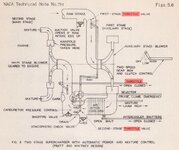
It would be very interesting to have an overall drawing of these installations for Wright. For Pratt (R 2800-10 and derivatives), they are well known. There was an air-cooled "intercooler" between the two stages, just before the PD carburetor, with very complex valving and controls in the induction system. In particular, there were several throttles between the components (one before the first stage impeller, one before the PD carburetor, a third one into the carburetor....).

For the record, the Rolls-Royce Merlin, the archetype of the succesfull engine with a two-stage, two-speed supercharger, had the two impellers mounted on the same shaft and rotating at the same speed, and the induction flow was cooled by an air-water exchanger placed at the outlet of the entire compressor - a true aftercooler.
 
There was also a liquid coolant section/pathway between the 1st- and 2nd-stage rotors, kind of a 'collar' arrangement centered on the supercharger rotor shaft. This allowed the coolant to absorb heat from the supercharger walls between the 1st- and 2nd-stage rotor chambers.

The coolant flowed from the cool side of the radiator to the header tank to the coolant section/pathway 'collar' and then back to the radiator where it was cooled, along with the air/fuel charge mixture as it left the output section of the supercharger 2nd-stage rotor chamber.

This is as opposed to conventional inter-coolers that take the output air-fuel charge mixture from the 1st-stage, send it through a cooling system, and then send it on to the 2nd-stage, where it is output to the cooling radiator once again.

I may be using the terms incorrectly but I usually think of the Merlin 2-stage supercharger as having both a liquid inter-cooler and an air-fuel charge mixture after-cooler.

??
 
There was also a liquid coolant section/pathway between the 1st- and 2nd-stage rotors, kind of a 'collar' arrangement centered on the supercharger rotor shaft. This allowed the coolant to absorb heat from the supercharger walls between the 1st- and 2nd-stage rotor chambers.

The coolant flowed from the cool side of the radiator to the header tank to the coolant section/pathway 'collar' and then back to the radiator where it was cooled, along with the air/fuel charge mixture as it left the output section of the supercharger 2nd-stage rotor chamber.

This is as opposed to conventional inter-coolers that take the output air-fuel charge mixture from the 1st-stage, send it through a cooling system, and then send it on to the 2nd-stage, where it is output to the cooling radiator once again.

I may be using the terms incorrectly but I usually think of the Merlin 2-stage supercharger as having both a liquid inter-cooler and an air-fuel charge mixture after-cooler.

??

I agree. Your description is very accurate; in the Merlin, the liquid circuit dedicated to the big square aftercooler, before joining it, passed through an annular chamber located between the two stages and concentric with the impellers' common drive shaft .

Therefore, there is both an intercooler and an aftercooler, all liquid-cooled.

One might wonder about the actual efficiency of this first level of charge cooling. It is undoubtedly quite low, both due to the small heat exchange surface and the low temperature difference between the coolant and the charge only "first staged". (This last point is specific to all intercooler-type assemblies !).

So, it is certain that the majority of the charge cooling is provided by the aftercooler.
 
Here is a FICTIONAL R2600 powered upgrade to the Brewster Buffalo created as part of the Sentinel Empresses story I wrote a few years ago

airship-buffalo-late-brumby.jpg
 
It would be very interesting to have an overall drawing of these installations for Wright. For Pratt (R 2800-10 and derivatives), they are well known. There was an air-cooled "intercooler" between the two stages, just before the PD carburetor, with very complex valving and controls in the induction system. In particular, there were several throttles between the components (one before the first stage impeller, one before the PD carburetor, a third one into the carburetor....).
WW2 carburetors were self metering or compensating carburetors , so there was no intermediate throttle. Even with the intermediate throttle I would hardly call the system "very complex". At least no more complex than the automatic gear change or boost regulator of the two-stage Merlin.
 
WW2 carburetors were self metering or compensating carburetors , so there was no intermediate throttle. Even with the intermediate throttle I would hardly call the system "very complex". At least no more complex than the automatic gear change or boost regulator of the two-stage Merlin.

Complex... or simple... straight or twisted... it's a matter of perspective.

But the diagram below (NACA TN 794, drawing source: Pratt & Whitney) looks like a plumber's nightmare! (with three taps, of course...)
 

Attachments

  • PW Two stage 2.jpg
    PW Two stage 2.jpg
    241.6 KB · Views: 20

Users who are viewing this thread

Back