Some thoughts on "combat effectiveness/performance" factors that are often hidden.

Ad: This forum contains affiliate links to products on Amazon and eBay. More information in Terms and rules

Yes, well I think especially the figure on the lower right is interesting, because in it, you can see that initially the Spitfire Mk I at the +6.25 boost setting actually turns better than the one at full blast 100 octane +12 boost.

But what is no shown in the figure is what would happen if you reduce the throttle all the way to idle: In this case the red "mountain top" would be shifted even further to the left since the excessive induced drag would not be counteracted by any prop thrust and you would slow down even faster. So initially, and somewhat paradoxically, you would have both a tighter turn radius and higher turn rate at idle.

But this is only for a very short while and rather the exception to the rule: Because in the other 99% of the cases, more power gives you the ability overcome the high induced drag in tight turns and simply haul yourself around by brute force.

And this is why to turn with the highest possible turn rate, you would actually only reduce throttle until you slowed down to the point you are no longer g-load limited, and you would then again increase power to the maximum to turn as best as possible.

So if anything, more power as a rule means better turn performance.

However, this scientific fact will of course not stop you if insist on cherry picking anecdotes, and then interpret them with augury as some insist on doing......
What is meant by g-load limited?
 
What is meant by g-load limited?

I'm assuming that both aircraft have a design limit of a maximum of 6 g's. Now IRL the pilots could of course exceed this just by pulling even harder, but the only thing that would happen then is that they would slow down even faster.

However, there comes a time when the speed has gone down to the point where they can't maintain the g's they would like because the speed is not fast enough. At this point they will ride the edge of stall, i.e. at the maximum lift coefficient, which in aerodynamics is defined as the Clmax.

For context, In my book I have an appendix showing a German calculation by the Messerschmitt firm where they assume a maximum load factor of 5 for a Bf 109 K-4 doing an instantaneous turn (picture on the left). I used that calculation for verification purposes, and talk more about that in my book, but I will also show it in the video I'm working on, so I may as well post it here as well.

As you can see, there is a satisfactory correlation between my C++ simulation model and Messerschmitt's calculation, so I think it's accurate enough to make the sort of comparisons that I do in my book and in the Spitfire Mk I and Bf 109 E comparison I just posted.

Validation of instantaneous turn performance slide.jpg
 
I'm assuming that both aircraft have a design limit of a maximum of 6 g's.

For what it's worth the Spitfire I had a design limit of 10.0 at 6,200 lb

In actual destruction testing (RAE, April 1940):
9.0 -- negligible permanent set
11.5 -- initial failure
12.3 -- final failure​

In July 1943 a captured 109E was also subjected to destruction tests using an all-up weight of 5,610 lb:
9.0 -- minor failures began​
9.7 -- major failure​
 
For what it's worth the Spitfire I had a design limit of 10.0 at 6,200 lb

In actual destruction testing (RAE, April 1940):
9.0 -- negligible permanent set
11.5 -- initial failure
12.3 -- final failure​

In July 1943 a captured 109E was also subjected to destruction tests using an all-up weight of 5,610 lb:
9.0 -- minor failures began
9.7 -- major failure​

Do you have G limit data like that for any other WW2 fighters?
 
Hey wrathofatlantis,

re


Where did you get these numbers? And which marks are the numbers referring to? (sorry if I missed it up thread)

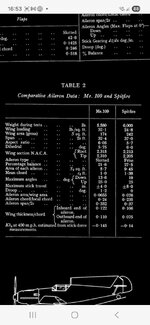
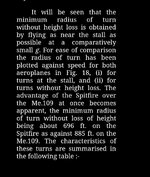
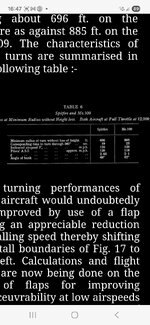
The reason I ask is that the only numbers I have run across show 885 ft best sustained (ie no loss of height) radius for the 109E, and 696 ft for the Spit Mk I, both at 12,000 ft and full throttle. Spit Mk I at ~6000 lbs and 109E at ~5600 lbs.

The charts below show the same basic performance although they use different terms and are displayed differently:

View attachment 873947
View attachment 873948
View attachment 873950
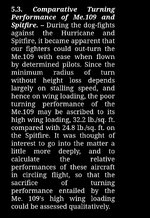
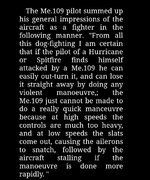
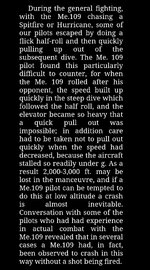
Findings of abuse evaluation between 109E3 and Mk1 Spitfire
 

Attachments

  • Screenshot_20260403_213809_Samsung Internet.jpg
    Screenshot_20260403_213809_Samsung Internet.jpg
    235.8 KB · Views: 30
  • Screenshot_20260403_213652_Samsung Internet.jpg
    Screenshot_20260403_213652_Samsung Internet.jpg
    187.8 KB · Views: 37
  • Screenshot_20260403_213612_Samsung Internet.jpg
    Screenshot_20260403_213612_Samsung Internet.jpg
    300.8 KB · Views: 40
Hey wrathofatlantis,

re


Where did you get these numbers? And which marks are the numbers referring to? (sorry if I missed it up thread)

The reason I ask is that the only numbers I have run across show 885 ft best sustained (ie no loss of height) radius for the 109E, and 696 ft for the Spit Mk I, both at 12,000 ft and full throttle. Spit Mk I at ~6000 lbs and 109E at ~5600 lbs.

The charts below show the same basic performance although they use different terms and are displayed differently:

View attachment 873947
View attachment 873948
View attachment 873950


Please note how the word "pilot" is crossed out.... Why? Because there was no pilot...


Real minimum radius is 1025 ft Spit I, Hurricane I 800 ft, Me-109E 880 ft.

These are the real RAE figures I saw in at least 2 1990s books on the Spitfire, and later confirmed by at least one other source. Twenty or thirty years ago.

They sure have lost their popularity contest have they not? WWII Aviation is where the real seekers of truth rule...

Now, are these sustained speed or un-sustained speed? Sustained altitude or not? I don't know. But they ARE the real figures.

Because the Spitfire I is doing so poorly, I would assume they are actual flat sustained speed circles.

Now try this exercise: Your 696 feet (with 68 degrees angle of bank, no kidding, another dead giveaway this is a math formula): When was the flight date and what were the airframe numbers?

Dates and airframes are the minimum any real life test would have. And you don't have them.

Oh, and the word PILOT is crossed out.... :pilotsalute: Mmmmmh.
 
For what it's worth the Spitfire I had a design limit of 10.0 at 6,200 lb

In actual destruction testing (RAE, April 1940):
9.0 -- negligible permanent set
11.5 -- initial failure
12.3 -- final failure​

In July 1943 a captured 109E was also subjected to destruction tests using an all-up weight of 5,610 lb:
9.0 -- minor failures began
9.7 -- major failure​

You have to differentiate the design load limit and what is allowed for the pilot to do:

In aeronautics it's common practice to have a safety factor of 1.5. So say you want to allow pilots to go up to 6 g's, and print that in the flight manual, then the procurement agency in charge of getting the aircraft for the air force, would then mandate testing showing that the design is safe for 6*1.5= 9 g's.

Now designing a plane with a slide rule and without CAD and FEM, is a bit more difficult, and it's embarrassing for an engineer to see his design fail, so when you design, and you know it's going to be tested to 9 g's, you always add that little extra mm of material in your spar, and the design therefore passes 9 g's but breaks at maybe 11-12 g's, and everybody is happy.:)
 
I don't see how that contradicts anything

You don't see how the top Spitfire ace saying his defeat in multiple circles, on the deck, against a 190A-4 was inevitable contradicts anything?

"Sickening apprehension as the 190 gained on my tail."

1775295486494.png


Ok, so how many quotes do I need to provide then?

With prolonged medium low altitude turns and/or the word circles in plural?

Have you provided one? How about the 3 best ones and we see what you come up with? I already know the one circle one (after a dive) with the word "fired repeatedly". That's the closest I've seen in 30 years...
 
Please note how the word "pilot" is crossed out.... Why? Because there was no pilot...


Real minimum radius is 1025 ft Spit I, Hurricane I 800 ft, Me-109E 880 ft.

These are the real RAE figures I saw in at least 2 1990s books on the Spitfire, and later confirmed by at least one other source. Twenty or thirty years ago.

They sure have lost their popularity contest have they not? WWII Aviation is where the real seekers of truth rule...

Now, are these sustained speed or un-sustained speed? Sustained altitude or not? I don't know. But they ARE the real figures.

Because the Spitfire I is doing so poorly, I would assume they are actual flat sustained speed circles.

Now try this exercise: Your 696 feet (with 68 degrees angle of bank, no kidding, another dead giveaway this is a math formula): When was the flight date and what were the airframe numbers?

Dates and airframes are the minimum any real life test would have. And you don't have them.

Oh, and the word PILOT is crossed out.... :pilotsalute: Mmmmmh.
 

Attachments

  • Screenshot_20260403_165358_Samsung Internet.jpg
    Screenshot_20260403_165358_Samsung Internet.jpg
    200.9 KB · Views: 36
  • Screenshot_20260403_164625_Samsung Internet.jpg
    Screenshot_20260403_164625_Samsung Internet.jpg
    172.4 KB · Views: 35
  • Screenshot_20260403_164747_Samsung Internet.jpg
    Screenshot_20260403_164747_Samsung Internet.jpg
    279.2 KB · Views: 33
You can "prove" basically anything using cherry-picked pilot quotes: I even begin my book with the example below. However, and as I say in the following chapter, I ONLY included Leykauf's statement to show just how WRONG you can get if you rely solely on individual pilot quotes and not a meta analysis, which would have revealed that the overwhelming majority of pilots who have flown these aircraft agree that the Spitfire handily out-tuns the Bf 109.

This is nothing short of me saying, that on average, men are taller than women, and some fool then saying: "Yeah? Really? Well my aunt is 6 foot 4 inches!!! How do you explain THAT! You can't, can you?!!!!"

Erwin Leykauf Spitfire quote from WW2 Aircraft Performance book.jpg
 
As an Amazon Associate we earn from qualifying purchases.
Please note how the word "pilot" is crossed out.... Why? Because there was no pilot...


Real minimum radius is 1025 ft Spit I, Hurricane I 800 ft, Me-109E 880 ft.

These are the real RAE figures I saw in at least 2 1990s books on the Spitfire, and later confirmed by at least one other source. Twenty or thirty years ago.

They sure have lost their popularity contest have they not? WWII Aviation is where the real seekers of truth rule...

Now, are these sustained speed or un-sustained speed? Sustained altitude or not? I don't know. But they ARE the real figures.

Because the Spitfire I is doing so poorly, I would assume they are actual flat sustained speed circles.

Now try this exercise: Your 696 feet (with 68 degrees angle of bank, no kidding, another dead giveaway this is a math formula): When was the flight date and what were the airframe numbers?

Dates and airframes are the minimum any real life test would have. And you don't have them.

Oh, and the word PILOT is crossed out.... :pilotsalute: Mmmmmh.
Screenshot_20260404_130552_Samsung Internet.jpg
Screenshot_20260404_130607_Samsung Internet.jpg
 

Attachments

  • Screenshot_20260404_130331_Samsung Internet.jpg
    Screenshot_20260404_130331_Samsung Internet.jpg
    134.7 KB · Views: 38
There you go, using science! How dare you?!!!
But seriously, you need a glossary to explain the meaning of those sciency terms like "g-load limited" and "CLmax limited. For those of us who are on this site just because we think airplanes are pretty.
I've been waiting for years to figure out how to work Vfoos into the conversation.
 
You don't see how the top Spitfire ace saying his defeat in multiple circles, on the deck, against a 190A-4 was inevitable contradicts anything?

"Sickening apprehension as the 190 gained on my tail."

View attachment 874135


With prolonged medium low altitude turns and/or the word circles in plural?

Have you provided one? How about the 3 best ones and we see what you come up with? I already know the one circle one (after a dive) with the word "fired repeatedly". That's the closest I've seen in 30 years...
Johnson states that he was 'greying out' in his turns, so his turn rate was pilot limited, not airframe limited, and that plus the 190's superior roll rate might have been the deciding factor.
 
Johnson states that he was 'greying out' in his turns, so his turn rate was pilot limited, not airframe limited, and that plus the 190's superior roll rate might have been the deciding factor.

This is a very good point (pilot limited turn). In fact, just as my previous post comparing the Spitfire Mk I and Bf 109 E showed, the Bf 109 can initially during the instantaneous phase of a turn, turn inside the Spitfire. And I see no reason why a determined Fw 190 pilot following a Spitfire in a high speed turn could not do the same. No physics broken. Explanation for Johnson's quote provided. Problem solved.
 
Do you have G limit data like that for any other WW2 fighters?

Just the Hurricane (sort of) and Blenheim.

The RAE tested the metal-winged Hurricane in 1937 at an all-up weight of 5,700 lb. This was 1,000 pounds lower than the Hurricane I ended up needing to be by 1940, but this was nothing to worry about as the RAE gave up at 15.0 G when there was still no failure (no major failure, I'm assuming. It is only a short summary of the test).

In February 1941 the RAE wanted to test the Blenheim's wing to see if it could take the additional requirements for the new Mk.V: 7.5 G at 15,000 lb.
4.5 G -- skin buckling
4.9 G -- minor fracture
6.0 G -- minor fracture
6.75 G -- no major failure, but the accumulated minor fractures and permanent set of 0.6" upwards was deemed enough to prompt modification.​
 
Last edited:
I got to thinking about some of the hidden (not often thought about ) things that affect both effectiveness and performance. This was in regards to the idea that the US could have used cheaper, lighter planes and gotten about the same effectiveness in combat. Maybe they could but I am not interested in going into the claims/losses rabbit hole. I am thinking about a quite different rabbit hole that has even less documentation.
I am going to use the US as the example as the US is rightly or wrongly considered to have the heaviest/most rugged aircraft and actual combat performance (climb and turn) suffered.
In the early part of the war with France vs Germany there was one sort of war going on. Apologies to the Poles but that part of the war was too short for engine life and airframe life or accident rate to have much effect. It did have an effect even during the Phony war over the winter of 1939/40.
Amount of spare parts for both engines (and accessories) and airframes became more important. For France and Germany the front lines were only a few hundred Kilometers from the factories except for the purchased American planes (Hawk 75s). In some cases there are reports of the French squadrons not being able to repair/maintain aircraft due to lack of spare parts because a high percentage of the parts were going to new construction. We don't (in English sources) have much good information about the reliability/durability of French engines, except it was not what was wanted once they got passed the Hispano-Suiza radials which seem to have been really horrible. Now against this is the fact that distances and flight times were short, often 2-3 hours? or less?
The Hawk 75s have had a little written about them about this. The US got two reports in 1939, one Oct 1939 and one id Dec about things like fuel tank protection, fuel management (tank switches), landing gear operation, ammo capacity and rear seat armor. One French commander reported that 3 of his Hawks had been damaged due to bullets penetrating the hydraulic system for the landing gear. Others had been damaged due the electric landing gear position indicator failing to function. His own mechanics came up with a visual indicator, white paint on part of the landing gear that was only visible when the landing gear was down, red paint on the part when it was not down. In Early Jan 1940 the head of the French Air Mission in the US was trying very hard to purchase 30 extra wing sets for the Hawk 75s already delivered. The French had ordered the equivalent of 25% spares in monetary value for the first 200 planes (equivalent to 50 airframes) but they were running out of spare wings a lot faster than expected. They had 30 Hawks grounded due to damaged wings in jam 1940. The US Army with a very vested interest in problems with the P-36 as the US P-36s were interspersed with the French Hawk 75s on production line and the US Army and over 500 P-40s with a very closely related airframe on order. The US Army had the Military Intelligence Division revue the French reports and give their assessment.
US Report was that the major causes as a high rate of landing accidents (but no cause/s?) and lack of sufficient spares.
The Hawks seem to have done quite well in combat in both the Phony war and after the actual invasion.
French fighter fields were often not very good. Many of them were old (WW I or just after) and not maintained well during the years of peace. Some were very good if they had been regular fields in the 1930s.
Many countries wound operating from poor airfields after the BoF. In the BoB both sides operated from a variety or airfields and both sides, while transport distances were short, often prioritized new construction over spare parts.
Both the Spitfire and 109 are often criticized for weak landing gear and/or landing/ground handling problems. What is rarely/never mentioned is what else gets damaged in landing/taxiing accident that caused by the landing gear? Can they just bolt a new landing gear leg onto the original mounts or does the wing (Spitfire) or fuselage (109) need parts or replacements. Sometimes on the Hawks the landing gear leg punched it's way up through the wing.
What is known on the Hawks is that the wings on the P-40s (the ones with four .303/.30 cal guns) gained about 150lbs over the P-36/Hawk 75 wings.
Some of the French Hawks had four 7.5mm mgs.
The P-40 was heavier and needed stronger wings handle the US required G loadings. Now despite the Hawk 75s being built to handle 11.5-12 Gs ultimate (breaking, bending could be at a lower G load) in flight they had a problem with landing. US P-36s also had problems with landing gear attachments and wing skin buckling around the landing gear.
How much of the weight increase was to handle the flight load/s and how much was to fix the landing gear problem/s I don't know. P-40E and up gained about another 100lbs in the wings, higher gross weight.
When the US went to war it did so in areas thousands of Kilometers from the factories. Spare aircraft or spare parts were going to take a lot longer to get to where they were needed and cost a lot more (fuel and manpower) to get them there.
The US had started testing their engines (commercial and military) to a 150 hr endurance test instead of the 100 hours most of the rest of world used in 1936 (?) which meant that US engines were a little heavier than other engines during the 1930s and early 40s.
Now once you get to a crappy airfield in the North African dessert or some of the Jungle airfields or coral Islands US endurance testing is sort of useless but only sort of. An engine that limped though a European test (there were different standards on how many full power hours and how many parts could be replace) trying to operate in the same environment as a US 150 hour engine (with a few allowances) might show a similar life span, roughly 2/3rds ???
British had problem. Flying out of England, close to the Factories, had the best conditions (on average) for engine life compared to flying out of North Africa or the Far East and with the Med shut down sending spare aircraft/parts/engines around Africa was real logistics problem.
Japan had a problem also but is about 2800-2900 miles from Japan to Rabaul and around 6000 miles from San Francisco to Henderson Field.
Not saying that either county designed aircraft with those specific transport distances in mind but the US was more mindful than most that logistics was going to be a major factor in any war the US got involved with.

Some things just sort of happened. The US was figuring out how to make protected tanks and fit armor/BP glass during much of 1940. Sometimes it didn't make it into some the planes until 1941 and while the US figured it would have to fight Japan at some point they didn't know when or what planes they would have and they didn't know that the Japanese would fail to follow the world trend and not fit protection to many of their aircraft for 2-3 years after most other nations did. US pilots sometimes took guns/ammo and fuel out to increase performance. I don't think they ever took out armor/BP glass.
Perhaps the US overbuilt considering the amount of time a fighter or it's engine or it's guns would last on average in combat. But if you go too light you are loosing more equipment to mechanical attrition than to combat and accidents.

Every air force and point to planes that were lost to a single 7.5-7.9mm bullet (the Golden BB) and to planes that came home with several hundred holes and/or major pieces missing. Both are the exceptions and trying to figure out 'average' damage that was survivable takes a lot more time, information and computer power than I have.

I will note the Odyssey of the US 1st Pursuit Group in Dec 1941 to June/July 1942.

Dec 7th the Group is at Selfridge Field Michigan and is ordered to San Diego to guard against the Japanese.
Dec 8th the first aircraft arrive in San Diego, about 2000 miles straight line. Entire group (including ground elements) arrives Dec 22nd.
At least one squadron had been in El Paso Texas.
The 2st stays at San Diego until April 15th when it is decided to send the 1st to England and for them to fly across the Atlantic. The 1st is to get brand new P-38Fs from the factory prepared for the trip. The Group heads east to New England. and then is told to fly west after Midway. They are stopped in North Carolina and then sent sent north to Bangor Maine. By June 18th the 1st Pursuit group has it's full compliment of P-38s at Bangor. June 23 sees the first P-38s fly out of Presque Isle Maine to Goose Bay Labrador.
The US was sort of used to deployments that covered several thousand miles.
By the late 30s they were operating trans-continental air services several departures per day. It took about 15-17 hours and took 3 refueling stops.
The US Airlines were demanding reliable, long lived engines.
This is a bit off-topic but militaries around the world are presently considering the tactical advantages of "swarming" their enemy with dozens of drones, instead of just one. I say this in reference to your point about the US having focused on producing HEAVY bombers instead of large numbers of lighter more nimble aircraft. Thank you!
 
This is a very good point (pilot limited turn). In fact, just as my previous post comparing the Spitfire Mk I and Bf 109 E showed, the Bf 109 can initially during the instantaneous phase of a turn, turn inside the Spitfire. And I see no reason why a determined Fw 190 pilot following a Spitfire in a high speed turn could not do the same. No physics broken. Explanation for Johnson's quote provided. Problem solved.
I recall reading (might have been Clostermann or Eric Brown?) that the German fighters had a more reclined position for the pilot, in particular feet higher up, than British ones, and this gave German pilots better G tolerance.
 

Users who are viewing this thread

Back