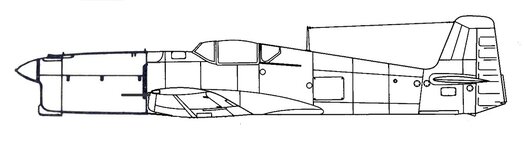
Trouble is the I-F Delta engine was 750hp at 4,000 meters. So you have less than 70% of the power.
The engine is light (510Kg?) but it is large, over 10cm wider. It is has around 18% more frontal area, granted it doesn't have a radiator.
You could just keep the Jumo 210 in production

680hp at 4200 meters?
Use the time between 1938 and 1940 to figure out how run the Jumo 210 a few hundred rpm faster?
RR made a much better job with Peregrine, than what Jumo did with the 210 (even when we have the 10% displacement deficit in mind), so there was a lot of headroom left to the 210 IMO. Not just better RPM, but also the better supercharger might be needed ( that was - inefficient as it was - still served as the pattern to the Jumo 211s before the F version).
Granted, every extra manhour in improving the 210 is a manhour less in tweaking the 211.
I'd use the time between early 1939 and late 1939 to figure out how to install the HS 12Y on the He 100, if the DB 601s can't be had for it.
IIRC Italians were toying with the idea of a supercharged sibling of the Fiat A.30, that came to naught due to the switch from the liquid-cooled engines towards the radial engines. At 24L and 2900 RPM, and a decent S/C, there is an Peregrine equivalent with a bit of luck by late 1930s for them? Not just the power surplus vs. the Delta - and vs. the A.74, plus less drag - but also a few years earlier.
The big V-8 doesn't work well. Unless you switch to 90 degree V angle you wind up with vibration problems. You have 2/3rds the power with equal or greater frontal area and you do not save 1/3 of the weight. Maybe close but not the full 1/3. You also get 4 power impulses per revolution of the crankshaft instead of 6 with also has vibration problems.
I've noted that 90 deg is needed.
We are back to the "cheap" fighter which always going to be a looser. If you cut the engine to V-8 you still have the cost of the supercharger and the gearbox and the other stuff. close to 2/3rds but not quite. Instruments and radio are going to cost the same and so on. You are not going to get a 2/3rds cost fighter. maybe 75-80% if you are lucky but then it won't do what the full fighter will do.
Thread is about the fighters of high 'producibility'.
Engine can save just so much, both in weight and price, and some engines can save manufacturing time (thus no big suggestion by me of 2-row radials - they make sense for the USA - let alone the multibank engines, or sleeve-valve engines). A smaller and/or lighter engine allows for a smaller airframe, that means reduced weight and drag, as well as smaller number of parts (both bigger, like ribs and formers) as well as small (rivets, mostly), again improving the time required for manufacture of the fighters required. Not every fighter needs to be as big & draggy as Hurricane.
(yes, if the Italians are their old selves, the fighter still gets manufactured very slowly with a forest of small bits and pieces to make a single rib)
A captured engine is a boon, reduces not just the cost, but also the time required for production.
Small fighter, at least in continental European parlance in the 2nd half of 1930s, was required to carry a pair of LMGs, or a pair of HMGs, or one cannon + two LMGs, or two light cannons + two LMGs, and it was done with 60-80% of the Merlin III power. So it is not outrageous what I've suggested above.
Problem with historical designs was lack of producibility (MS.405-406, Italian fighters), outdated layout (many times open cockpit, fixed U/C, even biplanes were produced), low power of radial engines coupled with inefficient/draggy engines' installation. 1st problem = not suitable for the requirements of this thread by default, 2nd and 3rd problem = performance was far lower than what a fighter of modern appearance can offer on similar or same power.