I have completed my checks into the Spitfire V candidate. Though I couldn't find any references to Barbarossa plans or operations calling for minimum aircraft to be kept in the West to oppose the RAF I did note from an earlier post that Aircraft were withdrawn from duties in NWEurope to help resist Tunisia landings. So the idea that forces were pinned in the West was not fanciful. Coming back to on-line resources I found this from the Imperial War Museum
"Hitler's invasion of the Soviet Union in June 1941 put pressure on the RAF to step up its attacks and tie down as many Luftwaffe fighters as possible in France. Operations became larger and more sophisticated. The so-called 'summer offensive' saw about 90 major sweeps, mostly between Rouen and Lille, alongside Rhubarbs and attacks against coastal shipping (known as 'Roadsteads'). The results were disappointing, and costly. Some 300 RAF pilots were lost. The famous British ace
Douglas Bader, who had lost both his legs in a pre-war flying accident, was one of those shot down and captured. Nor did the attacks prevent the Luftwaffe from moving most of its force eastwards. Only two German fighter units with about 200 aircraft remained in France, and these proved more than enough to counter the RAF."
What Did Fighter Command Do After The Battle Of Britain?
which puts the tin lid on that explanation.
So, I'm back to first principles. Until otherwise proven, by default, the null hypothesis is that no causal effects exist, all apparent relationships are in fact random. Which is to say the Type and model of aircraft performing the most combat sorties before whatever you consider to be the turn is the one that did the most to turn the tide. Now I'm not saying that he null is true, only that to be reasonable, rational, one would need evidence not opinion to overturn the null.
For example parsifal argued that no fighter could be "the one that did most". As I understand it his argument was that fighters do not by themselves cause strategic change. I think again that this addresses a different form of the question, we are trying to identify the aircraft that did most to turn the tide, not putting up a theory that one model did turn the tide.
Running through the numbers as a summary
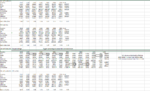
Aircraft production
Country 1939 1940 1941 1942 1943 1944 1945 Total
U.S. 2,141 6,068 18,466 46,907 84,853 96,270 45,852 300,557
USSR 10,382 10,565 15,737 25,436 34,900 40,300 20,900 158,220
UK 7,940 15,049 20,094 23,672 26,263 26,461 12,070 131,549
Subtotal 22,402 33,622 56,238 97,957 147,959 164,975 80,767 590,326
Cumulative 22,402 56,024 112,262 210,219 358,178 523,153 603,920 (error)
Germany 8,295 10,862 12,401 15,409 24,807 40,593 7,540 119,907
Japan 4,467 4,768 5,088 8,861 16,693 28,180 8,263 76,320
Subtotal 12,762 15,630 17,489 24,270 41,500 68,773 15,803 196,227
Cumulative 12,762 28,392 45,881 70,151 111,651 180,424 196,227
Total 33,225 47,312 71,786 120,285 187,516 231,804 94,625 786,553
Allowing that the RAF rejuvenated in 1941 replacing front line platforms from Spit/Hurri I to II and Blenheim to Wellington
and that Soviets lost all aircraft notionally during Barbarossa 1941
and that only isolated lend-lease units from the USA were in operational use
and that the USAF had not deployed significantly
and neglecting that the USN had significant activity in the time frame (January 1941 - September 1942)
and neglecting that all the P40s everywhere could count as one model
I falsely concluded that from squadron numbers that Spitfire V's flew the most sorties and therefore attempted to explain why they might be influencing the turn (that is the stop) at Stalingrad. That was an error, I should have said it is for others to find evidence why the biggest sortie flyer does not have the most to do with turning the tide. Also I left out the Axis sorties. All we know for sure is that the Allies won and the Axis lost. So it is logically as sound to say that every Axis sortie disadvantaged the Axis as it is to say that every Allied sortie advantaged that side -until otherwise proven. So the answer may quite likely be A6M or Me109.
I hope you can see why I think this approach is promising.