

Kirby Morgan
Recruit
- 7
- Jan 18, 2026
You remember, right, that story from 1939, when at its combat debut, the newborn Supermarine Spitfire engaged in battle and shot down some friendly Hurricanes mistaken for enemies? You don't remember it? Well, I'll start another discussion later.
Well,during the Second World War, several pilots tried to find a solution to this long-standing problem and did so by taking the simplest route: painting their planes in bright colors, so they could beimmediately recognized and distinguished from the rest. Here comesour idol of the day, Lieutenant Colonel (Obersleutnant) and alsocaptain of JG 301, Fritz Aufhammer: it was March 22, 1945, when "our"Fritz took off from Stendal heading for the Luftwaffe technicalcenter at Rechlin, about 150 km east of the starting point.There,a group of experts was supposed to meet Aufhammer to discuss with thepilot the technical reasons for the continuous delays that preventedthe plane from entering active service with JG 301, with Aufhammerand his pilots itching to bring into action the latest jewel of theFocke-Wulf dynasty, considered by many to be a necessary aircraft capable of turning the tide of a war that already seemed lost.
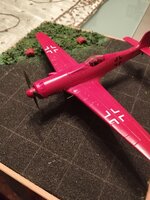
Giventhe novelty that the Ta-152 represented in those last chaotic days ofthe war and the quick trigger of the anti-aircraft units on theground trying to defend what remained of the glorious Third Reich,Aufhammer requested that the plane he was supposed to fly be painteda bright red-orange to avoid being mistaken for an Allied plane and thus targeted by the very dangerous FlaK... Thepilot's request was granted, and the plane was completely painted ina special color that closely resembled the color of Manfred VonRichtofen's famous Fokker Dr.1, the Red Baron.
Well,during the Second World War, several pilots tried to find a solution to this long-standing problem and did so by taking the simplest route: painting their planes in bright colors, so they could beimmediately recognized and distinguished from the rest. Here comesour idol of the day, Lieutenant Colonel (Obersleutnant) and alsocaptain of JG 301, Fritz Aufhammer: it was March 22, 1945, when "our"Fritz took off from Stendal heading for the Luftwaffe technicalcenter at Rechlin, about 150 km east of the starting point.There,a group of experts was supposed to meet Aufhammer to discuss with thepilot the technical reasons for the continuous delays that preventedthe plane from entering active service with JG 301, with Aufhammerand his pilots itching to bring into action the latest jewel of theFocke-Wulf dynasty, considered by many to be a necessary aircraft capable of turning the tide of a war that already seemed lost.
Giventhe novelty that the Ta-152 represented in those last chaotic days ofthe war and the quick trigger of the anti-aircraft units on theground trying to defend what remained of the glorious Third Reich,Aufhammer requested that the plane he was supposed to fly be painteda bright red-orange to avoid being mistaken for an Allied plane and thus targeted by the very dangerous FlaK... Thepilot's request was granted, and the plane was completely painted ina special color that closely resembled the color of Manfred VonRichtofen's famous Fokker Dr.1, the Red Baron.
Attachments
Last edited:


