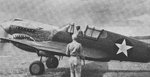
The P-40 in the photo, above also featured in photo from a different angle in Bartsch (in "Doomed", can't see the star), as well as the other P-40 captured there, were from the three P-40E-1's brought crated to Mindanao by the blockade runner Anhui in March 1942, not ones on Luzon at the beginning of the war. This is described by Bartsch as well as in other sources. The nose color scheme was an unusual product of the contingent on Mindanao, said to be inspired by publications they'd read (probably also brought in by the blockade runner) showing AVG P-40 tiger/shark mouths. So perhaps the white out of the red star center was another improvisation of the same imaginative team who painted that airplane. AFAIK there's no photo of the other plane which can be verified as being that plane and having been taken near the time of its capture.
The Japanese captured at least 5 P-40E's restorable to flying condition, since the P-40 detachment of the JAAF 50th Flying Regiment in Burma in 1943 had that many. The others were probably reconstructed from semi-wrecked P-40's captured at airfields on Java, or from the crated P-40's from the freighter Sea Witch dumped into the harbor at Tjilatjap on Java. So, later photo's of captured P-40's could be PI or DEI planes.
But here's something interesting I found wrt the markings of P-40's captured on Java. The first picture is from 日本軍鹵獲機秘録 , (~'Japanese Army Captured A/c –Secret Files', ISBN 4769810474, maybe it's the 'small Japanese book' referred to above?), p.61. The second picture is from Bartsch's "Every Day a Nightmare" p.138. It seems to be the same two a/c taken from a slightly different angle (trees and tents seem to be the same). Perhaps the Japanese painted or retouched out the red dots to avoid confusion of the lay public in Japan who might also mistake the red dot for the 'hinomaru' marking? I'm not attached to that theory, but anyway that photo comparison makes it harder to draw any conclusion about the meaning of the lack of red dot in the Mindanao photo.
Note also that the Japanese repainted some of the captured P-40's in an imitation pre-war USAAC scheme, with tail stripes, for the movie "Kato Hayabusa Regiment". Again perhaps the tail stripes were supposed to remove any confusion about the nationality of these planes to the Japanese audience, though the enemy in this movie, of the 64th Flying Regiment in Burma in 1942, flying Type 1 Fighters aka Hayabusa and led by Kato, would have been the AVG, whose a/c carried Chinese Nationalist AF markings.
Baeza's "Soleil Levant Sur l'Australie" has a number of photo's of USAAF P-40's in Australia with the red center dots dated as late as May 1942, in line with the general conventional wisdom that elimination of the dots dated from that month (the change was officially ordered in the USN on May 15, and some sources say it was applied to USAAAF in the field generally in late May). However the dates of those photos can't be independently verified by the reader.
日本軍鹵獲機秘録 p.61, dots
"Every Day a Nightmare" p.138, no dots
日本軍鹵獲機秘録 p.97, captured P-40, unknown origin, painted for "Kato Hayabusa Regiment"
Joe



 . I can make out no sign of the dot in the 'no dot' photo, even with a strong magnifying glass. Is there perhaps some other case of a photo where we know for sure there were red dots but they became invisible in a photo due to light conditions, to demonstrate that theory?


