Long time since I read Kenneth Poolman's "Escort Carrier, HMS Vindex at War". I had forgotten about her use of sonobuoys in April 1945. From Vindex history on Royal Navy Research Archive site (which basically repeats Poolman's narrative).
The convoy met with the Russian escort force at 06:30 on the 25th. The convoy is now split into two sections: 12 ships formed the White Sea (Archangelsk) section, which detached under escort by a local Russian force. Until now, no meaningful enemy force had been encountered; this was about to change. There were 11 U-boats waiting for the convoy, stretched across the entrance to the Kola inlet, and the Swordfish crews now began an intensive patrol period. Around 06:55 on the 25th, VINDEX, PREMIER, BELLONA, ZEALOUS, ZEST and ZEALOUS also detached to proceed to the ' flying off area ' in position 70°10'N, 36°10'E to begin an intensive relay of Swordfish laying sonobuoys at 12-mile intervals along the course of the convoy on approach to Kola inlet. Each aircraft remained overhead, monitoring the buoys for an hour, then returned to the ship once the convoy had passed their line. To help address this U-boat situation, the ships of the 19th Escort Group, made up of the Frigates ANGUILLAL, COTTON, GOODALL, LOCH SHIN, and LOCH INSH, were also sweeping in the approaches to the Kola Inlet to support the convoy. This force had departed Scapa Flow around 20:00 on the 17th and had proceeded directly to the entrance of the Kola Inlet to patrol there in advance of the arrival of the convoy. They had arrived in their patrol area around 15:30 on the 22nd and commenced patrolling. From 07:40, PREMIER launched Avengers in groups of three to conduct A/S sweeps 15 miles ahead of the lead ship in the convoy, and once all vessels had entered the inlet, they switched to patrol seaward. The Destroyer escort left the convoy inside the inlet to rendezvous with the Carrier force to escort them in. VIDEX and PREMIER secured at their berths in Vedanga Bay around midnight.
This was to escort convoy JW66 into the Kola inlet in April 1945. 813 squadron joined her on 8th April after a refit for a short work up. The air group was adjusted to 8 Swordfish III (reduced from 12) and 12 Wildcat VI (increased from 8) before sailing with JW66. One Swordfish was lost on the 22nd April due to a RATOG failure on launch. And one of the Wildcats had been damaged in a deck landing accident a few days previously and was u/s.
Digging into the 813 history "Squadrons and Units of the FAA" carries this comment:-
"From June 1944 the squadron had begun to receive Swordfish IIIs, some fitted with sonobuoy equipment, and by March 1945 it had a full complement of 12 fitted with this."
Between its reformation in Nov 1943 until it went ashore to Hatston on 24th Feb 1945, its time at sea was aboard the escort carrier Campania. It was still flying some of the earlier Swordfish II into July 1944. Campania spent her time until mid-Sept 1944 escorting convoys on the route south to / from Gibraltar / Sierra Leone. After that she was reallocated to the Home Fleet for the Kola run, anti shipping strikes and supporting the mining operations of other Home Fleet escort carriers. Unfortunately the RNRA history for Campania makes no mention of sonobuoy use by 813.
After the JW66 / RA66 Operation 813 was disbanded on 15th May 1945 after its return to Britain.
I can't currently find any other reference to Swordfish III using sonobuoys, especially amongst 811, 825 & 835 which were very active on the escort carriers Vindex & Nairana in 1944/45. Carrying sonobuoys would have further restricted the depth charge armament these aircraft could carry. As it was the load of a Swordfish III was very weather dependent and RATOG was essential to get them airborne.
Premier incidentally was operating 12 Avenger II and 8 Wildcat VI of 856 squadron. As laying the sonobuoys was left to Vindex's Swordfish, presumably the Avengers didn't have the capability.
A bit more.
HMS Vindex and FAA Input May 1945
The escort carrier HMS Vindex filed a report in early July with a rare piece of FAA sonobuoy-related
comment from 813 Squadron while with Arctic convoy JW66 to the Kola Inlet in May.
813 was equipped with sonobuoys for its Swordfish in October 1944 but had found little opportunity to use
the "lash-up" installation. In March 1945, 12 new Swordfish III arrived, with the dedicated sonobuoy Mod
SFX.157. The new Mod was actually regarded by 813 as inferior to the installation done locally in October,
primarily due to the Dynamotor now being located behind the receiver. This made access to the Dynamotor
difficult for servicing. More crucially it pushed the receiver further forward into the observer space, already
restricted with radio and radar sets. The observer's seat faced forward and the receiver was behind. The
further back from him the better so he had room to turn to operate it. As an aside, picture the operator's
role in the open-air cockpit, facing half backwards, wearing thick clothing in the Arctic air with the noise and
vibration, then trying to listen in to the basic pattern of five buoys and judging the subtle volume differences
to assess a likely U-boat course. Tricky! The electric supply in the Swordfish was stretched and the lash-up
solution of three 12-volt accumulators was thought better than the Mod which lacked a voltage test facility
and risked electrical failure. To allow the same headphones to be used for all requirements a third setting
was added to the switch so it covered the comms TR1460 & intercom, AN/ARR-3, and ZBX beacon. The
first operational use was on 23/4/45 on a disappearing contact, but only water noise was picked up.
Standard Swordfish loading was:
• Day - 3 depth charges, 6 sonobuoys, 2 marine markers, smoke floats in ear cockpit.
• Night - 3 Depth charges, 2 sonobuoys, 4 flares, 2 marine markers, flame floats in rear cockpit.
It was also planned to have two Swordfish as dedicated trackers with 18 sonobuoys and six marine markers
removing all attack capability. For this trip four Swordfish were replaced by more Wildcats, so the tracking
option was dropped.
The report's Appendix C covered investigation of a disappearing contact. Wind 45 knots, visibility 200
yards in snow, 900 yards in low cloud, sea condition rated as "fairly rough" but Vindex classified as state 10
with no explanation available for the discrepancy. Would aircraft fly in snow showers and sea state 10?
A Swordfish using Type XI radar with sea return filter picked up a radar contact at 3 miles which
disappeared at 1.5 miles. At an altitude of 400 feet a red sonobuoy and a marine marker were laid at the
estimated spot. The buoy failed and a purple one replaced it. "Persistent diesel noise" was heard – unclear
if surfaced or schnorkeling – and "very loud water noise". It lost visual contact with the original marker and
an orange buoy plus marker laid which picked up quieter diesel. Both buoys could still be heard when
Vindex recalled the Swordfish. By this time the U-boat was well astern of convoy and no longer a threat.
FAA felt that the sonobuoys functioned in much worse conditions that expected. However, maintaining
marker contact in poor visibility was again difficult, with the marker burning too intermittently.
In Appendix D, a plan was proposed by 813 Squadron for the approach to the Kola Inlet. Essentially a 60
square mile rectangle would be sown with buoys and closely patrolled by aircraft within listening range.
This was declined by the cruiser-based Admiral in charge for reasons not specified in the report; it would be
interesting to know what experience the Admiral had of sonobuoys. This plan has the first mention in the
report of the Mark 24 Mine with the reservation that it cannot be used close to surface vessels; two aircraft
would each be armed with one Mark 24 and one depth charge. The point was made that the cold water
was not found to degrade the sonobuoy performance.
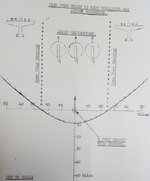
In Appendix E, an amended plan was submitted and accepted; this had a series of short rolling lines of
buoys giving the appearance of an arrow-head leading the convoy – Fig 33. The Mark 24 featured again.
The number of buoys was below what was thought to be ideal. 85 were dropped, one working intermittently,
nine failed completely – one possibly from a close escort depth charge and two where the static line was
not secure, probably due to the pressure on a fast-turn round on the carrier.