Wellingtons and sono-buoys (High Tea)

Ad: This forum contains affiliate links to products on Amazon and eBay. More information in Terms and rules

First operational tests of pre-production 'High Tea' by 210 Sqn supposedly took place in Jun/Jul'42, using Sunderlands out of Sullum Voe, Shetlands. 210 Sqn had (I think) officially transitioned from Sunderlands to Catalinas by this date, but possibly used a couple of available legacy Sunderlands for the tests? I have no idea if these 'High Tea' units were the US made CRT-1 series.

The UK first ordered 1000x CRT-1 sonobuoys and 30x R-2/AAR-3 receiver sets in Oct'42.


This is what I have for the CRT-1 series:

AN/CRT-1, Ø4.75" x 48"L as dropped, 14 lbs, 6 channels in 67.6-71.7 MHz 'Black' band, audio detection at 300 Hz to 8K Hz
in service 43

AN/CRT-1A, Ø4.75" x 44"L as dropped, 12.7 lbs, 6 channels in 67.6-71.7 MHz 'Black' band, audio detection at 100 Hz to 10K Hz
in service 1944

AN/CRT-1B, Ø4.75" x 45" as dropped, 13.5 lbs, 12 channels in 62.9-67.9 MHz 'White' band, audio detection at ?
in service 1944

Individual shipping tubes were either Ø5.25" for the CRT-1 & -1A or Ø5.5" for the CRT-1B (no idea why the difference).

NOTE the above dimensions and specs are from various manuals. However, I think there were a couple of different aerial sections that saw service - possibly of different length - which would result in different overall 'as dropped' lengths.


R-2/AAR-3 was usable with 67-72 MHz 'Black' band CRT-1 and -1A sonobuoys

R-2A/AAR-3 could receive both 'Black' & 'White' bands from 62-72 MHz.

As of Sep'49 the AN/CRT-1A/-1B series buoys with R-2A/ARR-3 receiver system was designated ARI.5286 in UK service.
 
Last edited:
First operational tests of pre-production 'High Tea' by 210 Sqn supposedly took place in Jun/Jul'42, using Sunderlands out of Sullum Voe, Shetlands. 210 Sqn had (I think) officially transitioned from Sunderlands to Catalinas by this date, but possibly used a couple of available legacy Sunderlands for the tests? I have no idea if these 'High Tea' units were the US made CRT-1 series.
The Sunderland trial really interests me. Blackett outlined his idea for a sonobuoy but the whole project was then passed to the US given the huge pressure British development resources were under. I have not spotted anything about a British device being designed during the war. So if 1942 trials happened they are highly likely to be a very early stage RCA AN/CRT design. Is it in the 210 ORBs or was it a 210 aircraft assigned to CCDU maybe? You don't hear of CCDU having dedicated flying boats (I think) so perhaps when needed they borrowed an operational one at a normal operational base. Was a formal CCDU report done in which case there is a good chance it is at TNA in AVIA7/1418. I have bits of that file but nothing relevant.

The rest of what you listed looked fine.
 
210 sqn ORBs for May-Aug 1942 offer no evidence. From web searches the squadron changed from Sunderlands to Catalinas from July 1940 to April 1941 ish. From the ORBs the main missions in summer 1942 were to Russia and other long range patrols unsuitable for Sunderlands. Does not seem any reason for the odd Sunderland to be held with issues of spares, ground crew, etc.
 
An informative paper on the sono-buoys, albeit from the US perspective: https://www.navairdevcen.org/PDF/THE EVOLUTION OF THE SONOBUOY.pdf

According to Chris Ashworth the use of High Tea in the Coastal Command was limited to "tentative operational use during the autumn of 1944", and by the beginning of 1945 ten squadrons had received the sono-buoys.

You don't hear of CCDU having dedicated flying boats (I think) so perhaps
"Flying units of the RAF: the ancestry, formation and disbandment of all flying units from 1912" by Alan Lake doesnt list any Sunderlands, however a Catalina IVB is mentioned.
1790769673266.png
 
Last edited:
120 Squadron was being equipped with sonobuoys in March 1944 but with inadequate supplies of hardware and buoys. Supply remained an issue for the UK and the US for a lot of 1944. The intention was to equip 162 aircraft that carried FIDO and 224 other ASW aircraft. By the end of 1944 the training plan was for 8 Liberator squadrons, 6 Sunderland and 2 Catalinas. That was expected to take six months. By the year end most Libs had been equipped and it was rolling out to others. In March 1945 there were frontline complaints of inadequate training time on courses with insufficient kit to get familiar with.
There was a big question over its effectiveness, at least in other than calm seas. One example had a propeller beat of 120pm being listened to but it was conclusively proved to be a whale. Mind you, the Navy was famed for depth charging many whales! The archives are littered with comments like "wishful thinking", "grossly exaggerated" and "dubious reports". Post-war with access to German records sonobuoy actions were lined up against U-boat locations. My summary follows.

• There were 32 examples between 3/11/44 and 4/5/45.
• Aircraft from CC, RCAF and USN were involved from a wide range of squadrons.
• Main aircraft type was, predictably, Liberator plus four Sunderlands and three Cansos.
• Positive sonobuoys sounds were claimed in 23 cases (72%) with contact lasting as long as three hours.
• Whenever a second aircraft arrived it always picked up positive noises.
• Sounds reported covered relatively slow beats of 55pm, below the taught minimum of 100pm, up
to 250pm accompanied by mechanical banging, hammering, clanking, hydroplane use, etc.
• In all positive 23 cases analysis of U-boat proximity concluded that no U-boats were involved. At
least one was close but did not schnorkel that day. In many cases there were no U-boats for 200+ miles.
• U-boat navigation was difficult while schnorkelling so there is a slight caveat that U-boat log
positions could be wrong which might affect one or two situations.
• The causes of the sightings were whales, whale spouts, porpoises, black fish, old markers and
commonly water spouts. The latter were also known as 'williwaws' or whirlwind squalls which could
include a terrific updraft sufficient to shake a large plane. These varied from a few hundred feet or
more to weak ones that just spread on the surface creating foam easily confused with feathering
and bow waves.
 
Hi Ewen

Looking at the NDRC dimensions there is no mention of the parachute which is the pointy bit at the top. I think the NDRC length is for the core buoy tube which entered the water. Although I cannot see why the diameter differs.

I am surprised at the early use of sonobuoys. Any primary sources you can point me at? My information is that AN/CRT-1A was only finalised as the mass production model in the spring of 1943 with bulk deliveries due to come off from June. I expect any AN/CRT-1's (essentially a prototype) received in the UK were just for trials. Operational models were the 1A and 1B. Supplies to the UK were only a trickle even by March 1944. If you PM me an email I will send you my article which has some examples of use and more on timelines.

HMS Vindex, a CVE, escorting a convoy leaving Murmansk used an innovative sonobuoy fence pattern. Buoys were laid along the sloping lines following the planned route of the convoy. 85 were dropped in total, rather less than the ideal number. It was felt that saving just one merchantman would justify substantial sonobuoy use.
Long time since I read Kenneth Poolman's "Escort Carrier, HMS Vindex at War". I had forgotten about her use of sonobuoys in April 1945. From Vindex history on Royal Navy Research Archive site (which basically repeats Poolman's narrative).

The convoy met with the Russian escort force at 06:30 on the 25th. The convoy is now split into two sections: 12 ships formed the White Sea (Archangelsk) section, which detached under escort by a local Russian force. Until now, no meaningful enemy force had been encountered; this was about to change. There were 11 U-boats waiting for the convoy, stretched across the entrance to the Kola inlet, and the Swordfish crews now began an intensive patrol period. Around 06:55 on the 25th, VINDEX, PREMIER, BELLONA, ZEALOUS, ZEST and ZEALOUS also detached to proceed to the ' flying off area ' in position 70°10'N, 36°10'E to begin an intensive relay of Swordfish laying sonobuoys at 12-mile intervals along the course of the convoy on approach to Kola inlet. Each aircraft remained overhead, monitoring the buoys for an hour, then returned to the ship once the convoy had passed their line. To help address this U-boat situation, the ships of the 19th Escort Group, made up of the Frigates ANGUILLAL, COTTON, GOODALL, LOCH SHIN, and LOCH INSH, were also sweeping in the approaches to the Kola Inlet to support the convoy. This force had departed Scapa Flow around 20:00 on the 17th and had proceeded directly to the entrance of the Kola Inlet to patrol there in advance of the arrival of the convoy. They had arrived in their patrol area around 15:30 on the 22nd and commenced patrolling. From 07:40, PREMIER launched Avengers in groups of three to conduct A/S sweeps 15 miles ahead of the lead ship in the convoy, and once all vessels had entered the inlet, they switched to patrol seaward. The Destroyer escort left the convoy inside the inlet to rendezvous with the Carrier force to escort them in. VIDEX and PREMIER secured at their berths in Vedanga Bay around midnight.


This was to escort convoy JW66 into the Kola inlet in April 1945. 813 squadron joined her on 8th April after a refit for a short work up. The air group was adjusted to 8 Swordfish III (reduced from 12) and 12 Wildcat VI (increased from 8) before sailing with JW66. One Swordfish was lost on the 22nd April due to a RATOG failure on launch. And one of the Wildcats had been damaged in a deck landing accident a few days previously and was u/s.

Digging into the 813 history "Squadrons and Units of the FAA" carries this comment:-
"From June 1944 the squadron had begun to receive Swordfish IIIs, some fitted with sonobuoy equipment, and by March 1945 it had a full complement of 12 fitted with this."

Between its reformation in Nov 1943 until it went ashore to Hatston on 24th Feb 1945, its time at sea was aboard the escort carrier Campania. It was still flying some of the earlier Swordfish II into July 1944. Campania spent her time until mid-Sept 1944 escorting convoys on the route south to / from Gibraltar / Sierra Leone. After that she was reallocated to the Home Fleet for the Kola run, anti shipping strikes and supporting the mining operations of other Home Fleet escort carriers. Unfortunately the RNRA history for Campania makes no mention of sonobuoy use by 813.

After the JW66 / RA66 Operation 813 was disbanded on 15th May 1945 after its return to Britain.

I can't currently find any other reference to Swordfish III using sonobuoys, especially amongst 811, 825 & 835 which were very active on the escort carriers Vindex & Nairana in 1944/45. Carrying sonobuoys would have further restricted the depth charge armament these aircraft could carry. As it was the load of a Swordfish III was very weather dependent and RATOG was essential to get them airborne.

Premier incidentally was operating 12 Avenger II and 8 Wildcat VI of 856 squadron. As laying the sonobuoys was left to Vindex's Swordfish, presumably the Avengers didn't have the capability.
 
Reading through the RAF Narrative I highlighted before, following a CC Group Commanders Conference on 31st Jan 1945, there were two attempts in 1945 to create sonobuoy barriers across likely U-boat transit routes. The first on 8/9 March 1945 was laid from the air west of Ireland and was constantly patrolled by aircraft. It didn't prove very successful due to battery life of the sonobuoys.This line was backed up by an escort group ready to prosecute any contacts.

A second attempt in May saw a string laid from ships between Rockall and the Hebrides. These were of a different type with longer battery life and the exercise lasted 3 days from 2-5 May. The lines were constantly patrolled by Liberator GR.VIII of 59 & 120 squadrons based out of Ballykelly, Northern Ireland.
Barrier trials March/May 1945 A bit more.

A sonobuoy trial took place over 8/9 March to the west of Ireland using the standard expendable buoys.
They were laid in staggered lines with the 1st Escort Group ten miles to the south. The Submarine
Tracking Room estimated 12 U-boats could potentially cross the lines. It was known later there were ten
outward and one inward crossings, so an excellent assessment by the STR! The reality was that none
actually crossed the lines during the trial. Three USN Lib squadrons laid and refreshed the buoys plus two
Catalina aircraft patrolled with MAD. One location was made and on sonobuoy evidence a Mark 24 was
launched but without success. 349 flying hours were involved.

In May a second barrier was tried with new three-day buoys. They were laid by ships from 10th Escort
Group between Rockall and the Southern Hebrides. Laying began at 0600 2 May taking five hours and the
trial ran to 0600 5 May. Flame buoys were laid every two hours to ensure the buoy positions were followed
– over the three days they drifted around 35 miles. Weather was good and reception strong, just fading as
the batteries began to run down. No evidence of U-boats was found. Post-war it was again found that no
U-boats crossed the line but several were close by and one reported seeing a Liberator [72].
 
Long time since I read Kenneth Poolman's "Escort Carrier, HMS Vindex at War". I had forgotten about her use of sonobuoys in April 1945. From Vindex history on Royal Navy Research Archive site (which basically repeats Poolman's narrative).

The convoy met with the Russian escort force at 06:30 on the 25th. The convoy is now split into two sections: 12 ships formed the White Sea (Archangelsk) section, which detached under escort by a local Russian force. Until now, no meaningful enemy force had been encountered; this was about to change. There were 11 U-boats waiting for the convoy, stretched across the entrance to the Kola inlet, and the Swordfish crews now began an intensive patrol period. Around 06:55 on the 25th, VINDEX, PREMIER, BELLONA, ZEALOUS, ZEST and ZEALOUS also detached to proceed to the ' flying off area ' in position 70°10'N, 36°10'E to begin an intensive relay of Swordfish laying sonobuoys at 12-mile intervals along the course of the convoy on approach to Kola inlet. Each aircraft remained overhead, monitoring the buoys for an hour, then returned to the ship once the convoy had passed their line. To help address this U-boat situation, the ships of the 19th Escort Group, made up of the Frigates ANGUILLAL, COTTON, GOODALL, LOCH SHIN, and LOCH INSH, were also sweeping in the approaches to the Kola Inlet to support the convoy. This force had departed Scapa Flow around 20:00 on the 17th and had proceeded directly to the entrance of the Kola Inlet to patrol there in advance of the arrival of the convoy. They had arrived in their patrol area around 15:30 on the 22nd and commenced patrolling. From 07:40, PREMIER launched Avengers in groups of three to conduct A/S sweeps 15 miles ahead of the lead ship in the convoy, and once all vessels had entered the inlet, they switched to patrol seaward. The Destroyer escort left the convoy inside the inlet to rendezvous with the Carrier force to escort them in. VIDEX and PREMIER secured at their berths in Vedanga Bay around midnight.


This was to escort convoy JW66 into the Kola inlet in April 1945. 813 squadron joined her on 8th April after a refit for a short work up. The air group was adjusted to 8 Swordfish III (reduced from 12) and 12 Wildcat VI (increased from 8) before sailing with JW66. One Swordfish was lost on the 22nd April due to a RATOG failure on launch. And one of the Wildcats had been damaged in a deck landing accident a few days previously and was u/s.

Digging into the 813 history "Squadrons and Units of the FAA" carries this comment:-
"From June 1944 the squadron had begun to receive Swordfish IIIs, some fitted with sonobuoy equipment, and by March 1945 it had a full complement of 12 fitted with this."

Between its reformation in Nov 1943 until it went ashore to Hatston on 24th Feb 1945, its time at sea was aboard the escort carrier Campania. It was still flying some of the earlier Swordfish II into July 1944. Campania spent her time until mid-Sept 1944 escorting convoys on the route south to / from Gibraltar / Sierra Leone. After that she was reallocated to the Home Fleet for the Kola run, anti shipping strikes and supporting the mining operations of other Home Fleet escort carriers. Unfortunately the RNRA history for Campania makes no mention of sonobuoy use by 813.

After the JW66 / RA66 Operation 813 was disbanded on 15th May 1945 after its return to Britain.

I can't currently find any other reference to Swordfish III using sonobuoys, especially amongst 811, 825 & 835 which were very active on the escort carriers Vindex & Nairana in 1944/45. Carrying sonobuoys would have further restricted the depth charge armament these aircraft could carry. As it was the load of a Swordfish III was very weather dependent and RATOG was essential to get them airborne.

Premier incidentally was operating 12 Avenger II and 8 Wildcat VI of 856 squadron. As laying the sonobuoys was left to Vindex's Swordfish, presumably the Avengers didn't have the capability.
A bit more.
HMS Vindex and FAA Input May 1945

The escort carrier HMS Vindex filed a report in early July with a rare piece of FAA sonobuoy-related
comment from 813 Squadron while with Arctic convoy JW66 to the Kola Inlet in May.
813 was equipped with sonobuoys for its Swordfish in October 1944 but had found little opportunity to use
the "lash-up" installation. In March 1945, 12 new Swordfish III arrived, with the dedicated sonobuoy Mod
SFX.157. The new Mod was actually regarded by 813 as inferior to the installation done locally in October,
primarily due to the Dynamotor now being located behind the receiver. This made access to the Dynamotor
difficult for servicing. More crucially it pushed the receiver further forward into the observer space, already
restricted with radio and radar sets. The observer's seat faced forward and the receiver was behind. The
further back from him the better so he had room to turn to operate it. As an aside, picture the operator's
role in the open-air cockpit, facing half backwards, wearing thick clothing in the Arctic air with the noise and
vibration, then trying to listen in to the basic pattern of five buoys and judging the subtle volume differences
to assess a likely U-boat course. Tricky! The electric supply in the Swordfish was stretched and the lash-up
solution of three 12-volt accumulators was thought better than the Mod which lacked a voltage test facility
and risked electrical failure. To allow the same headphones to be used for all requirements a third setting
was added to the switch so it covered the comms TR1460 & intercom, AN/ARR-3, and ZBX beacon. The
first operational use was on 23/4/45 on a disappearing contact, but only water noise was picked up.

Standard Swordfish loading was:

• Day - 3 depth charges, 6 sonobuoys, 2 marine markers, smoke floats in ear cockpit.
• Night - 3 Depth charges, 2 sonobuoys, 4 flares, 2 marine markers, flame floats in rear cockpit.

It was also planned to have two Swordfish as dedicated trackers with 18 sonobuoys and six marine markers
removing all attack capability. For this trip four Swordfish were replaced by more Wildcats, so the tracking
option was dropped.

The report's Appendix C covered investigation of a disappearing contact. Wind 45 knots, visibility 200
yards in snow, 900 yards in low cloud, sea condition rated as "fairly rough" but Vindex classified as state 10
with no explanation available for the discrepancy. Would aircraft fly in snow showers and sea state 10?
A Swordfish using Type XI radar with sea return filter picked up a radar contact at 3 miles which
disappeared at 1.5 miles. At an altitude of 400 feet a red sonobuoy and a marine marker were laid at the
estimated spot. The buoy failed and a purple one replaced it. "Persistent diesel noise" was heard – unclear
if surfaced or schnorkeling – and "very loud water noise". It lost visual contact with the original marker and
an orange buoy plus marker laid which picked up quieter diesel. Both buoys could still be heard when
Vindex recalled the Swordfish. By this time the U-boat was well astern of convoy and no longer a threat.

FAA felt that the sonobuoys functioned in much worse conditions that expected. However, maintaining
marker contact in poor visibility was again difficult, with the marker burning too intermittently.

In Appendix D, a plan was proposed by 813 Squadron for the approach to the Kola Inlet. Essentially a 60
square mile rectangle would be sown with buoys and closely patrolled by aircraft within listening range.
This was declined by the cruiser-based Admiral in charge for reasons not specified in the report; it would be
interesting to know what experience the Admiral had of sonobuoys. This plan has the first mention in the
report of the Mark 24 Mine with the reservation that it cannot be used close to surface vessels; two aircraft
would each be armed with one Mark 24 and one depth charge. The point was made that the cold water
was not found to degrade the sonobuoy performance.

In Appendix E, an amended plan was submitted and accepted; this had a series of short rolling lines of
buoys giving the appearance of an arrow-head leading the convoy – Fig 33. The Mark 24 featured again.
The number of buoys was below what was thought to be ideal. 85 were dropped, one working intermittently,
nine failed completely – one possibly from a close escort depth charge and two where the static line was
not secure, probably due to the pressure on a fast-turn round on the carrier.

 
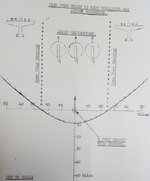
Another mention of sonobuoy barriers from 1947. An advanced scheme to counter high speed submerged submarines. As well as sonobuoys note the ASDIC helicopters,
 

Attachments

  • SB defence of convoy 1947.JPG
    SB defence of convoy 1947.JPG
    48.5 KB · Views: 1

Users who are viewing this thread

Back