Hi Magnon
probably my bad wording, the wing sweep was for your point no 1 (obviouslly important) but the actual sweep used was not sufficient to make a substantial difference to the transonic performance (your point 2) as below.
from
Messerschmitt Me 262 Schwalbe / Sturmvogel
quote
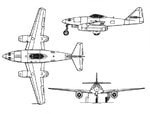
Swept wings had been proposed as early as 1935 by Adolph Busemann, and Willy Messerschmitt had researched the topic from 1940. In April 1941, he actually proposed to fit a 35° swept wing (Pfeilflügel II) to the Me 262. Though this suggestion was not implemented, he continued with the projected HG II and HG III high-speed derivatives of the Me 262 in 1944, which were designed with a 35° and 45° wing sweep respectively. The production Me 262 had a leading edge sweep of 18.5° primarily to properly position the center of lift relative to the center of mass and not for the aerodynamic benefit of increasing the critical Mach number of the wing (the sweep was too slight to achieve any significant advantage). The aircraft was originally designed as a tail-dragger which it was built as in the first (Me 262 V1) through fourth (-V4) prototypes, but it was discovered on an early test run that the engines and wings "blanked" the stabilizers, giving almost no control on the ground. Changing to a tricycle landing gear arrangement, firstly as a fixed undercarriage on the fifth prototype aircraft, then a fully retractable one on the sixth and succeeding prototypes, corrected all of these problems immediately.
unquote
It seems that the 262 was used for tests with higher sweep which certainly would have improved the transonic performance.
I mentioned the Dakota as its wings were swept for similar reasons, to adjust CofG/Cof Lift