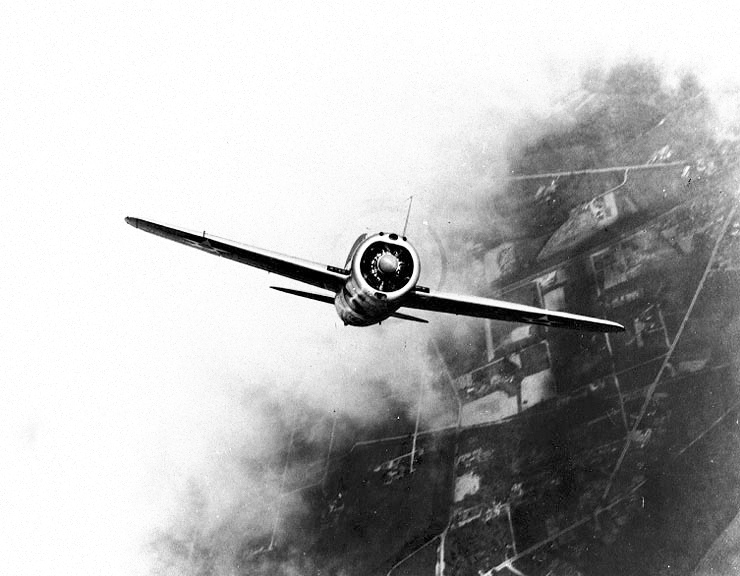
The TBD Devastator's torpedo was, as I understand these things, utterly useless... except for the fact that its fuel was a drinkable alcoholic beverage, and when mixed with pineapple juice, provided a palatable hooch for the officially alcohol-free US Navy.
In contrast, I have nothing but enthusiasm for the Dauntless's fairly unique ability get a particularly large weight of metal horizontally off one carrier's deck and return it vertically onto another one, allowing a single aircraft to play steampunk Luke Skywalker... but it's not really supposed to do anything else, in contrast with the Skua, which is basically a Val - designed to mob opposing heavy units in larger numbers using 500lb GP - that's supposed to double as a fighter and has all the sensible carrier-plane stuff like folding wings, catapult stress, and the ability to float when crashed...
Vindicator was better than the Skua. Hell, the Curtiss SBC Helldiver Biplane was better than the Skua
As someone else has said, the Vindicator/Chesapeake couldn't dive-bomb, and I'm not sure how easily it could get off a deck with a useful cargo in the first place... it rather shows up the speed performance of Fleet Air Arm fighter types, but not the dive-bomber part...
The Val, with its fixed undercarriage, seems to have outperformed both the Skua and the Vindicator, which is perhaps more shocking...
Me, I'd advocate for Bristol just making one or two small radials by 1935-ish. Pegasus is a given; where the Pegasus cannot fit install Mercury; ditch Perseus and Taurus (bar as prototypes).
That seems logical...
One account of the Skua says it got the Perseus after the two prototypes got Mercury's because all the Mercury's were being allocated to Blenheim's.
In fact there was a shadow factory built to make Mercury's which may explain the preponderance of Mercury engines compared to other 3.
I have no idea if there was any parts interchangeable between the engines (Taurus may have used a few nuts, bolts, washers) the Mercury and Pegasus used the same diameter cylinders. Don't know if the heads were the same or any of the valve gear. The Perseus also used the same diameter cylinders and the same stroke as the Mercury but with the sleeves holding the piston and rings nothing outside the crankcase would be the same and a lot of stuff inside would be different.
The big problem Bristol had in 1939-40 and later was sleeve production. They thought they had it solved in 1938-39 but they could not maintain quality in volume production and since the Hercules and Perseus used the same cylinders (or at least the same size) it turned out that for every 3 Perseus engines you could have built two Hercules (sort of, 27 cylinders vs 28 cylinders) .
This may (Guess by me) the reason that around 1/2 of the Lysanders built had Mercury engines. This includes 150 0f the Canadian production (after the first 75 got Perseus) ALL the Lysanders III, all the Lysanders IIIAs and the 100 TT.MK IIIA target tugs (only ones specially built and not converted.)
The story of all these switcharounds seems rather odd...
1. As I understand it, circa 1936 the Mercury was allocated for the Blenheim, the Skua and the Lysander, while the Perseus was allocated for the M.15/35 twin-engined, narrow-fuselage torpedo-bomber project that became the Botha (though even here, I've seen a statement that the original engine allocated was the Aquila, and that the parallel Bristol Beaufort retained this, with only the Botha being swapped over).
2. The torpedo-bomber became a wide-body aircraft with a side-by-side cockpit and a more flexible carrying capacity, but while the Beaufort was allowed to upgrade to the Taurus in mid-1937, the Botha was made to keep the now-underpowered Perseus; meanwhile, the Skua and the Lysander were both swapped from the Mercury to the Perseus, first flights with the new motor being in August and December 1938. Was all this really to free up Mercury capacity for the Blenheim, or to make use of the Perseus?
3. In a quite separate line of engine production, the Miles Master was due to upgrade from the Kestrel to the Peregrine, which was also assigned for the Whirlwind... but in October 1939, the Air Ministry ordered the cancellation of the Whirlwind to switch the floor space and workforce to make more Lysanders (which seems to imply even more Perseus engines); this caused the cancellation of the Peregrine, so the Miles Master was hastily ordered to switch to the Mercury.
4. In the event, a proportion of Lysander production continued to be engined with the Mercury, switching fully back to that motor in August 1940; on the other hand, although a proof-of-concept Miles Master with a Mercury flew in late 1939, the plane continued to come off the production line with the Kestrel until I
think 1941, when it switched over to the Mercury; I'm less clear over the Blenheim; I'd
assume the Mk. IV continued in production until it was superceded by the Bisley (for which the internet gives an in-production date of in November 1941) and Mercury-engined Bolingbroke in Canada, but I'm not totally sure...?
Any corrections or commentary?
Big airframe will be more amenable for increased fuel load vs. size. Problem with big airframe is that bigger size means bigger drag, and bigger drag means a slower A/C, that will tend to use the fuel in a more prodigal fashion.
People wanting to have long range/long endurance fighters in ww2 will need to recall that droppable fuel tanks were in use already inn early 1930s, and act accordingly.
How much more drag does a
longer airframe produce, though? All I know about drag along the sides of the plane is that no-one realised that that the air along the side of the fuselage needed to travel through the same space as the air over the wing root, except possibly the people who designed the English Electric Lightning...
The 72 knot stall speed was 'all up' LG and flaps raised. Stall speed was ~66 knots in landing condition with flaps and LG extended according to Wings of the Navy.
yeah, the speed itself isn't bad, but sudden stall behavior you don't want.
Devastator had a 63 mph landing speed, B5N Kate had a 72 mph landing speed
SBD had a 57 knot landing speed with full flaps and low fuel, to 73 knots , if trying to land at max take-off weight.
Leaving flaps up, added 8-11 knots to landing speed
stall behavior seems to have been to drop the left wing, but no warnings on a spin after that.
So the issue is less the landing speed than the abrupt sideways plunge out of the sky?
And, again a question that shows that I know nothing, would planes decelerate that much in combat?
I've certainly not been accused of lacking the Scottish equivalent, though I'm not sure we have a
word for it in quite the same way...