WW1 Aircraft Photos

Ad: This forum contains affiliate links to products on Amazon and eBay. More information in Terms and rules

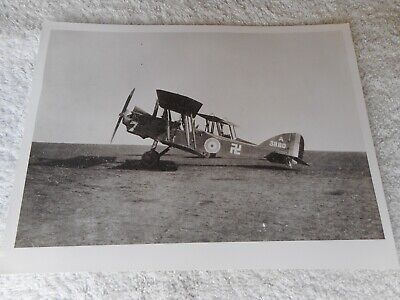
Royal Aircraft Factory R.E.8 A3880 with interesting marking.

A3880.jpg


Regards,

Clint
 
As an eBay Associate we earn from qualifying purchases.
The final two of these photos were taken after 11.11.1918, but perhaps that may be excused, as they are of WWI aircraft:

1761851132957.png
A Finnish Air Force (FAF) Nieuport 17 on the ice of Antrea's Lake Päähkjärvi on the Karelian Front in the spring of 1918, likely in April judging by the ice. This aircraft and another one like it came to FAF service as a result of two Russian pilots defecting to Finnish government forces (the Whites) along with their aircraft on 11 April 1918. Nieuport 17s normally had a 110 hp engine, but these two had 120 hp engines, more commonly found in Nieuport 23s. One was destroyed in an accident in May 1920 and the other struck off the books in February 1925.

1761851276920.png
An FAF D.F.W. C.V. ground reconnaissance aircraft at Utti airfield in the summer of 1918. The flight characteristics of the model are mentioned as being particularly good for aircraft of the period. In the spring of 1918, during the Finnish War of Independence, the FAF had two of these would-be excellent reconnaissance aircraft stationed at the Antrea airfield on the Karelian Front in the spring of 1918, but because the available Swedish pilots lacked the experienced to fly the aircraft, and because the Finnish leadership disagreed over letting experienced White Russian pilots fly them, they ended up not flying a single combat sortie in Finnish service. One of the aircraft was badly damaged in an accident in February 1919 and struck off the books in August of that same year, while the other was destroyed in an accident in February 1921. The FAF did not field other D.F.W. C.V.s. The man leaning against the aircraft in the photo is E. J. Ehrnrooth, with Tauno Hannelius sitting in the cockpit.

1761851432610.png
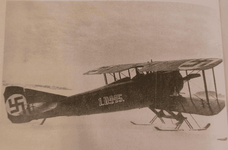
The sole FAF SPAD S.VII, likely in the winter of 1921-22 or '22-23. It is extremely likely that this one was built on license by the Russian Dux A/O company. The Russian-built SPADs featured French engines, often second-hand or otherwise in poor condition, and were of poorer construction and material than the original French-built SPADs. This one was flown to the Finnish Reds by the Russian pilot Ivan Jefimoff (Jefimov?) and there's a photo of it from April 1918 where it's in Tsarist-era insignia, so at least by then the decision to paint Red insignia on it had not been made, if it ever was. All Red aviation in Finland, at least more or less, was conducted by Russian pilots. The aircraft was captured by Finnish government forces in May 1918 in a partially burned condition and repaired in 1921. It was destroyed in a structural failure incident at take-off in May 1923.

1761851911395.jpeg
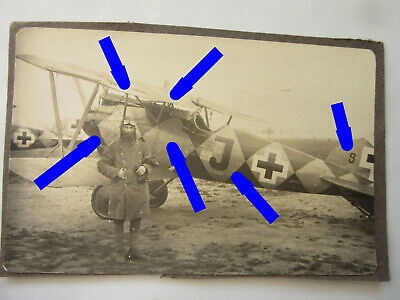
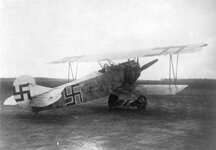
Aviation Detachment 2's (Ilmailuosasto 2) Fokker D.VII fighter FAF serial code 1.C.357 at Utti airfield in autumn 1919. Originally the Finnish government had negotiated to purchase 20-30 of these aircraft from Germany in 1918, but the November armistice put a halt to deliveries before any could arrive. However in 1919 through various middlemen the Finns managed to purchase five aircraft from Germany without permission from the victorious Entente, three of which were Fokker D.VIIs. Two of the three were destroyed in accidents in January and February 1920 and the third in January 1924.

Sources:
-Aarne Bremer (1934): Ilmavoimien osallistuminen Suomen vapaussotaan vuonna 1918 [The Air Force's Participation in Finland's War of Independence in 1918]
-Timo Heinonen, Hannu Valtonen (2010): Albatrosista Pilatukseen: Suomen sotilaslentokoneet 1918-2010 [From the Albatros to the Pilatus: Finland's Military Aircraft in 1918-2010]
-Jani Kortesluoma (2023): Kouvolan punaiset kotkat: Kaarlo Vilho Roine ja keskisen rintaman lento-osasto [Kouvola's Red Eagles: Kaarlo Vilho Roine and the Central Front's Aviation Detachment]

EDIT: I turned the images into thumbnails so that the post is more manageable to view. Click them to enlarge them.
 
Last edited:
Orenco Model B...built by Ordnace Engineering Corp. it was the first built US fighter design to benefit from wartime experience. E Dormoy who had been with Spad was instrumental in its design. Three were built powered by the new 165 hp Gnome engine. It was later decided to manufacture established European figthers. It had been designed to carry 3 mg's. Five additional B's were built but powered by a 80 hp Le Rhone, and were used only as advanced trainers.
ORENCO  B- C----01.jpg
ORENCO  B- C----02.jpg
ORENCO  B- C----03.jpg
ORENCO  B- C----04.jpg
ORENCO  B- C----05.jpg
ORENCO  B- C----06.jpg
 
Last edited:
The LWF Model G was a multi-purpose two-man aircraft designed by LWF in 1918. While it was originally designed as a reconnaissance plane, it was redesigned to be equipped as a heavy fighter or bomber. Two aircraft were built for the United States Army Air Services for evaluation, where the craft reached 138 mph in its fighter loadout whilst carrying seven 7.62mm guns. Both prototypes would unfortunately crash, and with the First World War over, the Army Air Service no longer needed the aircraft.

LWF G-2---03.jpg
LWF G-2---04.jpg
LWF G-2---05.jpg
LWF G-2---06.jpg
LWF G-2---07.jpg
LWF G-2---08.jpg
LWF G-2---09.jpg
LWF G-2---10.jpg

LWF G-2---01.jpg
LWF G-2---02.jpg
 
Every one in the US tries to build a US version of the Bristol Bris-Fit F.2 and fails.The Engineering Division USXB-1

General Pershing was so taken in by the Bristol F.2 fighter that he asked that it be made for the US forces in the US. Curtiss was given a contract for 2,000 Bris-fit Fighers.Two exampls was shipped to the US for Curtiss to study. The first thing they did was change the engine. First they tried a French Hisapon Suiza 300 hp, then they tried a 8 Cylinder Liberty 290hp and finally a 12 Cylinder Liberty Curtiss built 27 of the 12 Cylinder types, The Engineering Division got in involved and tinkered with the airframe making it a rounded plywood covered fuselage. Forty of these were built by Daton-Wright , as a fighter they were a flop being 800 pounds heavier then the Bristol. To add insult to injury the first one flew in 1919. They ended up being used as observation aircraft'

The last 2 photos are examples of 24 Curtiss built before the Engieering Diviosn changed the body work.

13th_Squadron_-_Dayton-Wright_XB-1A.jpg
Curtiss Brisfit---01.jpg
Curtiss Brisfit---03.jpg
Curtiss Brisfit---04.jpg
Curtiss Brisfit---05.jpg
Curtiss Brisfit---06.jpg
US Bristol wi.jpg
US Bristol with .jpg
 

Users who are viewing this thread

Back