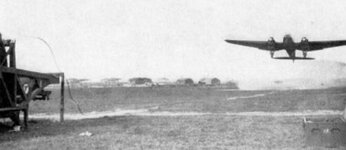
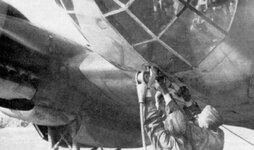
WW2 Catapult Launched Heavy Bombers

Ad: This forum contains affiliate links to products on Amazon and eBay. More information in Terms and rules

gruad

Airman 1st Class
215
129
Jun 13, 2009
London
The Lancaster was said to be super tough because it was specified for catapult launching, but as far as I know there were no actual catapult launches in World war II.

What were they actually expecting though when they said catapult launches? Was that rocket assisted takeoff or was it similar to a aircraft carrier type steam catapult launch?.

Did any other nations use catapult launches on land?
 
The Lancaster was said to be super tough because it was specified for catapult launching, but as far as I know there were no actual catapult launches in World war II.

What were they actually expecting though when they said catapult launches? Was that rocket assisted takeoff or was it similar to a aircraft carrier type steam catapult launch?.

Did any other nations use catapult launches on land?
The Germans did. Especially late in the war when their airfields were heavily bombed and the take-off areas were sometimes reduced due to airfield damage. I got this from Wiki using the term 'JATO'. But these used "rockets" directly instead of secondary "catapult" launches.
 
Last edited:
The catapult requirement was actually related to the British Air Ministry's Specification P.13/36 issued in May 1936 that called for a twin-engine monoplane "medium bomber" which included provisions to conduct catapult assisted takeoffs to permit the carriage of the maximum payload. This provision was removed in July 1938. It did affect the design of the AVRO Manchester (see below images) though which may have thus resulted in features on the associated Lancaster. The Lancaster itself wasn't specified for catapult assisted take offs though.

IMG_3414.jpeg

IMG_3413.jpeg
 
The Lancaster was said to be super tough because it was specified for catapult launching, but as far as I know there were no actual catapult launches in World war II.

What were they actually expecting though when they said catapult launches? Was that rocket assisted takeoff or was it similar to a aircraft carrier type steam catapult launch?.

Did any other nations use catapult launches on land?
Here some photos of a land catapult for launching XPBM-2. Was only a testing facility, never used for real war missions though:
XPBM-2.jpg

avc1b-08.jpg

avc1c-08.jpg

avc1a2-08.jpg
 
The story about schemes to launch heavy bombers is told in "Farnborough and the Fleet Air Arm" by Geoffrey Cooper, who worked at the RAE throughout this period.

The problem.
It was an era of grass airfields. As bombers got heavier, and with the prospect of heavier still on the horizon, grass fields got increasingly cut up in wet weather from aircraft movements. Catapults were seen as an alternative to hard surfaced runways / taxiways. In the end it was 1938 before the first hard surface runways were laid down, and it was fighter fields that got priority. It was well into WW2 before some pre-war airfields received hard runways. Scampton for example got them Aug 1943 to Oct 1944. But new airfields had been receiving them from early in the war.

The first solution - the Mark III Catapult.
Engineering design began Nov 1935 with a target of launching a 60,000lb aircraft at 110mphwith a 2g acceleration. A prototype was built at Harwell starting in towards the end of 1938.

This contraption consisted of a hole in the ground with a turntable 100ft wide with various buried tracks runnng off at various angles to allow for wind direction. It was pneumatically powered with 12 Kestrel engines hidden in the turntable operating as compressors. The aircraft was attached to a trolley which would detach as it neared the end of the run and the aircraft lifted off. Photos of the set up were the subject of an achaelogical dig back in 2023.

The second solution - Direction Controlled Take Off
This is the system that appears in the photo with the Manchester mounted on it. Its origins can be traced back to about 1937.

It consisted of a free running trolley system operating on a track of nearly a mile in length and the sole example was installed at RAE Farnborough. The aircraft would ride the trolley and lift off from it while the trolley would continue into a braking system at the end of the track. All the motive power was delivered by the aircraft inself. As the undercarriage itself was not in contact with the ground, there was no opportunity for it to bog down. There were two trolley designs, a prototype by the RAE itself and the other by Arrol. It is the latter that was used in the Manchester trials. The first trials aircraft to use it was an HP Heyford. The first, and last, trial with the Manchester was on 8 Sept 1942. It was briefly resurrected in 1945 for trials with an Auster.

By 1942 there was no need for this airfield "catapult" gear. Hard runways were now the norm for new airfields and were being added to airfields without them.
 
So we have pneumatics, rockets and self propelled.

2g is quite an acceleration hence the need for strength I assume.

To calculate average acceleration during take off no wind

d= take off distance required
v = take off speed
t = take off time
a = acceleration

a = v / t ( equation 1)
d = 1/2 a * t^2 ( equation 2. )
d = 1 / 2 v / t * t^2 = 1/2 vt so t = 2d / v

For Lancaster
d = 800m
v = 40 m/s

so we have t = 40s and thus a = 1 m/s^2
which is 0.1g so not seat in back like a sports car or motorcycle or even an airbus and 2g is thus a brutal acceleration!
 
So we have pneumatics, rockets and self propelled.

2g is quite an acceleration hence the need for strength I assume.

To calculate average acceleration during take off no wind

d= take off distance required
v = take off speed
t = take off time
a = acceleration

a = v / t ( equation 1)
d = 1/2 a * t^2 ( equation 2. )
d = 1 / 2 v / t * t^2 = 1/2 vt so t = 2d / v

For Lancaster
d = 800m
v = 40 m/s

so we have t = 40s and thus a = 1 m/s^2
which is 0.1g so not seat in back like a sports car or motorcycle or even an airbus and 2g is thus a brutal acceleration!
The British BH.III accelerator fitted to WW2 aircraft carriers from the Illustrious class onwards was designed to provide a pull with a designed mean acceleration of 2.6g with a short duration peak not exceeding 3.25g The arrester gear was designed to provide a 2.0g deceleration from a 60 knot entry speed and a 150ft pull out on the wire.

The C13 steam catapults on the Nimitz class carriers impart up to a 4g acceleration on the aircraft!
 
The British BH.III accelerator fitted to WW2 aircraft carriers from the Illustrious class onwards was designed to provide a pull with a designed mean acceleration of 2.6g with a short duration peak not exceeding 3.25g The arrester gear was designed to provide a 2.0g deceleration from a 60 knot entry speed and a 150ft pull out on the wire.

The C13 steam catapults on the Nimitz class carriers impart up to a 4g acceleration on the aircraft!
4g is 10 to 15x Passenger Jet takeoff which you feel viscerally.

So what effect does 4g have on a pilot. It would knock a man of my fitness out or make me puke.

I remember being first on a fairground ride and the carnie gave us more than the normal ride to attract punters. I couldn't stand up and spiraled so 4g has to affect super fit pilots!
 
Plenty of cars can go 0 to 100 faster than a commercial passenger jet.

"the unaided physiological threshold—nominally around 6.0 G, although highly variable between individuals. "

The early G-suits being worked on 1939/40 could protect up to 9G, more than the aircraft structural limit but the price was paid in terms of weight and wearability. "The Germans had experimented prewar with a similar design, but—unbeknownst to the Allies—abandoned it as unwieldy, favoring instead tilted seats and accessory rudder pedals to align the head and heart as closely as possible with the lower body"

The widespread late war US suits had "1.0–1.5 G improvement in blackout threshold", that is to around 7 to 7.5G. Even that was cause for concern given fighter weight growth.

The Spitfire sent to Canada was used for Franks G-suit development, one of the first users was the RN, "Entering service in October 1942, the FFS Mk II was dispatched aboard HMS Furious. The carrier's Supermarine Seafire pilots praised the suit's effectiveness in combat against Vichy French Dewoitine D.520s over North Africa the following month"

Grass surfaces cut tyre wear, increase take off rolls and decrease landing distances compared with hard surfaces, apart from that the land has to be purchased and levelled for the longer runways/distances needed for increasingly heavier aircraft.

Probably the most used land based catapult was by the RAF Merchant Ship Fighter Unit for training, aircraft were launched with undercarriage down as at times the aircraft sank enough after launch to contact the ground.

When it comes to synthetic rubber remember many allied aircraft did not operate in temperatures far from normal ground level and the Germans had a heavy reliance on synthetic rubber.

The main landing wheels of the Lancaster, Halifax and York in January 1944 are listed as Dunlop A.H. 2238. In July 1955 it is Lancaster and Halifax 24.00-19 or Lincoln, Lancaster, York and Hastings 64x22.50-26

When it comes to tyre inflation pressure that is dependent on the tube inside the tyre, with grass and dirt surfaces taking more damage than concrete etc. as pressure goes up.

The forces trying to pull the tyre away from the undercarriage tend to be small compared with the loads imposed by landings, remembering the regular difference between maximum take off and landing weights.
 
4g is 10 to 15x Passenger Jet takeoff which you feel viscerally.

So what effect does 4g have on a pilot. It would knock a man of my fitness out or make me puke.

I remember being first on a fairground ride and the carnie gave us more than the normal ride to attract punters. I couldn't stand up and spiraled so 4g has to affect super fit pilots!

I hate to be that guy, but at rotation/climbout passenger jets are running at about 1.2-1.5g. So 4g is about 2.5-3 times what we experience taking off, not "10 to15x". 15 x 1.5g = 22.5g. I'm pretty sure that would break the airplane.

By way of comparison, the roller coaster Shock Wave at Six Flags over Texas, which I've ridden, runs about 5.5g at max.
 
I hate to be that guy, but at rotation/climbout passenger jets are running at about 1.2-1.5g. So 4g is about 2.5-3 times what we experience taking off, not "10 to15x". 15 x 1.5g = 22.5g. I'm pretty sure that would break the airplane.

By way of comparison, the roller coaster Shock Wave at Six Flags over Texas, which I've ridden, runs about 5.5g at max.

Hi Thumpalumpacus

As always thanks for your input.

Please correct me if you think I'm still adrift

I think the discrepancy is that I am referring to acceleration during take off roll and you refer to rotation/climbout.

I got this from Google

To get a 170,000-pound metal tube off the ground, the Airbus A320 relies on a pretty consistent surge of power. While it won't pin you to your seat quite like a Formula 1 car, the sensation is unmistakable.

The Physics of the Roll
On average, an Airbus A320 experiences a linear acceleration of approximately 2 to 3 m/s^2 during its takeoff roll.

To put that into perspective:

  • In G-force: This is roughly 0.2g to 0.3g.
  • In "Street" Terms: It's comparable to a brisk acceleration in a modern sedan—enough to feel the back of your seat, but not enough to make your coffee fly.
 
Hi Thumpalumpacus

As always thanks for your input.

Please correct me if you think I'm still adrift

I think the discrepancy is that I am referring to acceleration during take off roll and you refer to rotation/climbout.

I got this from Google

To get a 170,000-pound metal tube off the ground, the Airbus A320 relies on a pretty consistent surge of power. While it won't pin you to your seat quite like a Formula 1 car, the sensation is unmistakable.

The Physics of the Roll
On average, an Airbus A320 experiences a linear acceleration of approximately 2 to 3 m/s^2 during its takeoff roll.

To put that into perspective:

  • In G-force: This is roughly 0.2g to 0.3g.
  • In "Street" Terms: It's comparable to a brisk acceleration in a modern sedan—enough to feel the back of your seat, but not enough to make your coffee fly.

Yeah, lateral gs are about .5g

In no circumstances are takeoff-gs "10 to 15 x". That is what I am taking issue with. It's simple math.
 
Hi Thumpalumpacus

As always thanks for your input.

Please correct me if you think I'm still adrift

I think the discrepancy is that I am referring to acceleration during take off roll and you refer to rotation/climbout.

I got this from Google

To get a 170,000-pound metal tube off the ground, the Airbus A320 relies on a pretty consistent surge of power. While it won't pin you to your seat quite like a Formula 1 car, the sensation is unmistakable.

The Physics of the Roll
On average, an Airbus A320 experiences a linear acceleration of approximately 2 to 3 m/s^2 during its takeoff roll.

To put that into perspective:

  • In G-force: This is roughly 0.2g to 0.3g.
  • In "Street" Terms: It's comparable to a brisk acceleration in a modern sedan—enough to feel the back of your seat, but not enough to make your coffee fly.st case scenario
That is probably true BUT an A320 with no passengers no cargo/luggage and enough fuel for 1 hour in the air would be a different beast, it has enough reserve of power for a worst case scenario loss of engine power on take off, however airline plane makers dont like pilots displaying what they can do, it puts passengers off.
 
Everyone seems to have forgotten that someone standing still on the Earth's surface is already subject to 1g.

When Ted Johnson barrel rolled the prototype Boeing 707 he noted the manoeuvre was a 1g one so imposing no great stresses on the airframe.

"The airplane does not recognize attitude, providing a maneuver is conducted at one G. It knows only positive and negative imposed loads and variations in thrust and drag. The barrel roll is a one G maneuver and quite impressive, but the airplane never knows it's inverted."

View: https://www.youtube.com/watch?v=hKbfl4nf8V4
 
Following on from EwanG your apparent weight increases in take off as the plane accelerates upward as in the lift example below.

Ever felt that weird "stomach-drop" sensation when an elevator starts moving? That's not just your imagination—it's physics playing with your apparent weight.
While your actual mass doesn't change, the force the floor exerts on you fluctuates based on acceleration. Here is the breakdown of what happens and why.
1. Standing Still or Moving at Constant Speed
If the lift is stationary or moving up/down at a steady pace, you feel normal.
* The Physics: The upward force of the floor (Normal Force) exactly balances your gravity.
* Your Weight: Feels exactly the same as it does on solid ground
N = mg
2. Accelerating Upwards (The "Heavy" Feeling)
When the lift first starts going up, or when it quickly brakes while going down, you feel heavier.
* The Physics: The floor has to push up harder than gravity pulls down to get you moving. This extra "push" is added to your normal weight.
* The Formula:
N = m( g + a.)
(Where N is your apparent weight, m is mass, g is gravity, and a is acceleration)
 
What were they actually expecting though when they said catapult launches?
This.


Paywall free: https://archive.is/DSuNf
 
Last edited:
4G vertically when sitting would grey you out fairly quickly, and knock you out after several seconds, more for a trained and adapted person. But I thing 4G backwards (as perceived) would be much more tolerable.
 

Users who are viewing this thread

Back