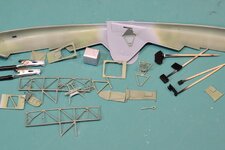
1/48 Eduard Westland Lysander Mk.III

Ad: This forum contains affiliate links to products on Amazon and eBay. More information in Terms and rules

Grant Barr

Senior Airman
Time to kick off the thread for the next build on my list. After having just completed an old Classic Airframes kit it is refreshing to open the box on a much newer kit from Eduard (although I understand this may be a re-box of the Gavia kit).
001_Box Lysander.jpg
(Box art shot courtesy of Scalemates)

The box contents are quite comprehensive, with 4 main sprue trees in grey styrene and 1 in clear, along with some neat resin parts and two PE sheets. One PE sheet is straight brass, with the other cockpit sheet being the pre-painted fare we've come to expect from Eduard.
002_Lysander Instructions Decals PE & Masks.jpg 003_Lysander Styrene Sprues & Resin Blocks.jpg

Even though it is a limited-edition kit with some extra resin and PE goodies, but I could not resist the temptation to add some more after-market bits to this. SBS make a very nice resin engine, cowl and prop for the Eduard/Gavia kit, and I acquired this not too long after buying the Lysander.
004_SBS Aftermarket Engine & Prop.jpg

This boxing of the Lysander provides options and decals to support 7 different paint schemes, although three are variations on a theme for Finnish aircraft, two being in standard UK daytime finish and one each for the East Indies and night operations schemes.

I had originally intended to do one of the standard daytime versions, but another kit I have further down the "build list" has prompted me to choose again. I have opted to do the Option B, which is a Finnish Lysander with a white limewashed paint scheme.
005_Instructions Lysander_Page_15.jpg

To do this paint scheme, the plan is to show the aircraft sometime after the limewash was applied, once the white paint has been subject to wearing back down to the original paint scheme. So to achieve this effect I will need to first paint the standard olive green/black camouflage used by the Finnish AF as shown below.
006_Instructions Lysander_Page_20.jpg

Once this paint scheme is complete, I can then apply a very thin covering of a whitewash colour to simulate a worn winter camouflage. With luck I won't get too heavy handed with this and end up with an interesting, weathered finish. I really do need to practice this type of affect as I have a pending build that has quite some personal significance and I want to have the skills to get that one right.

I have made a start on the initial steps to building the cockpit up. There are a lot of small, delicate and very fragile parts for the cockpit, and they all need to be carefully removed from the sprues and cleaned up ready for assembly/paint. I will be taking my time at this point as I have been known to "rush" the early stages of a build, wanting to "get it done"!

I don't have any photos of parts clean up (it's all a bit too boring to document to be honest) but will hopefully have some shots of assembled/painted components in the next post.
 
I like the worn lime wash idea, you can have good fun with this. :lol:
Certainly can Vic. I really want to use this kit as practice for doing a heavily weathered limewash finish as I have a captured Japanese aircraft that my father was personally involved with at the end of the war. This aircraft was also limewashed white and was quite heavily weathered in the photos that I have to hand. Fingers crossed, I can get this one right and use it to fine tune any issues I may encounter.
 
Moving into the build proper now. I have removed all the parts required to construct the cockpit and cleaned up all the mold seams and attachment gates. Luckily, most of the seams are quite fine and the attachment gates are smallish and mostly in positions that are not difficult to clean or will not be obvious on the finished product.

I elected not to take any shots of this work – it's nothing special and there was nothing noteworthy on this step. Once cleaned up, I hit them with some grey undercoat to see what the initial work looked like and to provide a base on which the colour coats would get some purchase.

All the paints used on this kit will be Vallejo Acrylic (unless otherwise noted). I have some experience now with this paint brand and am getting more and more confident that I will achieve the desired outcome with it.
007_Interior Parts Cleaned Up & Painted.jpg

I did take a shot of cockpit parts and fuselage interior once I had a coat of colour on them, shown above. For the black I went for a dirty black by mixing in some interior green and yellow to tone it down.

For the interior green I tried something a bit new for me. I sprayed all the parts the base interior green and then added some black to get it about 3 shades darker and sprayed all parts from the bottom up. Then I went 3 shades lighter and sprayed again from the top down. It's a bit hard to see the result in this photo, but when the parts are placed side by side with the base colour you can really see the difference.

After taking that shot, I sprayed the parts with a fine layer of gloss clear. This allows me to add some dirt and grime to the interior without getting the messy "tide marks" that appear with a matt finish.

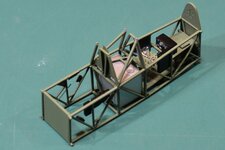
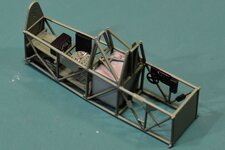
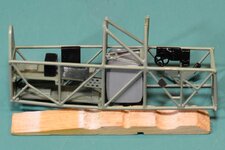
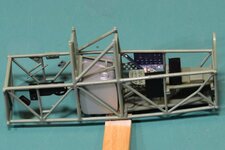
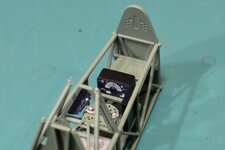
There is quite a bit to unpack from the next lot of photos, starting with the first major assembly sequence in the instructions. Putting the tubular framework together around the cockpit parts proved a bit of a challenge. My biggest issues were, firstly, the alignment of the longitudinal and lateral frame pieces. I ended up waiting until the glue was tacky and popping the frame into the fuselage halves to make sure it all lined up. The second issue revolved around the fuel tank. There are a couple of tiny alignment lugs on the side of the fuel tank that, at least in theory, mount the tank at the right height in the frame. Wrong!! It puts the tank too high in the framework and won't allow the PE brace piece to fit above it. This PE part is very flimsy and does not tolerate too much jiggling about. I ended up breaking the tank back out, removing the lugs and resetting the tank with some CA glue into the right location.
008_Interior Assembly Step1 LHSF.jpg 009_Interior Assembly Step1 RHSF.jpg 010_Interior Assembly Step1 RHSC.jpg
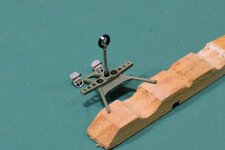
011_Interior Assembly Step1 LHSC.jpg 012_Rear Seat & Radio Close Up.jpg 013_Flight Controls.jpg
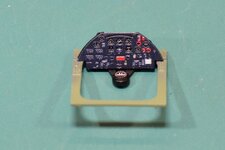
014_Instrument Panel.jpg 016_Pilot Surround & Wing Mount Panel.jpg

Happily, they were the only real issues I faced. Everything else just fell together (at least so far). I must note how nice the PE instrument panel looks – way better than I could ever hope to do with a brush and paints. The belts also came up quite well, but I think some layers of dirt might help tone them down a bit.

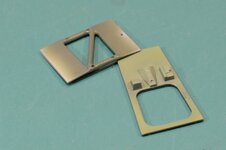
The last photo is highlighting the tonal variance between the underside of the wing mount panel and the top of pilot surround panel. When placed side-by-side like this the difference really pops out. Hopefully this will produce some subtle variations in the cockpit once the glass goes into place.

Having gotten this far with the interior & whilst waiting for things to dry/set I moved on to assembly of the resin engine from SBS. The detail in this resin set is amazing – there is no comparison between the styrene parts supplied with the kit and this stuff.
017_Resin Engine Build_1.jpg 018_Resin Engine Components.jpg

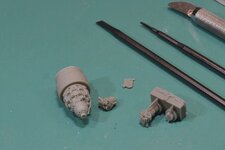
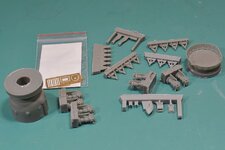
The first shot shows making a start on removing the pieces from their mold blocks and cleaning up any seams or rough edges. The second shot is a quick look at all the remaining parts in this engine kit. Except for the inlet manifold pipes the parts are well molded and free from bubbles. Sadly the being the smallest parts the inlet manifolds do have some holes, especially where the pipes split to route up to the cylinder heads. I'll clean these up as best I can and fix the holes with some Mr Surfacer 500.

That's about all that I have documented at this point. I'm hoping to make some more progress this weekend before I have to take off for a couple of weeks. With luck I'll find some time for an update during next week.

Thanks for dropping by with feedback and reactions.
 
Nice and tidy work, Grant, the kit is really well detailed, with perhaps one exception:
-shouldn't there be small windows at the rear of the fuselage just before the tail?
Hi Hal - I have seen some shots of Lysander's with the window and some without, but to be perfectly honest, it's a detail I had completely overlooked. I'll do some research on whether the Finnish aircraft were so configured. Thanks very much for the heads up!
 
Not all Lysanders had a glazed panel in the rear hatch (not sure, but may be dependant on Mark, or just painted over).
The "window" was circular on Canadian-built aircraft, and rectangular on Westland - built aircraft, and those photos I've seen of Westland aircraft in Finnish service had the rectangular window.
 
Not all Lysanders had a glazed panel in the rear hatch (not sure, but may be dependant on Mark, or just painted over).
The "window" was circular on Canadian-built aircraft, and rectangular on Westland - built aircraft, and those photos I've seen of Westland aircraft in Finnish service had the rectangular window.
Thanks Terry. I have not been able to locate a lot of photos of the Finnish Lysanders, but the few I've seen appear to have the full-size rectangular window. It's a bit bizarre that a detail like this was overlooked by Gavia/Eduard. Perhaps the molds were based off an extant Lysander that was so configured?

Time to get out some plastic surgery tools!! Is it weird that I am looking forward to doing this? My wife thinks I need "help"....
 
Moving on with this build now.

I have now completed enough engine sub-assemblies to apply some paint. The engine details on the resin parts now really start to stand out. As I've already mentioned, the detail on these resin parts is superb. It's a real pity that 95% of this detail will not be seen once the cowlings are in place.

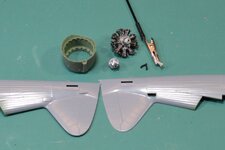
In the shots below you can see a sample of the painted parts. The engine and the cowl both need some further colour added to pick out some of the detailed bits, even on the back of the engine which won't be seen – but I'll know it's there…
019_Painted Sub-Assemblies & Parts.jpg 020_Engine Rear Detail.jpg

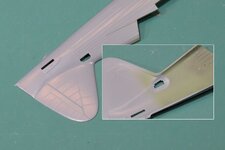
I've also started down the path of cutting out the small square window just below the vertical stabiliser. My thanks again to hal bregg hal bregg for catching this problem and Terry ( Airframes Airframes ) for confirming what shape it should be.

021_Fuselage View Window LHS.jpg

I am pleased with how the window opening has turned out. Now the shape is set, and a small step-down recess has been gouged out, I can make the window panel itself from some 0.13mm clear styrene sheet I have to hand. If I get this right then the clear sheet should sit snugly into the recess, flush with the fuselage. Fingers crossed! I also carved out some of the plastic thickness from the inside to help with the appearance of the window at the edges. It's one of those little details that also bug me about canopies as well, but they are really difficult to thin down and still mount effectively (not mentioning the issues that can cause with cockpit internal details).

I was hoping to get some more done by this point, but it is where it is.

I won't be adding to this thread much over the next couple of weeks whilst I am away. I may not be able to do anything on the workbench, but I hope to use some of the time productively on a bit more research on the Lysander.
 

Users who are viewing this thread

Back