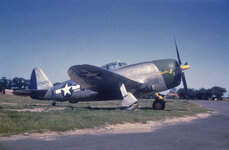
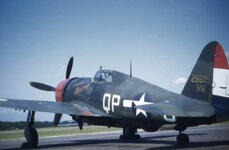
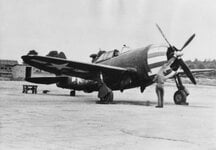
I can see (and appreciate) the big picture in all this but my main question pertained to why so many ETO fighter groups equipped with Mustangs were going to be issued P-47N's prior to transfer to the Pacific. Was it to spread the production out between defense plants, was P-51 production maxed out in CA and TX and Republic had excess capacity?
The title 8th Air Force moved to the Pacific, along with a few people like General Spaatz. The following from Air Force Combat Units of World War II Author: Maurer, Maurer Date: 1986
4th FG Moved to the US in Nov 1945. Inactivated on 10 Nov 1945. Activated on 9 Sep 1946. Equipped with P-80's. Converted to F-86 aircraft in 1949.
359th FG, Returned to the US in Nov 1945. Inactivated on 10 Nov 1945. Redesignated 123d Fighter Group. Allotted to ANG (Ky) on 24 May 1946
364th FG, remained in England until Nov 1945. Returned to the US. Inactivated on 10 Nov 1945. Redesignated 131st Fighter Group. Allotted to ANG (Mo) on 24 May 1946.
No mention of P-47 in any of them. Is the idea they received P-47 in Britain post VE day? The P-47D in Europe had some significant differences to the P-47N. The fighter units of the 9th and the US part of the 1st TAF were P-47 dominated, the 9th had 1 P-38, 12 P-47, 3 P-51 groups. The P-51 was a latecomer to the Pacific but numbers were growing in 1945.
US fighter production was falling in 1945 as losses dropped and the end of the war in Europe became apparent. P-38 production was around 300 a month in January 1945, to 250 in April and kept decreasing until ending with 53 in August. Around 540 P-47 in February 1945 as the N model ramped up, stayed that way until June when it fell to above 400, then 157 in August. Like the P-47 the P-51 had a significant model change, to the H, 820 odd P-51 in January 1945, still 700 in June and 570 in July, before production wound down. P-63 continued around the same levels in 1945 until mostly ending in June. P-80 production had its gaps, hit a peak of 66 in December 1945. To an extent all part of the planning that saw trainer production hit peaks in late 1942, drop significantly in 1944 to replacement levels by end year, falling further in 1945
The ETO/MTO fighter groups were relatively late movers. Post VE day the US ETO requirement for POL actually increases as troops and supplies are redeployed. To give the required troop lift post VE day 200 liberty ships are converted to 550 man troop transports by October and 100 victory ships to 1,500 man transports by November.
In June 1945 around 375,000 men depart the inactive theatres, about 20,000 for the Pacific, the rest for the US. There were 56,000 returned to the US by air and 236,000 by sea from Europe. Ninth army HQ is redeployed heading for the Pacific.
In July 1945 around 450,000 men depart the inactive theatres, about 80,000 for the Pacific, the rest for the US.
In August 1945 around 420,000 men depart the inactive theatres, about 180,000 for the Pacific, the rest for the US.
In September 1945 around 290,000 men depart the inactive theatres, about 80,000 for the Pacific, the rest for the US.
The US Army had 7 divisions in Italy and 61 in France/Germany in March 1945, down to 7 and 50 by end July.
Many of the early departures were people who had the least overseas time, meant to end up in the Pacific, the 86th and 97th infantry divisions originally meant for the Pacific but sent to Europe as a result of the Ardennes offensive, they, along with the 95th and 104th left Europe in June, the 86th and 97th arrived in the Pacific (Philippines) in September.
Sadly there were next to no plans to reoccupy any of SEA beyond Singapore and the Borneo operations carried out between May and July 1945.
Note I said allies and parts of South East Asia where there was a lot of oil, rubber and tin, whose populations were beginning to starve. The end of major amphibious operations in Europe by the end of 1944 freed a lot of British controlled landing craft for the war against Japan, along with military forces and shipping. Retaking key parts of Asia had political, military and economic advantages. As far as I know there were at best ideas about operations in Thailand (Neutral as far as the US was concerned), French Indo China and further north, while the plans were to only take key points of the Dutch East Indies.
The split with US forces leaving the South West Pacific Area had begun with the Philippines operations which also saw a shift from taking key points to clearing the Japanese from the entire country, requiring more forces. There was still a sizeable USMC etc. air force in the Solomons. Rabaul in particular kept being bombed. The down side of bypassing enemy forces is the need to keep watch over what had become your rear areas. The Australians found themselves doing combat operations from the Solomons to Borneo and beyond, which is why the RAAF in the Pacific was expanding in 1945, partly as the need to supply its forces in Europe largely ended around late 1944/early 1945. The supply requirements for the invasion of Japan were immense, the US trans continental rail links could not handle the freight, ships were being loaded on the US east coast. Non US forces were going to complicate this further.
Operation Zipper was far enough advanced it became exercise Zipper the post war move in Malaya. Non political reasons for the operation included Singapore as port and base. Pre war nearly 80% of the world's rubber was produced in Malaya and the Netherlands East Indies and around 2/3 of the world's tin supplies as well. By the looks of things around 75% of the rubber and around 90% of the tin went to Canada and the USA. There was hemp in the Philippines (for rope, not smoking, Manila). The US, in the 1940's, was as close to an autarky as was possible, short only bauxite and rubber when it came to making a modern war machine. The US synthetic rubber project, which used the same techniques as the German one, is reported to have been larger than the Manhattan Project. Ending the need for that would free resources and help the British earn hard currency while easing the rubber shortage.
Pre war in South East Asia Burma exported around 3 million tons of rice, Indo China and Thailand around 1.5 million tons each out of a total production of around 14.4 million tons. Losing Burma started the road to the Bengal Famine in 1943. Malaya needed 700,000 tons of rice a year pre war, it received 94,000 tons in 1944 and 12,000 tons in 1945, rice went from $6 to $7,500 between December 1941 and August 1945. Living in Malaya in 1945 required an adult male to get by on 1.8 kg (around 4 pounds) of rice a month, 1.2 kg for a female, compared with 10.5 kg pre war. Thailand built up a 1,000,000 or so ton rice reserve (the Thais ran the economy, the Japanese the transport), which really helped post war. The British wrote into the peace agreement with Thailand the requirement for the Thais to deliver 1,500,000 tons of rice at cheap prices (given the prices then being charged). There was French Indo China, where the famine death toll in 1945/6 was around 800,000 to 2,000,000. See Food Supplies and the Japanese Occupation in South East Asia. The US Army cut rations in the ETO in 1945, the world was very food insecure.
Thai Burma railway figures, 46,000 POW of which 1 in 3 died, around 75,000 Burmese and 75,000 Malay labourers, 3 out of 7 Burmese and 1 out of 2 Malays died. The Thai Burma railway was 415 km long, meaning one labourer died for roughly each 5 metres of track and mostly non allied military personnel.