Advanced French Fighters vs 1942/1943 contemporaries (2 Viewers)

Ad: This forum contains affiliate links to products on Amazon and eBay. More information in Terms and rules

The US & Uk were both looking at going to fuels with ~200 rich mixture ratings, but these fuels would have been significantly more expensive than the already not cheap 115/145 grade (toward the end of the war the cost of 115/145 was about 2x the cost of 100/130). Along with the other advantages of the jet engine, the US & UK jet engines in the late-1940s used a form of kerosene, or kerosene mixed with 87 octane petrol - both of which were relatively cheap in comparison even to 100/130 grade.
 
Last edited:
Going back to some earlier posts about superchargers and efficiency.
Superchargers are balancing 3 things.
1, airflow in mass (weight) per unit of time.
2. pressure ratio (output pressure times input pressure)
3. Efficiency, which is how much power is actually being used to achieve the results vs the power being put into the drive shaft of the supercharger.

Problem here is that peak efficiency is never achieved at either max air flow or at peak pressure. And trying for close to max air flow and close to max pressure ratio can really affect efficiency.
This is also a spiral.
Lower efficiency means more power wasted in the supercharger which means the air is heated more for the same amount of compression (pressure rise) which means both less actual airflow (mass) and the higher temperature of intake air means higher temperatures in the cylinders and a higher exhaust temperature. This actually pretty much flows right through. 100 degrees more intake temperature means 100 degrees more temperature in the cylinder (not necessarily 100 degrees more temperature to the cooling system but something to worry about) and the exhaust gas temperature also goes up just about the same 100 degrees.
Now add that to the fact that if you raise the intake pressure from 38in to 42in you are burning just under 10% more fuel and air per stroke for 10% more heat per cycle and we can see that supercharger efficiency gets real important very quickly and we can also see that engine cooling, especially for air cooled engines, gets real important very quickly.
A supercharger that is 75% efficient and required 100hp to get the required airflow at the required pressure (very efficient for most of WW II) is turning 25hp into pure heat, over and above the heat caused by the increase in pressure. About 62,500 BTUs over and above the heat of compression.
I will note that just the Aux supercharger of the R-2800 on the F6F needed over 300hp to drive it. It was not a very efficient supercharger.

The flip side is that putting a really big supercharger on an engine means you are driving a larger than needed supercharger at cruise settings and throttle the engine down to an in-efficient zone also. You won't over heat the engine but you will shorten the range at lease slightly.
 
Going back to some earlier posts about superchargers and efficiency.
Superchargers are balancing 3 things.
1, airflow in mass (weight) per unit of time.
2. pressure ratio (output pressure times input pressure)
3. Efficiency, which is how much power is actually being used to achieve the results vs the power being put into the drive shaft of the supercharger.

Problem here is that peak efficiency is never achieved at either max air flow or at peak pressure. And trying for close to max air flow and close to max pressure ratio can really affect efficiency.
This is also a spiral.
Lower efficiency means more power wasted in the supercharger which means the air is heated more for the same amount of compression (pressure rise) which means both less actual airflow (mass) and the higher temperature of intake air means higher temperatures in the cylinders and a higher exhaust temperature. This actually pretty much flows right through. 100 degrees more intake temperature means 100 degrees more temperature in the cylinder (not necessarily 100 degrees more temperature to the cooling system but something to worry about) and the exhaust gas temperature also goes up just about the same 100 degrees.
Now add that to the fact that if you raise the intake pressure from 38in to 42in you are burning just under 10% more fuel and air per stroke for 10% more heat per cycle and we can see that supercharger efficiency gets real important very quickly and we can also see that engine cooling, especially for air cooled engines, gets real important very quickly.
A supercharger that is 75% efficient and required 100hp to get the required airflow at the required pressure (very efficient for most of WW II) is turning 25hp into pure heat, over and above the heat caused by the increase in pressure. About 62,500 BTUs over and above the heat of compression.
I will note that just the Aux supercharger of the R-2800 on the F6F needed over 300hp to drive it. It was not a very efficient supercharger.

The flip side is that putting a really big supercharger on an engine means you are driving a larger than needed supercharger at cruise settings and throttle the engine down to an in-efficient zone also. You won't over heat the engine but you will shorten the range at lease slightly.
Yes. The "infernal spiral" of compression is very well described. Supercharger efficiency is fundamental to the problem.

To solve the problem of "overly" powerful centrifugal S/C, attempts were made to vary their rpm according to real engine needs. Many nations designed two-speed or even three-speed gear drives; the Germans perfected infinite—or almost infinite—variability via an impeller with hydraulic coupling on the DB 601.

In France, a very unique approach was achieved with the Planiol/Szydlowski supercharger, in which the internal aerodynamic characteristics varied in order to adapt the compression ratio, and therefore the volume and temperature of air supply to the engine, according to altitude. The system was copied by the Germans and Soviets in what Callum Douglas called the "swirling throttle," with designs that incorporated all or part of Planiol and Szydlowski's concepts, that were published as early as 1937.
 
Last edited:
The system was copied by the Germans and Soviets in what Callum Douglas called the "swirling throttle," with designs that incorporated all or part of Planiol and Szydlowski's concepts, that were published as early as 1937.
(my bold)
That is a bold statement (no pun intended).
 
(my bold)
That is a bold statement (no pun intended).

I don't think so.
Second-generation Soviet superchargers create a rotational motion for the air entering the S/C. By varying the amount of this rotation, the angle at which the airflow meet impeller blades is varied. In other words, a variable-pitch impeller is created, allowing optimized operation over a very wide airflow speed range.

This is exactly what Planiol and Szydlowski patented in July 1936:

You see a same design in recent German S/C, notably that of the Jumo 213.

Chronology clearly shows where the original is and where the copycats are.

It had been my idea from a while... and long after, Callum Douglas documented it under the name "swirling throttle" in his THE SECRET HORSEPOWER RACE, as I mentioned above.
 
You see a same design in recent German S/C, notably that of the Jumo 213.

Chronology clearly shows where the original is and where the copycats are.
S-P system used radial vanes to control the flow. Soviet system, copied by Germans, used axial vanes.

It had been my idea from a while... and long after, Callum Douglas documented it under the name "swirling throttle" in his THE SECRET HORSEPOWER RACE, as I mentioned above.

Did Calum made a statement that Soviets and/or Germans copied the S-P system?
 
S-P system used radial vanes to control the flow. Soviet system, copied by Germans, used axial vanes.


Did Calum made a statement that Soviets and/or Germans copied the S-P system?

Axial or radial, the process aims to achieve the same thing: to create and control a swirling inlet flow before it meets impeller blades.

"The swirl throttle is [nowadays] still not quite a consumer product nearly three quarters of a century after its application as a German fighter aircraft engine supercharger control system - itself originating from the work of by Szydlowski-Planiol and then adapted to axial form by the DVL and then by the Russian engineers Mikulin and Polikovsky"

Callum Douglas, "The secret horsepower race", page 426.

These words answer your two questions.

I should add that D. Callum doesn't seem to suspect that the Russian system could have come directly from Hispano-Suiza without passing through Germany. Yet it's a very real possibility, especially if we consider that the VK-107's differential induction process (so strange and peculiar...) is directly copied from that of the Hispano-Suiza 12Z, patented by Marc Birkigt in 1937. There are threads in this forum about this.
 
Axial or radial, the process aims to achieve the same thing: to create and control a swirling inlet flow before it meets impeller blades.
"The swirl throttle is [nowadays] still not quite a consumer product nearly three quarters of a century after its application as a German fighter aircraft engine supercharger control system - itself originating from the work of by Szydlowski-Planiol and then adapted to axial form by the DVL and then by the Russian engineers Mikulin and Polikovsky"
Callum Douglas, "The secret horsepower race", page 426.
These words answer your two questions.
I should add that D. Callum doesn't seem to suspect that the Russian system could have come directly from Hispano-Suiza without passing through Germany.


The 1st engine using the Polikovsky's device was the AM-34 FRN, as it can be discerned by looking at the power curve posted here, for example. Engine 1st displayed in the 'West' in 1937, at the Paris air show.
The NACA technical memorandum no.1169 - a translation of the German DVL report on the Mikulin engines - says that the device is of 'purely Russian origin'.
 
The 1st engine using the Polikovsky's device was the AM-34 FRN, as it can be discerned by looking at the power curve posted here, for example. Engine 1st displayed in the 'West' in 1937, at the Paris air show.
The NACA technical memorandum no.1169 - a translation of the German DVL report on the Mikulin engines - says that the device is of 'purely Russian origin'.

No Paris Air Show in 1937. Only in even-numbered years.

What is mistakenly referred to as the "Paris Air Show 1937" is actually the 1937 Exposition internationale des arts et techniques dans la vie moderne (International Exposition of Art and Technology in Modern Life) held in Paris.

But it actually occurred much later after Planiol and Szydlowski's patent. I repeat, chronology is merciless.

And it must also be remembered that the French aeronautical press in the 1930s spoke very liberally about everything that happened in the workshops and laboratories. It was only after Munich that the government (formed by the Socialist-Communist Popular Front coalition) decided to fight the disclosure of military secrets. A little late...
 
No Paris Air Show in 1937. Only in even-numbered years.

What is mistakenly referred to as the "Paris Air Show 1937" is actually the 1937 Exposition internationale des arts et techniques dans la vie moderne (International Exposition of Art and Technology in Modern Life) held in Paris.
Okay.

But it actually occurred much later after Planiol and Szydlowski's patent. I repeat, chronology is merciless.

Polikovsky made a different device, in a merciless and timely fashion.
Unless you have a definite proof that he copied the French device, I'd still call the accusation of copying as a false one.
 
Okay.


Polikovsky made a different device, in a merciless and timely fashion.
Unless you have a definite proof that he copied the French device, I'd still call the accusation of copying as a false one.

He did not copy the mechanism, which is different, but used a principle already developped and exploited by Planiol and Szydlowski.

This is indisputable.

Afterwards... whether this is a deliberate copy or a simple coincidence is indeed subjective. Personally, I think about the first hypothesis, given the context of international relations in the 1930s, and in particular the numerous cases of URSS intelligence against Western countries.

To further clarify the debate, the true sentence in NACA TN 1169 report (translated from German) is : "Because the swirl throttle has never been found on other engines up to the present time, the assumption may be made that this throttle is a purely Russian development".

So this is a supposition, not a certainty. And not an origin, but a develoment.
 
He did not copy the mechanism, which is different, but used a principle already developped and exploited by Planiol and Szydlowski.

This is indisputable.

Afterwards... whether this is a deliberate copy or a simple coincidence is indeed subjective. Personally, I think about the first hypothesis, given the context of international relations in the 1930s, and in particular the numerous cases of URSS intelligence against Western countries.
As it can be easily verified, Polikovsky used the different set-up of the vanes. Claiming that he was merely copying the French device is a selling the man short.

To further clarify the debate, the true sentence in NACA TN 1169 report (translated from German) is : "Because the swirl throttle has never been found on other engines up to the present time, the assumption may be made that this throttle is a purely Russian development".

So this is a supposition, not a certainty. And not an origin, but a develoment.

It torpedoes the notion that Soviet device was a continuation from the German development, such the claim being quoted above. Ditto for the notion that it is a copy of the French device.
 
Yes. The "infernal spiral" of compression is very well described. Supercharger efficiency is fundamental to the problem.

To solve the problem of "overly" powerful centrifugal S/C, attempts were made to vary their rpm according to real engine needs. Many nations designed two-speed or even three-speed gear drives; the Germans perfected infinite—or almost infinite—variability via an impeller with hydraulic coupling on the DB 601.

In France, a very unique approach was achieved with the Planiol/Szydlowski supercharger, in which the internal aerodynamic characteristics varied in order to adapt the compression ratio, and therefore the volume and temperature of air supply to the engine, according to altitude. The system was copied by the Germans and Soviets in what Callum Douglas called the "swirling throttle," with designs that incorporated all or part of Planiol and Szydlowski's concepts, that were published as early as 1937.

Allison also used hydraulic variable speed drives on their two stage engines.
 
What is mistakenly referred to as the "Paris Air Show 1937" is actually the 1937 Exposition internationale des arts et techniques dans la vie moderne (International Exposition of Art and Technology in Modern Life) held in Paris.
Thank you. I was not aware of that expo.
I repeat, chronology is merciless.

While I agree that chronology is merciless one must never discount parallel development.

In many cases, and in many fields, two people in different continents or countries invented what is essentially the same concept.

This is just an observation - not a claim that the Russians did, or did not, get their ideas from others.
 
Last edited:
For those not familiar with the history of gas turbine engines, the modern gas turbine engine was invented some ten years before Frank Whittle was even born. Steam turbines long predate that.

In France a team invented a gas turbine shaft engine with the intention of using it to power electricity generators. The initial test engines showed enough promise that a full size engine was built which failed to deliver anywhere near its designed output.

In the USA Stanford Moss invented a gas turbine shaft engine with the intention of using it to power electricity generators. His never got to the stage where they built a full size engine but he went on to develop turbochargers for General Electric and when the Whittle designs were supplied to the US he was the man who built the first US gas turbine jet propulsion engines.
 
Last edited:
The Gas turbine idea may well predate WW I.
Turning it into hardware was a real problem. The early compressors were horribly inefficient, needed much more power to run than estimated and not supplying either the estimated volume of air or the estimate pressure. The turbine section may also have not performed as estimated. The few actual trials that were done had engines that could barely sustain combustion in the combustion chambers and often needed assist from an outside power source even to do that. They had no surplus power to power anything, like an air compressor for industrial use. These early turbine engines were around 10 times heavier per horsepower than later (WW II) engines, planned HP, not what they achieved.

Some websites leave out certain things.
Early Gas Turbine History — MIT Gas Turbine Laboratory

Mentions using a turbo charger to increase power on a diesel engine in 1923.
Completely skips Stanford Moss's early work and his work with a turbo charged Liberty engine mounted on a truck on Pike's Peak in 1918.
Also skips " he went on to Cornell where, in 1903, he wrote his Ph.D. thesis on the gas turbine." He was 31 years old at the time.

Theory needed a few decades for materials (steel, aluminum, exotic alloys) to catch up. Small details in theory also needed to catch up. Like how many stages you need in an axial flow compressor actually get a 3.5-4.0 compression ratio or what kind of compression ratio you can get out of a single centrifugal compressor.

Von Ohain used sort of a 1 and 1/2 stage ( 1/4?) compressor.
330px-HeS_3_Turbojet.jpg

14 blade axial "inducer" with no stationary stator blades before the 16 blade centrifugal compressor. Wiki claims a 2.8 overall compression ratio?

Some of the S-P superchargers used 3 such axial "inducers" ahead of the main centrifugal compressor. Actual inlet was not great.
 
Returning to piston engines...

I was recently reading the memoirs of Arthur Alexander Rubbra, chief engineer at Rolls-Royce. He recalls that during the first tests of the Kestrel (1927), it was discovered that the geared supercharger hindered the intake and that the power was lower than that of the naturally aspirated engine (!!). This blamed the entire S/C: intake design, impeller internal design, and vanes before and after impeller...

"Tests indicated a maximum efficiency of around 37%".

In short, a far cry from the formidable Merlin supercharger. This demonstrates how rapidly technology has evolved over these years.
 
In fact, the adjustable vanes to control the impeller flow originally named after Stechkin-Polikovsky - the main merit in their development belonged to Boris Stechkin, but he was repressed in 1939, and his name was no longer mentioned.
The AM-34FRNA engine was demonstrated in Paris in 1937, with no guide vanes.
According to Kotelnikov the installation of Polikovsky's blades in the FRN-5 supercharger was made by Flissky on the AM-35A in June 1938 (it was Flissky who was the leading designer of this engine), and initially the engine was equipped with the FN-35 supercharger without adjustable guide vanes. The designs of Stechkin-Polikovsky and Szydlowski-Planiol vanes are different.
H-S 12Y:
1757449578899.jpeg

VK-107A:
1757451759022.png
 
In fact, the adjustable vanes to control the impeller flow originally named after Stechkin-Polikovsky - the main merit in their development belonged to Boris Stechkin, but he was repressed in 1939, and his name was no longer mentioned.
The AM-34FRNA engine was demonstrated in Paris in 1937, with no guide vanes.
According to Kotelnikov the installation of Polikovsky's blades in the FRN-5 supercharger was made by Flissky on the AM-35A in June 1938 (it was Flissky who was the leading designer of this engine), and initially the engine was equipped with the FN-35 supercharger without adjustable guide vanes. The designs of Stechkin-Polikovsky and Szydlowski-Planiol vanes are different.
H-S 12Y:
View attachment 846451
VK-107A:
View attachment 846453

No one disputes that these two superchargers are constructed differently.

However, their operating principle is identical : a process based on adjustable vanes that create an inlet flow with helical motion - a "swirling" motion. The adjustable vanes allow controlling the angle of attack of this flow relative to the S/C impeller. In other words, everything happens as if the impeller had variable pitch.

This variable pitch considerably increases the supercharger's maximum efficiency range, and this is the true value of the invention—much more than simply controlling the airflow through the engine.

The difference between the two S/C lies solely in their construction: the adjustable vanes are radial in the French supercharger and axial in the Russian model. AND THAT'S ALL.

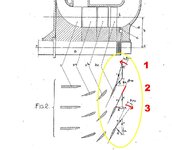
Below is the drawing of the Planiol-Szydlowski patent : it clearly shows the variations of airflow angle of attack relative to the first S/C wheel, alternately positive, neutral, or negative.
 

Attachments

  • Planiol Sz 1.jpg
    Planiol Sz 1.jpg
    81.3 KB · Views: 13

Users who are viewing this thread

Back