Hi Hardwarefreak,
>1. Excellent stable gun platform, no engine torque or rudder trim issues
Hm, the British Purchasing Commission noted that the P-38 required constant directional re-trimming after each power change because the two engines would never arrive at exactly the same power setting.
Hello HoHUn,
The British Purchasing Commission received 'castrated Lightnings', with Allisons that rotated in the same direction, and without the GE turbochargers. This was their own doing as they didn't want the counter rotating engines that were required to make the P-38 work properly. They wanted the same engine in both nacelles to ease maintenance. This caused lateral torque problems, and is more to blame for their re-trimming issues than uneven throttle settings. If they'd have purchased the Lightning as it was designed, they'd not have had this issue. Or, at least, not to the extent that they did.
>2. Tightly grouped/focused battery of 5 guns
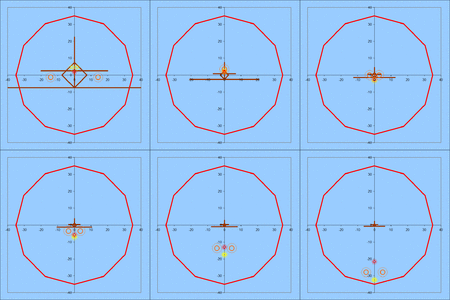
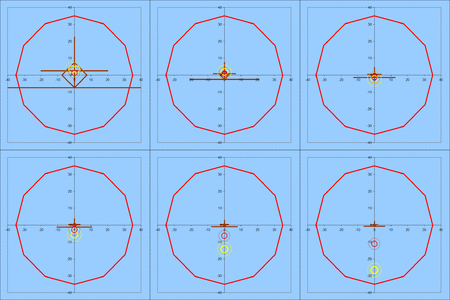
We agree on that. Have you seen the animated GIF above?

Absolutely. This is the main reason I vote for the P-38 as the answer to the question of this thread. If, for some odd reason, Lockheed had given it wing guns instead, I wouldn't even consider the P-38. And yes, those GIFs are kinda neat. I'm not sure how accurate they are, but they give an excellent graphical understanding of static trajectory. Unfortunately, most aircraft that were being fired upon were likely making evasive maneuvers.
Focused fire that does the maximum amount of damage in the smallest area is what kills vehicles the best, whether it's aircraft, tanks, trucks, etc. By disrupting the structural integrity of the vehicle, said vehicle will then, in essence, due to gravity or locomotion, destroy itself. If you destroy the integrity of a wing spar by punching enough holes in it, the wing is going to fold and come off the airplane, same with the tail spar(s). If you punch a hole though the turret of a tank with a high velocity AP round, the friction resulting from the high velocity round passing through the steel turret is going to create thousands of globs of molten steel. This often would ignite the ammunition magazine in the turret and thus blow the turret off the tank. Concentrated fire on the tracks of a tank or half track would often sever or damage a track link. If the vehicle then attempts to get underway, the track binds up and shreds itself. In essence, you make the vehicle destroy itself by introducing failure with concentrated localized damage. The P-38 was great at this because of its tightly grouped gun battery.
>No matter where the stream hit, serious structural damage was a result. Engine, wingroot, outer wing panel, cockpit, rear fuselage, tail--it didn't really matter.
Do you have a source on that?
That's not a direct quote from a print or web source. It's my own statement based on a combination of things, those being, mainly, episodes of Discovery Wings over the years with many pilot interviews, and videos of static tests of the P-38 gun battery against 1/2" steel plate and some airframes at various distances and angles, conducted by the USAAC. If a P-38 missed, it missed. But when it hit, it literally shredded the area it hit because of the tight grouping of the guns and the resulting large amount of ammo penetrating a small area on the target. I've also seen video of similar tests conducted on the "gun trucks" of the Vietnam war era. The gun spacing of the quad .50 turret in these trucks was a little wider than that of the P-38 gun battery, but the effect was very similar. Obviously the damage wasn't quite as extensive without the Hispano. Nonetheless, the gun truck quad .50 would also shred 1/2" steel plate out to 300 yards with few deflections even up to very steep off angle shots. At 70 degrees off angle, the number of ricochet rounds started increasing quite a bit. Keep in mind this is flat 1/2" steel plate. There are only 3 locations where this would be found on a fighter airframe (and it wouldn't be completely flat). These would be around the cockpit sides and floor, possibly around the fuel tank behind the cockpit in the rear fuselage, and under the engine cowling or bolted to the engine cradle. The .50 Browning, as with most .50 ammo of WWII from any nation, had zero problems penetrating the aluminum skin of any aircraft, and still had plenty of energy left to damage internal aluminum structural members, or to penetrate steel armor plate under the skin. The AP and standard 'ball' ammo of the 20mm was even more effective here. The reason the .50 Browning was more effective in the P-38 than many other US fighters mounting the same gun is the concentration of so many .50 projectiles in a confined area on the target. There's nothing magic about this, just simple physics. And, again, given the penetration power of the .50 BMG round, 10 to 20 of these rounds, combined with a couple of 20mm Hispano rounds into the same area, was often enough to destroy a wing spar or fuselage bulkhead causing structural failure of the airframe. The result was a wing or tail coming off the airplane due to the aircraft's speed and G load. If the cockpit area was hit, the armor plate was of little value and the .50s and 20mm would go right through it killing the pilot. Hits to the engine cowling would easily penetrate the steel armor plate and have sufficient kinetic energy remaining to damage the intake tubing, oil cooler lines and fuel lines. After the first few rounds weakened the armor plate, those following in flight would likely penetrate the engine block, igniting the fuel and oil in the engine manifold and oil passages. Add in a single hit from an AP round from the Hispno and the engine is toast in one hit, regardless of armor plate.
>This also would have yielded a cyclic battery rate of about 106 rounds/sec (assuming 800 rds/sec per gun) firing in a spread of about 2 ft x 3 ft.
Since you are new to this thread, please check out the paragraph on the "shotgun misunderstanding" above.
I've read the entire thread. I'm not sure what you're getting at here. I'm estimating that pattern as I don't know what the actual barrel spacing was on the 8 gun P-38. Obviously as the guns heat up you're going to get some fliers running around, and you'll have some variance from one gun to another, as with all aircraft. I'm not familiar with the sighting/alignment procedures the ground crews used to zero the P-38 guns. I can tell you that in the gun test videos I saw, the pattern on target was pretty darn tight.