Best armed fighter (2 Viewers)

Ad: This forum contains affiliate links to products on Amazon and eBay. More information in Terms and rules

Hi Clay,

>But I have to say that I know far more about guns than I do about aircraft, and I know that with a multitude of impacts each successive one is more damaging than the first, especially when hitting in rapid succession and creating a "stacking" effect of energy transfer. How many hits you can make is very important to how destructive any weapon is.

Hm, would you still agree that it is the product of the number of hits and the probability of kill of each hit that counts?

I'm not sure if the stacking effect is really applicable in air combat ... how quickly would have two 12.7 mm hits follow each other (and with which precision) to achieve this? A P-47 with guns converging at 300 m averages about 17 bullet strikes per second per square meter in the 75 % radius of its pattern, so the likelihood of two hits on exactly the same spot in a very shrot period is not that great.

In fact, my impression is that the advantage of high-powered explosive shells is that they concentrate a lot of damage in a localized area, similar to the stacking effect you suggest except that it only requires one hit to induce a lot of energy, which due to their ability to critically damage aircraft structure makes them more destructive than a greater number of hits of the same energy which spread the energy of a larger area.

I'm not aware of any wartime reports on this - the Luftwaffe from their gun camera films of bomber shootdowns concluded that the total amount of explosives counted, regardless of calibre. Though they preferred 30 mm cannon over 20 mm cannon, that was more due to economy of scale making the 30 mm cannon a more weight-efficient weapon ... the greate localization of damage with larger shells did not play a role for them.

Regards,

Henning (HoHun)
 
I'm not sure if the stacking effect is really applicable in air combat ... how quickly would have two 12.7 mm hits follow each other (and with which precision) to achieve this? A P-47 with guns converging at 300 m averages about 17 bullet strikes per second per square meter in the 75 % radius of its pattern, so the likelihood of two hits on exactly the same spot in a very shrot period is not that great.

It doesn't have to be the same spot, it just has to be on the same contiguous piece of metal. When a bullet strikes it, a shock wave travels through it, "ringing" it. If another bullet hits before the shock wave is expended through vibration it forces the metal to absorb more energy and dramatically decreases its' ability to distribute (and thus absorb) the force of the impact, increasing the chance of penetration or failure of structual integrity.

I agree that a 20mm give you more bang for your buck, so to speak. But successive impacts do affect armor.
 
HI Clay,

>When a bullet strikes it, a shock wave travels through it, "ringing" it.

Hm, how long does it usually take for the shock wave to dissipate?

Regards,

Henning (HoHun)
 
HI Clay,

>When a bullet strikes it, a shock wave travels through it, "ringing" it.

Hm, how long does it usually take for the shock wave to dissipate?

Regards,

Henning (HoHun)
It would depend on the mass of the armor and angle of impact, a second would be my guess for a pilot armor plate, hit it twice in the same burst and the second round would have much more chance of going through.

I've seen .50s tear armored land vehicles to shreds both from the ground and strafing including armored locomotives with literally tons of armor. I heard a WWII Thunderbolt ace say when he caught an enemy plane in his convergence range he could disintegrate it, and I've seen the gun cams to prove it. Like it or not, the P-47 had a positive kill ratio with the Fw 190.

I think you are RIGHT about 20mm vs. 12.7mm, but you make it out like the .50 could not possibly damage a plane and I've seen it done. You are overselling your case a little.
 
Hii Clay,

>I've seen .50s tear armored land vehicles to shreds both from the ground and strafing including armored locomotives with literally tons of armor.

On the other hand, if you look into US American WW2 aircraft manuals, they specifically indicate arcs of protection against 12.7 mm fire that is provided by the standard aircraft armour plates of the day. This was the same military that considered the 12.7 mm machine gun a good air-to-air weapon.

You might well be right that successive hits had a better penetration ability, but the various WW2 tests quoted in Tony's book "Flying Guns" also show that some hits had almost no pentrative ability due to rounds being disturbed after cutting through the non-armoured light alloy skin of the aircraft, so I don't see much reason to revise my assessment of the 12.7 mm machine gun effectiveness.

>I heard a WWII Thunderbolt ace say when he caught an enemy plane in his convergence range he could disintegrate it, and I've seen the gun cams to prove it. Like it or not, the P-47 had a positive kill ratio with the Fw 190.

Oh, kill ratio is the least of my concerns. The war is already over, you know ;)

With regard to destructiveness: Note that pretty early in this thread I quoted the USAAF pilot Riemensnider with his comment that a correctly ranged burst from the P-51's (only six) guns was "highly destructive", so I don't doubt that the P-47's battery could be even more destructive under the same circumstances.

>I think you are RIGHT about 20mm vs. 12.7mm, but you make it out like the .50 could not possibly damage a plane and I've seen it done.

Actually, I don't think I have ever called the 12.7 mm guns ineffective. I might have called them obsolete, overweight, behind the state-of-the-art or, tongue-in-cheek, even boat's anchors, but I think you would be happy with the appraisal Riemensnider gave them if you'd browse back to quote I mentioned. I believe his statement is quite rational and well-considered, and I've been using his quote countless times over the years.

What gunnery discussions on the internet are often lacking is in fact the rational approach ... much of what you'll read when browsing back is really romanticism as the result of anecdote-based history perception. The WW2 reports quoted in this thread often paint a different picture ... and they were designed to win a war, not to make nice stories for the next generations.

Regards,

Henning (HoHun)
 
Hii Clay,

>I've seen .50s tear armored land vehicles to shreds both from the ground and strafing including armored locomotives with literally tons of armor.

On the other hand, if you look into US American WW2 aircraft manuals, they specifically indicate arcs of protection against 12.7 mm fire that is provided by the standard aircraft armour plates of the day. This was the same military that considered the 12.7 mm machine gun a good air-to-air weapon.

You might well be right that successive hits had a better penetration ability, but the various WW2 tests quoted in Tony's book "Flying Guns" also show that some hits had almost no pentrative ability due to rounds being disturbed after cutting through the non-armoured light alloy skin of the aircraft, so I don't see much reason to revise my assessment of the 12.7 mm machine gun effectiveness.

>I heard a WWII Thunderbolt ace say when he caught an enemy plane in his convergence range he could disintegrate it, and I've seen the gun cams to prove it. Like it or not, the P-47 had a positive kill ratio with the Fw 190.

Oh, kill ratio is the least of my concerns. The war is already over, you know ;)

With regard to destructiveness: Note that pretty early in this thread I quoted the USAAF pilot Riemensnider with his comment that a correctly ranged burst from the P-51's (only six) guns was "highly destructive", so I don't doubt that the P-47's battery could be even more destructive under the same circumstances.

>I think you are RIGHT about 20mm vs. 12.7mm, but you make it out like the .50 could not possibly damage a plane and I've seen it done.

Actually, I don't think I have ever called the 12.7 mm guns ineffective. I might have called them obsolete, overweight, behind the state-of-the-art or, tongue-in-cheek, even boat's anchors, but I think you would be happy with the appraisal Riemensnider gave them if you'd browse back to quote I mentioned. I believe his statement is quite rational and well-considered, and I've been using his quote countless times over the years.

What gunnery discussions on the internet are often lacking is in fact the rational approach ... much of what you'll read when browsing back is really romanticism as the result of anecdote-based history perception. The WW2 reports quoted in this thread often paint a different picture ... and they were designed to win a war, not to make nice stories for the next generations.

Regards,

Henning (HoHun)
Something that might have bridged the gap in terms of firepower on American versus other aircraft is the emphasis on gunnery in American fighter training. I've heard a lot of references to the gunnery school in the US during the war, and not to the Germans or Japanese having a similar program.
 
Clay, the Luftwaffe had gunnery schools just like the USAAF did, no difference.
 
Clay, the Luftwaffe had gunnery schools just like the USAAF did, no difference.

Soren - I believe this to be true, as in "how could they not?" but confess I have never seen photos of LW Gunnery schools or heard them mentioned in any of the biographies or conversations.

Where were they and what was the syllabus?
 
"Blond Knight of Germany" -about some Hartmann guy :rolleyes:

"On 24 August 1942, while attending the advanced gunnery school at Gleiwitz, he flew down to Zerbst and demonstrated some of Lieutenant Hohagan's aerobatics over the airfield."

Jack
 
In Vaarlose / Denmark was a gunnery school for the fighter arm, too. It´s an less well known unit, perhaps best known by the inofficial use of three Fw-187 A0, resulting in occassional fighter combats over southern Norway and Denmark.
 
DerAdler- there is nothing "wrong" with Erich Hartmann. I consider him one of the best pilots of WW2. I also consider him a fine person and great example of German courage, intelligence, and perserverance. His caring attitude toward fellow pilots displayed on the Eastern Front were so outstanding that he became a natural leader in the post-war German air force.

Note the " :rolleyes: " symbol. I was being light-hearted because several posts mention reading pilot biographies. To me, "Blond Knight of Germany" is a Classic (along with Thunderbolt, Samurai, Wing Leader, etc.) and I was very surprised that these forum members are not familiar with this biography.

I apologize for deviating from the original topic of this thread, I was merely referencing that the Luftwaffe did have gunnery schools.

Jack
 
DerAdler- there is nothing "wrong" with Erich Hartmann. I consider him one of the best pilots of WW2. I also consider him a fine person and great example of German courage, intelligence, and perserverance. His caring attitude toward fellow pilots displayed on the Eastern Front were so outstanding that he became a natural leader in the post-war German air force.

Note the " :rolleyes: " symbol. I was being light-hearted because several posts mention reading pilot biographies. To me, "Blond Knight of Germany" is a Classic (along with Thunderbolt, Samurai, Wing Leader, etc.) and I was very surprised that these forum members are not familiar with this biography.

I apologize for deviating from the original topic of this thread, I was merely referencing that the Luftwaffe did have gunnery schools.

Jack

No worries. I just did not understand thanks. Thanks for clarifying.
 
Hi everyone,

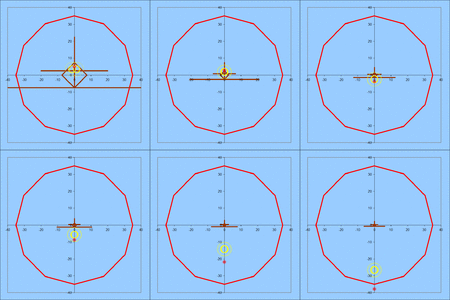
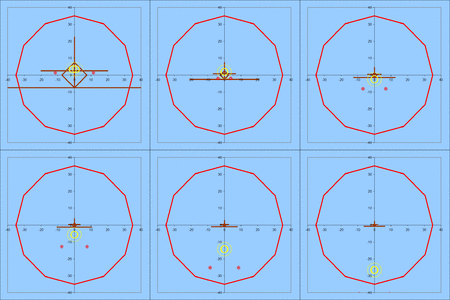
To get back on topic, here is another diagram for the Me 109F-0 with MG FF/M engine cannon and MG 17 cowl guns.

Regards,

Henning (HoHun)
 

Attachments

  • Me109F-0Guns.gif
    Me109F-0Guns.gif
    109 KB · Views: 106
Hi again,

And here is te Me 109E-4 with MG FF/M wing cannon and MG 17 cowl guns (based on the Me 109C-3 manual, the first cannon-armed variant that was overtaken by events and never built).

Regards,

Henning (HoHun)
 

Attachments

  • Me109E-4Guns.gif
    Me109E-4Guns.gif
    108.1 KB · Views: 107
As the originator of this thread, ME262 should not be compared as it is not piston powered. The P61 should be considered because it was a pursuit(fighter). It had 4-50s and 4-20mms with a throw weight of 17.96 pounds /second.
The damage that the 50 BMG will do is incontrovertible no matter how much theory is thrown out. All of us have seen combat film of P47s blowing up locomotives with 50 BMGs. To intimate that it might not be effective against AC is ludicrous. The British thought enough of the 50 BMG to use two of them in the E wing of the Spit MarkIX, perhaps the best mark of the Spitfire. The Japanese went to 12.7s in the Zero and the Germans did in some of their fighters also.
I believe the US used the 50 BMGs in all their fighters because it was very effective against the enemy AC they faced, it was reliable, available in large quantities, the armorers could service it easily and it's widespread use in all the US inventory of AC made ammunition supply easy.
The bottom line is that the war was won with 50 BMGs doing the job both in the ETO and the Pacific. There possibly could have been better weapon choices for all US fighters as far as ballistic effectiveness was concerned but taking all in consideration the 50 BMG was the best choice for the US.
 
All German fighter pilots had to go through gunnery school (FliegerSchützenSchule), Erich Hartmann did it as-well.

There were several of these schools, including the Værløse Luftwaffe FliegerSchützenSchule in Denmark.

You can read about some of them here:
Various schools


And then here about the FliegerSchützenSchule for bomber gunners, later renamed to BordSchützenSchulen in 1942 (as written), the designation FSS still used for the fighter pilots. And up until very late in the war it was a 5 month process:
Kampfflieger: Bomber Crewman of the ... - Google Bogsøgning
 

Users who are viewing this thread

Back