You are correct.
I was looking at Knots at a quick glance to an altitude table. Since the basic concepts are not correct, I did not bother to calculate anything out.
However that does not change the fact Mach .91 is well into the transonic realm and compressible theory applies. The drag forces it must over come are nothing on the scale of the P47 or Bf-109 experience in level flight.
It remains a very poor example.
This comment is unsupportable. Zero lift drag coefficient for the F-4 (which I am sure is no cleaner than the F-15) is as follows:
Mach .6 .022
Mach .8 .022
Mach .9 .022
No large increases.
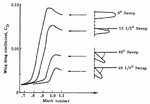
Also, NASA wing drag coefficient for transonic flight for 45 degree wing sweep (F-15) shows very small increase in drag coefficient up to about .94 Mach (see graph).
Of course if that makes you uncomfortable, I could lower the example Mach to .87, which is getting into the realm of commercial jet cruise, with very low transonic effects. Then, at 55kft, we get at TAS of 575 mph and an EAS of 194. Again, from your perspective, the Bf-109k is faster than the F-15 by 100 mph.
It is definitely generating an order of magnitude more thrust than the P47 or Bf-109. This statement indicates you have no idea of the basics concepts of power producers and how they develop thrust.
The F-15 is a thrust producer and follows typical thrust producer characteristics. It has considerably more drag to overcome and needs all of that excess thrust to counter transonic drag rise.
Basic stuff, once again.
Remember EAS for the F-15 is only 209 mph, or 181 knots, probably approach speed. The F-15 is not generating a lot of thrust at approach speed, even in level flight, only enough to counter the low drag at that airspeed. I maybe slighty higher due to some transonic drag, but I have already shown that this would not be significant.
Having flown jet aircraft above 45000 ft I can tell you fuel flow is quite low.
I think it is philosophically correct but is confusing. I won't try to defend any more than to say that speed is a distance, divided by time the distance is traversed. If a Bf-109k is going 299 mph EAS at 24k ft, in one hour it must go 299 miles, right? 299 miles relative to what? It certainly is not over land in a no wind environment, which would be TAS, or 440 miles. it is not in the air mass, that would be TAS also, 440 miles. In the real physical world made up of air mass and earth distance, EAS has no plane of reference. Neither does IAS or CAS. All of these are just comparisons of total pressure and static pressure with many errors. These errors can be correct to get the real velocity through or over air or ground. If you fly IAS or CAS, or try to apply EAS to get any real distance measured for flying an hour, you have to convert it. Now this doesn't mean that IAS, CAS and EAS are not important. They do represent the actual aerodynamic loads on an aircraft and, as a result, is vital for how an aircraft maneuvers and handles, and therefore, either IAS or CAS is mandatory in flying the aircraft. The wings only see and react to, IAS, CAS, EAS, the aircraft as a whole, in relating to the world, either in the air or over the ground, only knows TAS.
Name one TAS speed where aircraft performance occurs?
It tells you the actual velocity that the aircraft is going through the air mass. As a result:
1. With wind speed, you can calculate your speed over the ground.
2. With fuel flow and wind speed You can calculate how far you can go with the fuel you have on board.
3. You can calculate how long it will take you to reach a destination.
4. You can compare your aircraft performance to another. For instance, If You are in a P-47M at 32.5k ft and you see a Bf-109K below you at 24k, and you know your max TAS is 467 mph at 32.k, and you know his max TAS at 24k is 440 mph, you know that even though his EAS if higher than yours, it is useless information because, with your higher TAS, you can catch him without losing altitude. On the other hand, if you were in the Bf-109K and saw the P-47M was ahead of you, you would know that, if he saw you, you could never catch him, even if you didn't climb, even with your higher EAS, because you have a lower TAS.
You can do none of the above with EAS.
What is Vs1 at sea level in TAS? What is Vs1 at 20,000 ft?
A lot faster since to maintain the same dynamic pressure at Vs1(sl), Vs1(20k) must be much higher in the low density environment. See discussion on this later.
There are very good reasons why EAS is used for comparing aircraft performance by engineers.
I have no argument now, or ever, with EAS being used for predicting aircraft performance such as stall speeds, maneuverability, climb rates, etc. My argument is that, one, you can't predict aircraft airspeed performance at a higher altitude using EAS alone without hp data, and two, a higher EAS does not mean you are going faster than another aircraft at a higher altitude, but lower EAS.
That is completely different from your original claim that EAS was not used for aircraft performance comparison. Now you are changing your tune.
This is disingenuous. I have never claimed in this post that I thought EAS was NOT used for aircraft performance comparisons other than airspeed comparisons at different altitudes. I have NOT changed my tune.
You said
"EAS is useful for performance comparisons"
I replied "This is true for some aircraft performance parameters, just not for airspeed comparison at different altitudes"
You later said,
"That is why it is industry standard.
TAS assumes density effects at altitude. Any values calculated using the TAS velocity are only appropriate for that specific altitude.
Using EAS eliminates this as a step and there is no need to recalculate all of our values for density effects.
It is then much easier to convert EAS to TAS if we want to account for density effects. The differences in EAS to TAS velocity are solely based on atmospheric properties alone. Two aircraft at the same EAS will have the same TAS if they are at the same altitude.
However if we want to compare aircraft performance, then using EAS puts the aircraft under the same conditions which is essential for a good comparison."
I said "Actually, I don't think I have ever disagreed with any of this except the last statement for comparing airspeed at different altitudes with different aircraft."
Somehow, you have twisted my comments to imply I think EAS is worthless when I have not.