Brewster Buffalo - what is the verdict? (4 Viewers)

A minor point but the RAF in Malaya had access to naval stores and dockyard stores if they found the Brewster armour ineffective and too far away to obtain better in a hurry from the UK nor USA. It would seem probable that they would turn to the naval dockyards for better armour plate sufficient for their needs. Which are trivial compared to replacing armour on damaged vessels. I only mention this as a surmise. I know of no evidence that they did so.
 
A minor point but the RAF in Malaya had access to naval stores and dockyard stores if they found the Brewster armour ineffective and too far away to obtain better in a hurry from the UK nor USA. It would seem probable that they would turn to the naval dockyards for better armour plate sufficient for their needs. Which are trivial compared to replacing armour on damaged vessels. I only mention this as a surmise. I know of no evidence that they did so.
This assumes the dockyards had armor plate that thin. Trying to turn a sheet of 1/2 armor into two sheets of 1/4in armor was almost impossible (somebody somewhere may have done it ;)
 
This assumes the dockyards had armor plate that thin. Trying to turn a sheet of 1/2 armor into two sheets of 1/4in armor was almost impossible (somebody somewhere may have done it ;)

The armour plate for RAF Buffalos in the Far East was, indeed, made in the Singapore dockyard. Brewster provided the schematics, the dockyard made the armour plates, and the poor bluddy fitters had to crawl inside the fuselage in 88-90 deg F and 80+% humidity to install it…only to find that the mounting holes didn't line up with the pilot's seat support bars. Some of the armour plate was held in position by wire, which doesn't sound very secure to me.
 
Last edited:
A member at another forum posted this:

Oh yes!
Let me spend 30 seconds on google

Here this should do it
First one I found
So in short -
Poor QC at factory (the factory was garbage and there was corruption from top management to shop floor)
Landing stuts failed particularly in use by Fighter 3 sqn on Sara
Cyclone engines provided in the 170 Model 339E where of a substandard version often 2nd hand taken from DC3s - these had 1100 HP compared to the 1200 HP provided for the USN and Finns
The Cyclones power was porcine and got worse the higher it got, the engines over heated and leaked.
Commonwealth Squadrons lost many aircraft before Dec 7th due to training accidents - I believe 30 in total - granted a lot might have been down to the mostly green pilots and squadrons lacking in tools etc but much was also down to component failures and the aircraft being utter garbage.
The bloody thing was a Pork Barrel - Brewster did not expect to be found out before it was opened on the other side of the world!
The British took one look at it and went nope...nope nope nope....and fobbed it off to the ends of the earth where the only enemy it might face was the Japanese and they were thought to be rubbish, the Americans fobbed it off to the Marines after a single squadron on Saratoga (VF3) operated them in 1940-41 and found them wanting!
While initially it was made heavier by the addition of equipment found on other British fighters like armour seat rests, etc - subsequent efforts were made to reduce weight such as replacing the 50 cals with 303 Browning's and less ammo and fuel
But you cannot polish a turd!


Any takers?
Interesting. Thanks for that! Now to dig into the corruption. Years before the F-104 Lawn Dart.
 
In my quest for said primary sources I also found this:

View attachment 890243

It's from a 1942 Luftwaffe frontline news bulletin on enemy aircraft, which can be found here. Assuming the depicted figures are indicative of a 339E (Buffalo Mk. I), I'm wondering how correct they are.

The 302 l on both sides of the fuel tanks is either indicative of a slight drop in capacity from 606 l to 604 l from the Linatex and horshide leather the Brits coated the fuel tanks on the 339E with, or it's just a mistake.
The drawing in the attachment is likely from the Belgian 339B the Germans captured in France. The Belgian 339B had four .50 machine guns.
 
What I'd like to know is how have people been able determine which NX test registry belonged to which aircraft. NX56 (apparently later NX56B) supposedly had the construction number 56, hence NX56. But then why is the aircraft that's purported to be c/n 61 coded NX15694? Shouldn't it be NX61? Was it first NX61, then NX15694 after being modified into a 239 for the Finnish order? And how is it known that NX56 is the very same aircraft that ended up captured by the Germans? I assume there is some primary source documentation somewhere, but I've never seen it referenced for any of this.
The Belgian NX numbers, at least the initial ones, and Dutch and RAF NX numbers, have a tie-in to the Brewster construction numbers. I've fried my brain a couple of times trying to do an exact matchup, but remember, it;s Brewster.... Also, I have some notes done by Dayton Brown (on the back of calendar pages) which suggest the planned Finnish order may have been for 66 aircraft, interrupted no doubt by the end of the Winter War.
 
I wondered if anything could be done to improve the Buffalo. Had it been ordered to the same requirements as the F4F (ie folding wings giving a longer wingspan...) or if it had been built by anyone else. It wouldn't be the Buffalo we've all come to know and adore.
I "designed" a 2 seater super Brewster with R-2800 radial.
 
Well my design was to rule the Reno races.

lol
USD137285 R D macCart - Fig 1.jpg


This one?
 
I could no longer find my super brewster design....but I might. OTOH I did find my super CW-21 drawings.

RACER_2023_A.JPG


Speed_Deamon_Racer_2023_A1.JPG


FAF tried to buy CW-21s in pre war situation but bought Fokkers instead as they were much cheaper.

Sea Fury is almost 2 meters longer.


This is just half a meter longer than original CW-21:


Design goal was 1000 km/h in Reno. 860-900 more realistic.
 
Last edited:
There actually were at least two designs for a racer version of the F2A-1: the P-21 and P-21 A (these are Brewster project designations), the former with a 1,200 hp Wright R-1820-G231, which I can't find on this list of Wright engines, and the latter with a 1,000 hp Wright R-1820-34, with estimated top speeds of 330 mph @ 16,000 ft and 310 mph @ 17,200 ft respectively, with the spec sheets dated 25 and 27 January 1939 respectively. Neither left the drawing board.

Another proposed design was the P-22, which was a version of the F2A-1 for the USAAC with a 1,200 hp Allison V-1710 inline engine, with a calculated top speed of 342-347 mph @ 12,000 ft, with the spec sheet dated 16 February 1939. With a two-stage supercharger it was calculated the design could reach 363 mph. In 1940 (1939?) using this design as a reference, Brewster's chief engineer Dayton Brown calculated that an Allison-equipped Model 339 (the export version of the F2A-2) could reach 375 mph. The latter was related to French interest in buying Brewster fighters; aircraft engine production couldn't keep up with demand at the time, but France had already ordered large quantities of Allison engines for their P-40s, so the idea was to mate French Allison engines to Brewster 339 airframes.

The sale didn't materialise, but French interest in buying from Brewster did lead to France on 9 May 1940 giving a letter of intent for an order of 250 Brewster Model 240 dive-bombers. The Model 240 was a proposed 2-seater version of the Model 339 with two .30 cals, presumably in the fuselage, internal stowage for a 500 lb bomb, and a rear-gunner with a single .30 cal flexible machine gun. Germany began the invasion of the Low Countries on 10 May 1940 followed by the invasion of and fall of France, leading to the cancellation of the order. Later Brewster tried to sell Turkey the Model 240, without success. Despite the engine shortage, the spec sheet for the 240 has it with a 1,200 hp Wright GR-1820-G205A geared radial engine, and 338 mph @ SL at the maximum military-rated power setting and an approximated 330 mph @ 18,000 at normal power. From what I understand those figures are perhaps on the optimistic side as far as max speed estimates go. I wonder why the G205A engine? Did the logistical situation with the various engines change, or was the Allison thought too unreliable or vulnerable for a dive-bomber? The spec sheet for the 240 is dated 21 March 1940.

At any rate, the Model 240 was never produced, and neither were any of the inline-engined variants of the F2A. If the latter had been produced, they might have looked something like this:
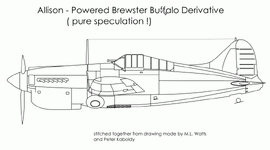
Allison-Buffalo.gif

The above speculative drawing is from someone's post on the Secret Projects forum here.

Sources:

Jim Maas (1985): Fall from Grace: The Brewster Aeronautical Corporation, 1932-42 in American Aviation Historical Society Journal, vol. 30, 1985
Brewster Aeronautical Corporation Airplane Characteristics data sheets kindly provided to me by Jim Maas

FAF tried to buy CW-21s in pre war situation but bought Fokkers instead as they were much cheaper.

The Commander of the FAF suggested the Fokker D.XXI in October 1936 and the decision to purchase the first squadron of the aircraft was made then or soon thereafter. By the time the order for the first batch of 35 Finnish-produced Fokker D.XXIs was placed in June 1937, the first seven aircraft together with the production license had already been purchased from Holland.

The CW-21 came into the picture later, with Curtiss-Wright giving the Finns a verbal estimate via Colonel Talvela in the spring of 1939 of a cost of $40,000-50,000 for the airframes alone, with an estimated delivery schedule of 3-8 months. Curtiss-Wright even made the assurance that deliveries would continue even if Finland was at war. This was either a misunderstanding or a deception, as the US Neutrality Acts forbade selling materiel to countries at war. This ban would not be lifted until 4 November 1939. The Finnish company Autola Oy showcased the CW-21 to the FAF as late as September 1939. Note that in those days in peacetime it took around a year just to train a fighter squadron ready for wartime operations, and that's after a squadron's worth of aircraft have arrived to the unit. To my knowledge at no point did the FAF "try to buy" the CW-21. For more on this see e.g. Jukka Raunio's excellent magazine GX-hanke.

Sources:

Kari Selén (1980): Mannerheim ja hänen puolustusneuvostonsa 1931-1939, pp. 161-162
Jukka Raunio (2017): Suomen Ilmailuhistoriallisen Lehden Erikoisnumero 2: GX-hanke: Suomen hävittäjävaihtoehdot ennen talvisotaa, pp. 28-29

 

Users who are viewing this thread

Back