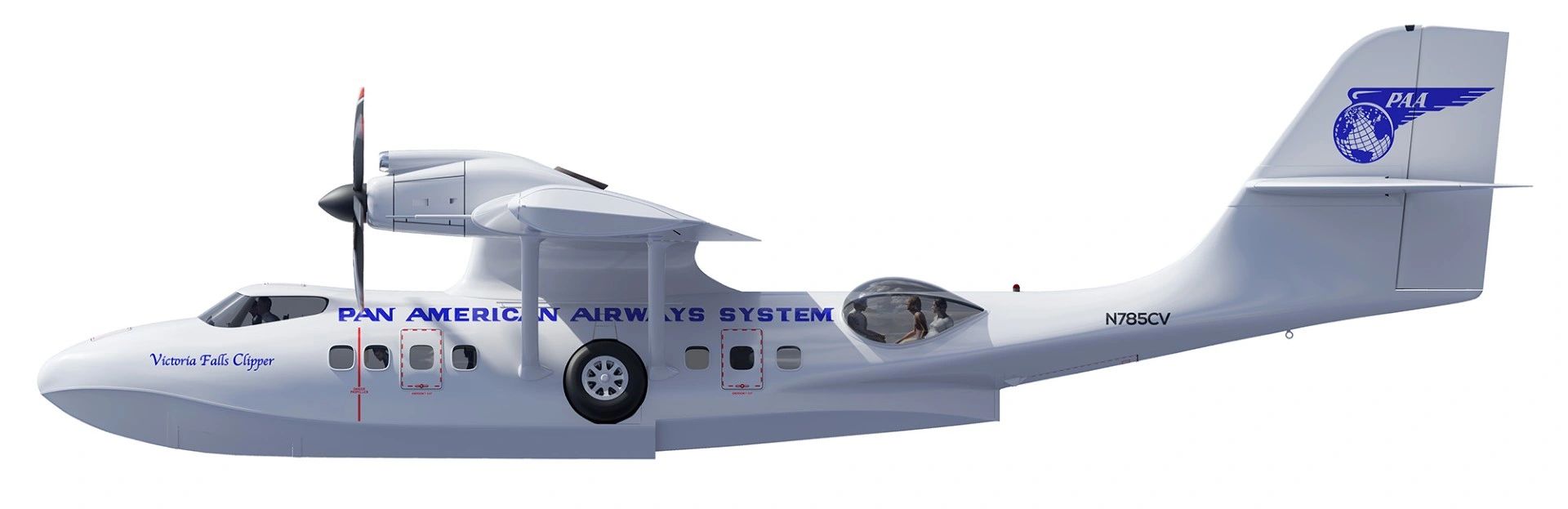
Catalina Aircraft Trust receives letter of intent for Catalina II

ThomasP

Chief Master Sergeant
4,340
7,379
Joined
Apr 17, 2017
Location
midwest USA
Pan Am Airways System has issued a letter of intent to purchase 46x Catalina II flying boats.

"Catalina Aircraft pushes ahead with updated Catalina II after securing 46-aircraft commitment"

PAAS Catalina II.jpg
 
Pan Am Airways System has issued a letter of intent to purchase 46x Catalina II flying boats.

"Catalina Aircraft pushes ahead with updated Catalina II after securing 46-aircraft commitment"

View attachment 887561
Does anyone have more concrete info on this? Anything more than is on the Catalina Aircraft Trust website to prove this is anything more than an AI concept? Is a prototype under construction? If so, where, and what are the performance specs?
 
Does anyone have more concrete info on this? Anything more than is on the Catalina Aircraft Trust website to prove this is anything more than an AI concept? Is a prototype under construction? If so, where, and what are the performance specs?
smoke and mirrors and speculation. No prototype, no pre-production that I can see in that fluff article. Planning on turning out aircraft by 2029 when they have not sheared a panel or bucked a rivet.
"The company must still select a production site. Reece has evaluated several locations and says production and testing requirements mean no existing facilities will do. Catalina Aircraft requires a site near a "secure" body of water (to avoid boat traffic) and 122 x 2,438m (400 x 8,000ft) of usable water space to allow for aircraft tests and evaluating the firefighter's scooping system."
Right. focus on either building a pond or finding a private lake.
It is all over the 'net, which means to me it has about as much of a chance as a fart in a whirlwind of happening.
 
Catalina Aircraft is now evaluating engines, avionics and other systems needed to develop the aircraft, which founder and president Lawrence Reece notes will be the only Western-certificated transport-category flying boat.

Obviously he has not heard of the Canadair CL215/515 family of aircraft now made by Viking. And yes they can carry passengers - fire fighters with their equipment - though not as many.

And yes Catalina's were used as fire bombers in the 60's and possibly later.
 
Like other similar projects, I will believe it when I see it in the air, and even then will remain doubtful it will reach mass production. Look at Amphibian Aerospace Industries in Darwin, Australia, that actually did acquire the type certificate for the Grumman Albatross and announced in December 2021 that it planned to commence manufacturing a new version of the with PT6s from 2025. They still have a way to go IMHO and are arguably far further along than this new player.

That said, I would lover to see new Catalina's flying…
 
I would be surprised if this gets as far as regards actually being built. The water-bomber function is surely providing the operating backbone of the plan, but here it must fall flat compared the DHC 515.
Attractive though the Cat is as an amphibian, the DHC 515 is far better for the waterbomber role it has been developed into for 60 odd years.
If the Cat could stand on its feet by just doing money-making pax Ops, it might happen, IMO.

Eng
 
Note the difference between the headline "securing 46 aircraft commitment" and the content of the article "covering purchases of UP TO 46 aircraft" (my emphasis).

In addition to the CL-515 and the Australian Albatross project, there are many more amphibious airfraft projects around the world being touted. It seems a very crowded area of the aviation industry. Taking a 1930s design and getting it to meet today's safety standards seems to be relying on nostalgia rather than sound engineering, unless all they are hoping to cash in on is the name.
 
Note the difference between the headline "securing 46 aircraft commitment" and the content of the article "covering purchases of UP TO 46 aircraft" (my emphasis).

In addition to the CL-515 and the Australian Albatross project, there are many more amphibious airfraft projects around the world being touted. It seems a very crowded area of the aviation industry. Taking a 1930s design and getting it to meet today's safety standards seems to be relying on nostalgia rather than sound engineering, unless all they are hoping to cash in on is the name.
...kind of like the Titanic II. Too bad.
 
Like other similar projects, I will believe it when I see it in the air, and even then will remain doubtful it will reach mass production. Look at Amphibian Aerospace Industries in Darwin, Australia, that actually did acquire the type certificate for the Grumman Albatross and announced in December 2021 that it planned to commence manufacturing a new version of the with PT6s from 2025. They still have a way to go IMHO and are arguably far further along than this new player.

That said, I would lover to see new Catalina's flying…
Latest on the Albatross project.
 
Catalina Aircraft is now evaluating engines, avionics and other systems needed to develop the aircraft, which founder and president Lawrence Reece notes will be the only Western-certificated transport-category flying boat.
And AFAIK, an amphibian is not a flying boat.
Obviously he has not heard of the Canadair CL215/515 family of aircraft now made by Viking. And yes they can carry passengers - fire fighters with their equipment - though not as many. And yes Catalina's were used as fire bombers in the 60's and possibly later.
With their dead slow production rate of two or three units a year, DeHavilland Canada could use a competitor in the firefighting department.
 
Last edited:
I think a flying boat is an airplane in which the fuselage acts as the main displacement element when at rest, as opposed to a float plane which uses 1 or 2 floats separate from the fuselage as their main displacement elements. Hence the Catalina, Sunderland, Walrus, Goose, etc, are flying boats, while the Kingfisher, Pete, He139, etc, are float planes, But they are all sea planes.
 
I think a flying boat is an airplane in which the fuselage acts as the main displacement element when at rest, as opposed to a float plane which uses 1 or 2 floats separate from the fuselage as their main displacement elements. Hence the Catalina, Sunderland, Walrus, Goose, etc, are flying boats, while the Kingfisher, Pete, He139, etc, are float planes, But they are all sea planes.
Agreed. But both types can be amphibians, capable of operation from land or water.

The Catalina was produced in both pure flying boat and amphibious versions (PBY-5A & PBY-6A). The latter formed about one third of production.

Today's Cessna Caravan can be fitted with floats containing wheels making it capable of operation from land or water i.e an amphibian.
 
1930s flying boats had the advantages of a long runway compared to the land runways of the time. But they also had low powered engines which meant they often could not carry the weight of land landing gear and carry the desired fuel/cargo load. Catalinas got retracting landing gear when they got 1200hp engines instead of the earlier 900-1000=hp engines.
Something to what for in 1930s flying boats is actual retractable landing gear and not retractable beaching gear. A few planes had retractable gear that could be lowered once the plane had landed on water to make getting the plane up the ramp onto dry ground easier. The size wheels and tires and the shock absorbing landing gear of a sizeable seaplane (30,000lbs or more) could cut into payload on small engine aircraft.
Turbo props solve that problem and since nobody is flying long distance with flying boats (over oceans) the fuel load is also lower.
 
Last edited:
When you look at the major long range air routes of the 1930s the use of flying boats meant no costly land airfields that the airlines would have had to spend their own money to develop.

Imperial Airways flying routes from Britain to the east. While it used both landplanes and flying boats inter-war, it was the Short Empire flying boats in use from 1937 that had the greatest passenger capacity.
1784365888587.jpeg


Pan Am routes across the Pacific
1784366606484.jpeg
 

Users who are viewing this thread

Back