Could the Bf 109 E really out-turn the Spitfire Mk I? (3 Viewers)

Ad: This forum contains affiliate links to products on Amazon and eBay. More information in Terms and rules

All, I have found the articles that I was looking for.

a) Document file number 043697, in the BP Archive at Warwick University, and specifically to 'Petroleum Board Enemy Oils Fuels Committee. A Survey of the Results Obtained to Date in the Examination of Enemy Fuel Samples', by D. A. Howes, dated 4 November 1940. This used fuel samples taken from 29 crashed Luftwaffe aircraft between November 1939 and September 1940, and, exclusive of one sample of captured British 100-octane, revealed octane ratings which varied between 87.5 and 92.2 octane. The results were summarised by H. E. Snow to Sir William Fraser on 13 November 1940 as follows (and I quote from the original document):

'No general indication [of] iso-octane or other synthetics. The only 100 octane fuel identified was definitely captured British.'

b) The Narrow Margin of Criticality: The Question of the Supply of 100-Octane Fuel in the Battle of Britain by Gavin Bailey
This paper concentrates of the origin, supply and distribution of 100 Octane fuel. Included in that is the distribution to the RAF in France and the capture of that fuel.

Note 1 - Gavin Bailey was a member of this Forum and gave us a considerable insight into this subject
Note 2 - There was a second paper which covered the analysis for the period after September 1940 which I cannot find. But that was less relevant anyway.

General point
I think we know which German aircraft had the 100 octane in it, the one that crash landed at East Dean. As you are aware, I believe that you put the warning sign on the fuel to ensure that the right fuel goes into the right aircraft.
You may consider it speculative for me to say that, but unless you can come up with a reason as to why you would put a 100 Octane warning on a plane that can only use a different fuel I would consider my position to be a strong working assumption.
I do not pretend to know what technical changes would be needed to make a DB601 run on 100 octane, all I do know, is that the changes to make the Merlin run on 100 Octane were fairly minor and done at squadron level.

I hope the above helps
Thanks for including this information.
I have seen this before and we know that the fuel samples in the crashed aircraft were routinely analysed. In fact some very clever work was done later in working out where the Germans were not able to fully use the fuels that they actually had.
So, we discussed earlier how the Germans captured and used the fuel, usually by blending to improve the lower grades, a problem that the Germans had.
The question remains though, was any advantage taken of the different British fuel at its defined 100 Octane and could the DB 601 A engine use the 100 Octane? In a straightforward
view, you might say "why not?" Well, just before WW2, the British were looking at using 100 Octane and improving the performance of some front line engines. Unfortunately, when the USA sourced 100 Octane fuel was tested it was found that it was unsatisfactory in Rich mixture response, ie, it did not have the expected higher octane characteristics of approx 130PN when used in Rich mixture, and full power detonation could occur at high boost pressures. After evaluation, fuel chemists devised a different 100 Octane fuel that did give a rating of 100/130 and this was initially called "Sweeny's Blend". This was the initial standard that was able to be used in the RAF change to 100 Octane. This illustrates that all fuels are not the same even if the Octane numbers are similar, for instance the BoB German C3 of 96 Octane was nominally something like 96/125 but, it was wreaking DB 601 N engines because it had a very high boiling point constituant that did not boil off at the DB 601 N oil temperature.
Personally, I do think that the RAF 100 Octane fuel would work in the DB601 A and possibly the 601 N, but that is not certain, and we have no information, so far, that increased engine performance was taken by engine modifications, and I have not seen a Luftwaffe or RLM clearance to use British 100 Octane.
I am interested that you view the 100 Octane modifications for the Merlin were minor.

Eng
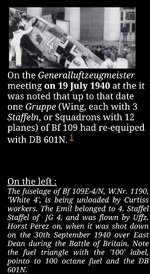
 
Clearly I don't know the answers to most of your questions, my comments are based on what we have in front of us. We have an aircraft that I believe clearly had (RAF) 100 Octane fuel in it and therefore its fair to assume that the German DB601 could use that fuel. Almost certainly it would need modification but I don't pretend to know what changes were needed.
As to what change it made to the performance of the Me109, again I don't know, but we do know that it made a significant change to the Merlin so some benefit would be expected, or it wouldn't have been undertaken.

As to the changes needed to the Merlin going from memory it was basically Spark Plugs and piston rings. Again there is a paper out there which I will have to hunt down.

Hope this helps
 
Getting the DB 601 to run on British fuel is one thing. Maybe different spark plugs or maybe not. Maybe a slight tweaking of the fuel injectors (slightly richer or leaner) or maybe not.
Problem comes in with trying to use the British fuel to get more power. At squadron level you can't take the engine apart and change pistons. You can't change the supercharger gear ratio/s or change the fluid drive (much). You can change the boost limit.
Now what do you do for the increased fuel supply to the fuel injectors?
Piston pump is strictly mechanical. It is geared to the rpm and there is a control that turns the pump cylinders or the piston rack. The pump pistons use a spiral grove (?) to bleed of some excess fuel. If you want to make 1300hp you need to provide enough fuel for 1300hp, not 1100hp at the same rpm. Just having the supercharger provide more air means you are running lean and things are going to get really noisy and expensive really quick. Merlin with carb means less chance of running lean. Small carb may choke power but at least what air that is flowing through should have enough fuel.
There is a solenoid (?) that adjusts the richness of the injector rack/s all at the same time. Problem for the squadron mechanics is how much adjustment does it have? How much richer can they set it for a given rpm to handle the increased airflow from higher boost.
 
Hi,

There is no doubt that the Luftwaffe fuel triangle marking carried several different markings from photographs around the BoB, including the 100 mark. However, the presumption that this indicates the aircraft used British 100 Octane fuel and was modified for higher performance is speculative. Furthermore, the DB 601A engine is listed as fitted and this was rated to use the B4 87 Octane standard fuel. The Luftwaffe were quite strict in there adherence to the regulations and operation of their aircraft, and standard fuels were strictly controlled.
If the only evidence on this point you present is the 100 marking, then the detail of the why it is marked 100 is unknown. However, if you have other information to support your point, then it would be interesting to see.
As regards the possible use of higher octane fuel in the DB 601 engine in 1940, you will be aware that the Luftwaffe did this and the DB 601 A engine was not suitable for the simple
use of C2/C3 "100" Octane type fuels and higher Manifold pressure as the RR Merlin used with British 100 Octane. Daimler Benz had to modify the DB 601 A engine quite extensively
to run higher rpm and higher compression, they could not simply increase the Manifold pressure on the DB 601 A engine using their own high-Octane fuels and had to introduce the DB 601 N which came into service starting June 1940. So, what makes you think that a Luftwaffe unit in the field in September 1940 would be messing about with their own engine/fuel modifications to a DB 601 A that had been done by the Germans themselves at the factories and was available in Service as the DB 601 N? If you want to speculate, I think it is more likely that this aircraft had been fitted/uprated with a DB 601 N and either, it was mis-recorded as a 601 A by the British, or the 601 N engine had been changed back to a 601 A and the fuel triangle was still painted for the "100" (C2/C3). However, if you have more info, please post it.

Cheers

Eng
Source :Kurfurst.org.
Screenshot_20260711_192637_Samsung Browser.jpg
Screenshot_20260711_193948_Samsung Browser.jpg
Screenshot_20260711_192218_Samsung Browser.jpg
 

Attachments

  • Screenshot_20260711_192608_Samsung Browser.jpg
    Screenshot_20260711_192608_Samsung Browser.jpg
    313.3 KB · Views: 13
Getting the DB 601 to run on British fuel is one thing. Maybe different spark plugs or maybe not. Maybe a slight tweaking of the fuel injectors (slightly richer or leaner) or maybe not.
Problem comes in with trying to use the British fuel to get more power. At squadron level you can't take the engine apart and change pistons. You can't change the supercharger gear ratio/s or change the fluid drive (much). You can change the boost limit.
Now what do you do for the increased fuel supply to the fuel injectors?
Piston pump is strictly mechanical. It is geared to the rpm and there is a control that turns the pump cylinders or the piston rack. The pump pistons use a spiral grove (?) to bleed of some excess fuel. If you want to make 1300hp you need to provide enough fuel for 1300hp, not 1100hp at the same rpm. Just having the supercharger provide more air means you are running lean and things are going to get really noisy and expensive really quick. Merlin with carb means less chance of running lean. Small carb may choke power but at least what air that is flowing through should have enough fuel.
There is a solenoid (?) that adjusts the richness of the injector rack/s all at the same time. Problem for the squadron mechanics is how much adjustment does it have? How much richer can they set it for a given rpm to handle the increased airflow from higher boost.
Yes, many of the points you raise here are reflections of the way that a standard engine is built with its design to work within a narrow band of conformity and only minor adjustments available within that range.
For specifics, the engine would have to operate at a higher Manifold air pressure to burn more fuel and generate more power, which it can only do if more air is forced into each induction stroke. As you say, the sparkplugs were often a limiting factor as Manifold pressures were raised and problems here could easily lead to engine failure in a short period. The fuel injectors themselves might have a problem with higher flow rates or spray pattern and every upgrade of the DB engines was closely matched with improved fuel injectors at various points. The Injection pump elements, have to have a range of pumping variation that matches the fuel demand variation between minimum and maximum required injection volume. This mean't that Injection pumps varied between engine models.
Yes the rack position is adjustable to adjust the overall basic setting of the complete 12 pumping elements. Also each pumping element can be individually adjusted on the test rig for flow rate of each element. However, these adjustments were made empirically on the test rig and calculated against test data from thousands of hours of development and prototype testing, not from just guessing.
Due to the fact that the Germans own design for a "100" octane version of the DB601 engine only managed to be rated at 1.35ata on C2/C3, I do not think that a considerable increase in MAP and power was easily possible with the DB 601 A engine, even if using British 100 Octane fuel. There might have been some increase of MAP available compared to 87 Octane, but it will not have been substantial due mostly to the supercharger efficiency being lower, compared to the Merlin.
OTOH, I have little doubt that the DB 601 A and possibly the N could have operated satisfactorily at their standard ratings on British 100 Octane, but there would have been no power increase. Only if some proven technical advice can be found from the RLM or Luftwaffe on these points can this be proven.

Eng
 
War Thunder and il2 light models are going to be very similar in so far that they use drag pullers to create them. War Thunder can trace its lineage directly back to some of the original il2 games. The War Thunder developer was originally subcontracted to develop an il2 title for the Xbox 360.

The lead developers for both games went to the same University in Moscow.

Once again you do run into the issues of it is not simply finding the correct drag puller and copy and pasting it into their flight model programming. Doing so will oftentimes give you erroneous results that do not match real world data. This becomes especially problematic when they are using publicly available. Clcd diagrams that are derived from computational studies. Find three different computational studies of a modern jet fighter clcd diagram and you will have three very different results depending on who ran the simulation and how it was built.

The Dynamics in il2 for the 109 versus p51 r fairly similar to the Dynamics between the p51 and 109 in War Thunder. However, in War Thunder, I feel that the p51 has an easier time accelerating away from and resetting a position against the bf109.
PM sent.
 
The following are the changes needed to run 100 Octane in a Merlin. My memory was close and the changes are done as part of service maintenance. Hope this helps

View attachment 887287

Thanks for posting the Rolls-Royce Merlin II and III 12psi Boost modification sheet. I was looking for it but hadn't found it yet!
As you will be aware, the modified boost control cut-out will require partial dismantling of the Boost control and the engineering of the holes.
The modification of the cylinder top joints on engines not so previously modified, would require removal of the cylinderblocks and engineering modification. This is a considerable task and it would appear wise to have incorporated this modification with previously modified replacement cylinders so that the work could be achieved as a double block change, rather than having to wait for the engineering on the cylinders.
As has recently been pointed out, the replacement of the standard sparkplugs is a high priority.
It is worth noting that this mod sheet is from the RAF issue AP 1590B. I would expect that there was also a a more comprehensive worksheet from the Group engineering HQ that would specify the procedure in more detail, including such things as a post mod engine test.
Cheers
Eng
 
In the longer video, I have a quote by John Godfrey who used flaps in a turn fight with a Fw 109 D-9. Does this mean that the P-51B should try to engage Bf 109's in turn fights using flaps? Of course not.


Of course not? That's literally all they did when they did not sneak up under the tail... Up to 40 circles. (some claim 100 circles, but probably wrong)

Go read the 900 P-51 Encounter Reports on the Mike Williams site. I have. Twice. Doing so would enlighten you as to how false your statement is.

Without flap deployment, a good third to a half of all P-51 European kills would be P-51 losses. That is how absurd this is.

They discussed flap angles over the radio during dogfights...

As to zooming after a Hit and Run attack, given that a successful Hit and Run attack required firing from 50-75 metres. An overtaking speed of 25m/s (90 km/h) gave you 1 to 2 seconds to fire.

And then they usually turned or they dived, because how much higher can you go with an extra 90 km/h?

The one thing want to see in my life is a European WWII US Encounter Report saying: "I dived on him, fired, and then I zoomed back up."

There must be some, but in my 30 straight years of reading thousands of them, I literally can't remember a single one.

The one aircraft that did zooms and loops constantly, during or after an attack, was called the Mitsibishi Zero.

If you don't know what the Hinero Komi is, you probably know very little about the Zero...
 
Of course not? That's literally all they did when they did not sneak up under the tail... Up to 40 circles. (some claim 100 circles, but probably wrong)

Go read the 900 P-51 Encounter Reports on the Mike Williams site. I have. Twice. Doing so would enlighten you as to how false your statement is.

Without flap deployment, a good third to a half of all P-51 European kills would be P-51 losses. That is how absurd this is.

They discussed flap angles over the radio during dogfights...

As to zooming after a Hit and Run attack, given that a successful Hit and Run attack required firing from 50-75 metres. An overtaking speed of 25m/s (90 km/h) gave you 1 to 2 seconds to fire.

And then they usually turned or they dived, because how much higher can you go with an extra 90 km/h?

The one thing want to see in my life is a European WWII US Encounter Report saying: "I dived on him, fired, and then I zoomed back up."

There must be some, but in my 30 straight years of reading thousands of them, I literally can't remember a single one.

The one aircraft that did zooms and loops constantly, during or after an attack, was called the Mitsibishi Zero.

If you don't know what the Hinero Komi is, you probably know very little about the Zero...
Remember that you are reading the Encounter Reports of the Winner of the turning fight between a 51 and a 109. The loser did not survive to comment.
 
Of course not? That's literally all they did when they did not sneak up under the tail... Up to 40 circles. (some claim 100 circles, but probably wrong)

Go read the 900 P-51 Encounter Reports on the Mike Williams site. I have. Twice. Doing so would enlighten you as to how false your statement is.

Without flap deployment, a good third to a half of all P-51 European kills would be P-51 losses. That is how absurd this is.

They discussed flap angles over the radio during dogfights...

As to zooming after a Hit and Run attack, given that a successful Hit and Run attack required firing from 50-75 metres. An overtaking speed of 25m/s (90 km/h) gave you 1 to 2 seconds to fire.

And then they usually turned or they dived, because how much higher can you go with an extra 90 km/h?

The one thing want to see in my life is a European WWII US Encounter Report saying: "I dived on him, fired, and then I zoomed back up."

There must be some, but in my 30 straight years of reading thousands of them, I literally can't remember a single one.

The one aircraft that did zooms and loops constantly, during or after an attack, was called the Mitsibishi Zero.

If you don't know what the Hinero Komi is, you probably know very little about the Zero...


Hello

While this combat report is not about P-51's and 109's, this is a copy of Laurence Blumer's report on a mission he flew August 25, 1944 when he engaged FW-190A's with his P-38J. Please note that all of his reported attacks started with a dive, followed by a climb to a higher position, followed by another diving attack., and another climb back to a higher position.

FWIW

Eagledad
 

Attachments

  • Blumer Aug 26 1944.jpeg
    Blumer Aug 26 1944.jpeg
    117.1 KB · Views: 33
A few points on the use of combat flaps in general. This issue has come up with many aircraft-to-aircraft comparisons, these are a few things I have learned:

  • There is an upper speed limit on deploying any amount of flaps.
  • This varies a lot by aircraft type but it's usually not much more than around 250 mph / 400 kmh, often much lower than that.
  • Some aircraft (a lot of US Navy types for example) would automatically close the flaps once back pressure got too high, meaning either G load or speed.
  • Most WW2 fighters either had combat flap settings or systems which could be used to deploy flaps easily.
  • Some WW2 fighters had automatic combat flaps which deployed on the basis of a mercury switch detecting degrees of bank. N1K2 is a famous example of this.
  • Some WW2 fighter did not have intermediate flap settings, they were either full-up or full-down.
  • The Spitfire was one of these types, and it was left that way because Spitfires were deemed to have such a tight turn radius (and good lift overall) that it wasn't needed.
  • Deployment of combat flaps, usually 5-15 degrees depending on the type, had a significant impact on airspeed.
  • Therefore airspeed drops rapidly when flaps are deployed, and will swiftly approach stall speed especially at high angles of bank if the flaps are left down.
  • Many pilots reported using combat flaps just for a few seconds during a turn.
  • This depended on how fast the aircraft controls responded (how quickly the flaps extend and close), which varied a lot by aircraft type. It could be less than a second or several seconds.
  • Use of flaps in high-G could sometimes damage the hydraulic system or electric motors system used to extend / close the flaps, which could leave them in a deployed state.
  • Some pilots deployed partial flaps during nose-down turns, the speed increased from the dive offsetting the drag from the flaps.
  • But regardless, altitude continues to drop...

With the 109E specifically, my understanding is that the leading edge slats, which helped them ride stalls so are also significant in a turn fight, did not work reliably. This was finally fixed with the F model which is one of the reasons it was so well regarded.
 
Enormous courage was required of LW pilots intercepting a large formation of bombers, even if vectored to avoid the fighter escort. That said LW controllers were successful many times to vector large formations of interceptors to lightly defended boxes. Another point to emphasize in parallel is that the relay system of penetration support, passing on to target and withdrawal support diluted the number of escorts actually attached to the bomber stream. The LW Day fighters often attacked with numerical superiority over the fighter escort.

IIRC the average strength of LuftFlotte Reich was about 500+ operational single engine fighters in 1944, compared to approximately 750 8th AF escorts dispatched on a maximum effort mission. Target escort numbers were greatly reduced for key targets such as Schweinfurt, Merseburg, Berlin, Munich, etc. during the period Feb 1944 through D-Day when most of 8th and 9th AF FGs were still equipped with the P-47.

That reality means that and entire Bomb Division of perhaps 10-12 BGs/3-5 Bomb Wings over a 20-30mile trail, were only escorted by 1-3 FG's composed of P-38J or P-51B. The LW was very successful at probing to launch and intercept, particularly Spring 1944 with much cloud cover, while actually hitting where there was limited to zero local escort cover. The technical feature that was responsible for making fighter escort more effective was the SCR-522 command radio in which the Fighter Commander and Flight leaders were on the same channel as the Bomb Group designated 'call for help' channel. This often meant the difference between massive bomber losses to none or only a few as the escort would throttle up and head for the distressed BG.

The oft repeated claim of 'we were outnumbered 10 to 1' was hyperbole, even when attacking with one flight. SOP for FG commanders were to dispatch flights or sections rather than an entire squadron, retaining the balance for escort. But more often than not the LW controller positioned Gruppe's to entire JGs to a soft spot in the escort coverage with excellent results.

Very interesting...
 
Hartmann did basically write what you say here. He usually operated with at least a wingman to cover him and when he was operating in his Ace way, he was doing his own thing, regularly not entering combat unless easy engagements were presented during the flight. Later in the West, he was downed by aggressive Allied aircraft that found him in a more disadvantaged environment.
I think Marseille also got little in his early days but, when he got mastery of the 109, and in the Western desert scenario, he found he could outfly most of the opponents. It seems he was possibly more aggressive in entering combat than Hartmann and like him, would close to very close range for firing. Again, as I understand it, as an Ace Marseille could pick and chose, with cover always behind him.

Eng

Several German pilots are quoted in Christopher Shores Mediterranean Air War series and all of them noted that Marseille's abilities were almost unique. From the descriptions, his success largely stemmed from his shooting accuracy - typically aiming at the cockpit, and he most often attacked from a very high angle, usually from above and sometimes from below, which allowed his shots to bypass the aircraft armor and hit the cockpit (or sometimes the engine).

Marseille was taking advantage of a somewhat unique situation for the Luftwaffe in which due to a combination of DAF policies and performance limitations, Luftwaffe were almost always attacking from a major altitude advantage and in a higher E state. This meant for a very skilled pilot like him, meant that they could pick off Allied fighters in formation from above. But he was fairly unique.

Right around the time he died, DAF had finally developed an effective strategy to counter this, as part of the 'big wing'. When enemy fighters were detected, the entire Allied fighter squadron (of Spitfire Vs, Hurricane IIs, or Kittyhawk I, II, or III types) would 'break' either right or left at the squadron leader's command, redline their throttles and climb toward the diving Axis fighters (Italian MC.202s used the same tactic). If properly executed, this left the Axis fighter pilots to decide if they wanted to continue their attack or break it off. Often they broke it off and the encounter ended up in a stalemate, which allowed the DAF to continue their mission which was typically to escort bombers or fighter bombers.

It's noteworthy that by mid-1942 German fighter pilots often neglected to closely engage Allied bombers which resulted in relatively low bomber losses by this time.

This is also at the time (third quarter of 1942) the Allies began to adopt the strategy of focusing heavy bomber and fighter-bomber attacks on Axis airfields. This meant that while they still had to deal with some high-cover (often just one rötte of 4 fighters) most of the enemy fighters would be climbing up from below, and were then forced to engage in turning fights with the Allied fighters. These did not go well for the Luftwaffe, in fact people seem to forget that Marseille's famous elite JG 27 was 'combat reduced' and suffered a morale collapse right around this time, requiring them to be rotated out of the Theater for rest and refit starting in October 1942, right before the pivotal Second Battle of El Alamain, and were replaced by JG 77, elements of JG 53 and some other units.

Several of the top aces of JG 27 were killed in 1942, notably famous experten Otto Schulz was shot down by Canadian ace James 'Stocky' Edwards in June of 1942, famed experten Günter Steinhausen (40 kills) was killed (also apparently by James Edwards) on Sept 6, Hans Stahlschmit (59 kills - and Marseille's best friend) was killed on Sept 7 1942, and Marseille himself died in his mysterious mishap on Sept 30 1942.

Victories in JG 27 were heavily stacked toward these experten. Between them Stalhausen, Stalschmit and Marseille accounted for 250 out of 588 claims for JG 27 between April 1941 and November 1942, or 42% of the total.
 
Sorry, late reading through everything ...

Yes, not having a negative G capable engine was possibly the biggest weakness of the 1939-1941 Spitfire.

I don't think this was that big of a deal. A minor handicap, sure, but I don't think negative G manoeuvring was a major factor in how things were decided. Judging by what was written at the time, the biggest weakness was the heaviness of the Spitfire's ailerons at high speed. After Jeffrey Quill's stint of combat operations he reported that it was "... the major disadvantage of the aircraft, and must be regarded as extremely serious. Immediate steps to remedy this should be taken as the importance of it, and its bad effect on both offensive and defensive evasive action, cannot be over-estimated."

Windscreen condensation is also often mentioned as a serious flaw.


Yes, it is strange why they used ball in so many guns at the time. But probably due to a shortage of other types of more effective ammunition during BoB.

In pre-war testing .303 AP rounds were more easily deflected upon hitting aircraft structure, and so they figured Ball rounds did more 'general' damage to the target. Mk.IV incendiary rounds weren't terribly effective, so their use was limited. The new mk.VI incendiary rounds, however, were in critically short supply.
 
Sorry, late reading through everything ...

I don't think this was that big of a deal. A minor handicap, sure, but I don't think negative G manoeuvring was a major factor in how things were decided. Judging by what was written at the time, the biggest weakness was the heaviness of the Spitfire's ailerons at high speed. After Jeffrey Quill's stint of combat operations he reported that it was "... the major disadvantage of the aircraft, and must be regarded as extremely serious. Immediate steps to remedy this should be taken as the importance of it, and its bad effect on both offensive and defensive evasive action, cannot be over-estimated."

Windscreen condensation is also often mentioned as a serious flaw.

There was a huge propaganda drive to belittle the Merlin float carb weaknesses, and even modern understanding is weak on this subject. Remember, Quill was deeply involved in Spitfire development as a company man from just 3 weeks after the first Spitfire flight and he had already had considerable opportunity to comment upon negative G effects of the Merlin, but this had not been highlighted as a operational weakness until the BoB when the Germans had an advantage. So, Quill was somewhat invested in the situation with the Merlin float-carb situation. If you consider that problems with Merlin negative G cutting-out was "A minor handicap", how do you explain the storm of complaint about it in the BoB, causing the crash design by R-R of a new diaphragm carburettor at a time when R-R were so flat-out with workload that they cancelled the Vulture and Peregrine-workload made worse by the float carb problems? Two Squadrons were equipped with the new R-R diaphragm carb engine at North Weald for operational trials which failed, and the diaphragm carb crash program was all wasted. The panic response to the problem also included the work by the RAE with Beatrice Shilling that came up with the basic RAE Restrictor that reduced the total cut-outs that the basic float carb suffered. The RAE Restrictor was also a crash-program of modification starting in early 1941. The Germans had been aware of the Merlin negative G cut-out problem from at least the time that they had a captured Spitfire and the tactical advice to Luftwaffe fighter pilots' advantage was used extensively in the BoB. You will know that the RR/SU Merlin float carb was later redesigned with complicated anti-G features and this was another major modification to improve the Merlin operation in zero or negative G conditions. R-R were so badly placed by the whole saga that they had to see the Packard engines built with the superior and negative g capable US Bendix Stromberg PD 12 carb and Licence-build the later Stromberg PD 18 carb for the Merlin 66. After that, R-R were forced to develop single point FI, first with SU, and later with their own system.

Spitfire ailerons and roll performance was indeed another weakness. Here, there were large variations in individual aircraft, such that some were good and others poor. The general improvement of that problem was also protracted and seems to be another issue that was not fully appreciated before the BoB.

Eng
 
I recently learned that P-40 pilots in the Pacific were doing an escape maneuver involving shoving the stick forward and to the right as an initial move, followed by a split-S and a dive away, but the initial part was specifically to exploit the same cut-out problem with a gravity fed carb on the A6M and the Ki-43. Apparently part of the initial shock when facing the Ki-61 is that due to it's fuel injection system it did not have the zero-G cut out. The Ki-100 and the Ki-84-II also had fuel injection.
 
Hello

While this combat report is not about P-51's and 109's, this is a copy of Laurence Blumer's report on a mission he flew August 25, 1944 when he engaged FW-190A's with his P-38J. Please note that all of his reported attacks started with a dive, followed by a climb to a higher position, followed by another diving attack., and another climb back to a higher position.

FWIW

Eagledad
Reading that report it seems as though the 190 pilots had little to no situational awareness even while under attack so in this situation the boom and zoom attack was effective, saying that I can't imagine this would have worked in the early war years but by the second half of 1944 they were desperate for pilots and when they did get them there was very little fuel for training so knocking down 5 190's, a plane that caused so much grief when it first came out with such ease could be classed as an outlier?.
 
I recently learned that P-40 pilots in the Pacific were doing an escape maneuver involving shoving the stick forward and to the right as an initial move, followed by a split-S and a dive away, but the initial part was specifically to exploit the same cut-out problem with a gravity fed carb on the A6M and the Ki-43. Apparently part of the initial shock when facing the Ki-61 is that due to it's fuel injection system it did not have the zero-G cut out. The Ki-100 and the Ki-84-II also had fuel injection.

FWIW I just watched this and thought of this thread. I wound it up to the pertinent section but the whole video is worth a watch.


View: https://youtu.be/Y5UP97oIZF0?t=677
 
War Thunder and il2 light models are going to be very similar in so far that they use drag pullers to create them. War Thunder can trace its lineage directly back to some of the original il2 games. The War Thunder developer was originally subcontracted to develop an il2 title for the Xbox 360.

The lead developers for both games went to the same University in Moscow.

Once again you do run into the issues of it is not simply finding the correct drag puller and copy and pasting it into their flight model programming. Doing so will oftentimes give you erroneous results that do not match real world data. This becomes especially problematic when they are using publicly available. Clcd diagrams that are derived from computational studies. Find three different computational studies of a modern jet fighter clcd diagram and you will have three very different results depending on who ran the simulation and how it was built.

The Dynamics in il2 for the 109 versus p51 r fairly similar to the Dynamics between the p51 and 109 in War Thunder. However, in War Thunder, I feel that the p51 has an easier time accelerating away from and resetting a position against the bf109.
Both WarThunder and IL-2 1946 used polares lookup to build FMs, while the WarThunder way is slightly more advanced featuring component-level polares and the Mach effect. A better way of achiving FM is by actively implementing CFD-like method (extremely simplified) to simulate real-time airflow interaction, like the X-plane and newest microsoft flight simulator.

The original 1946 FMs were made very badly, and commonly mixed with different people with different opinons during different upgrades, just as its DMs for different planes are programmed so differently that you are basically flying an apple to fight oranges.

About 109's FM in WarThunder, a very interesting fact is that they used completely different CLmax values for 109 families. Starting from early BF-109A/B/E, CLmax been only 1.24-1.25. Starting BF-109F its 1.4, and G-6 onward increased to 1.43, with G-14 been the highest with a CLmax of 1.46. In reality we had RAE tests on BF-109E that featuring a CLmax ~1.37 (rounded up to 1.4) power-off clean and ~1.9 with flaps extended. Considering its airfoil NACA2R1 had similar CLmax level as NACA-00 series, 1.37 seems to be a reasonable figure, but I doubt on late model 109s to have an increased CLmax due to their much dirtier in aerodynamic shapes.
 

Users who are viewing this thread

Back