Thanks for including this information.All, I have found the articles that I was looking for.
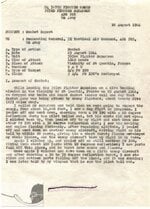
a) Document file number 043697, in the BP Archive at Warwick University, and specifically to 'Petroleum Board Enemy Oils Fuels Committee. A Survey of the Results Obtained to Date in the Examination of Enemy Fuel Samples', by D. A. Howes, dated 4 November 1940. This used fuel samples taken from 29 crashed Luftwaffe aircraft between November 1939 and September 1940, and, exclusive of one sample of captured British 100-octane, revealed octane ratings which varied between 87.5 and 92.2 octane. The results were summarised by H. E. Snow to Sir William Fraser on 13 November 1940 as follows (and I quote from the original document):
'No general indication [of] iso-octane or other synthetics. The only 100 octane fuel identified was definitely captured British.'
b) The Narrow Margin of Criticality: The Question of the Supply of 100-Octane Fuel in the Battle of Britain by Gavin Bailey
This paper concentrates of the origin, supply and distribution of 100 Octane fuel. Included in that is the distribution to the RAF in France and the capture of that fuel.
Note 1 - Gavin Bailey was a member of this Forum and gave us a considerable insight into this subject
Note 2 - There was a second paper which covered the analysis for the period after September 1940 which I cannot find. But that was less relevant anyway.
General point
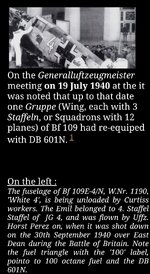
I think we know which German aircraft had the 100 octane in it, the one that crash landed at East Dean. As you are aware, I believe that you put the warning sign on the fuel to ensure that the right fuel goes into the right aircraft.
You may consider it speculative for me to say that, but unless you can come up with a reason as to why you would put a 100 Octane warning on a plane that can only use a different fuel I would consider my position to be a strong working assumption.
I do not pretend to know what technical changes would be needed to make a DB601 run on 100 octane, all I do know, is that the changes to make the Merlin run on 100 Octane were fairly minor and done at squadron level.
I hope the above helps
I have seen this before and we know that the fuel samples in the crashed aircraft were routinely analysed. In fact some very clever work was done later in working out where the Germans were not able to fully use the fuels that they actually had.
So, we discussed earlier how the Germans captured and used the fuel, usually by blending to improve the lower grades, a problem that the Germans had.
The question remains though, was any advantage taken of the different British fuel at its defined 100 Octane and could the DB 601 A engine use the 100 Octane? In a straightforward
view, you might say "why not?" Well, just before WW2, the British were looking at using 100 Octane and improving the performance of some front line engines. Unfortunately, when the USA sourced 100 Octane fuel was tested it was found that it was unsatisfactory in Rich mixture response, ie, it did not have the expected higher octane characteristics of approx 130PN when used in Rich mixture, and full power detonation could occur at high boost pressures. After evaluation, fuel chemists devised a different 100 Octane fuel that did give a rating of 100/130 and this was initially called "Sweeny's Blend". This was the initial standard that was able to be used in the RAF change to 100 Octane. This illustrates that all fuels are not the same even if the Octane numbers are similar, for instance the BoB German C3 of 96 Octane was nominally something like 96/125 but, it was wreaking DB 601 N engines because it had a very high boiling point constituant that did not boil off at the DB 601 N oil temperature.
Personally, I do think that the RAF 100 Octane fuel would work in the DB601 A and possibly the 601 N, but that is not certain, and we have no information, so far, that increased engine performance was taken by engine modifications, and I have not seen a Luftwaffe or RLM clearance to use British 100 Octane.
I am interested that you view the 100 Octane modifications for the Merlin were minor.
Eng