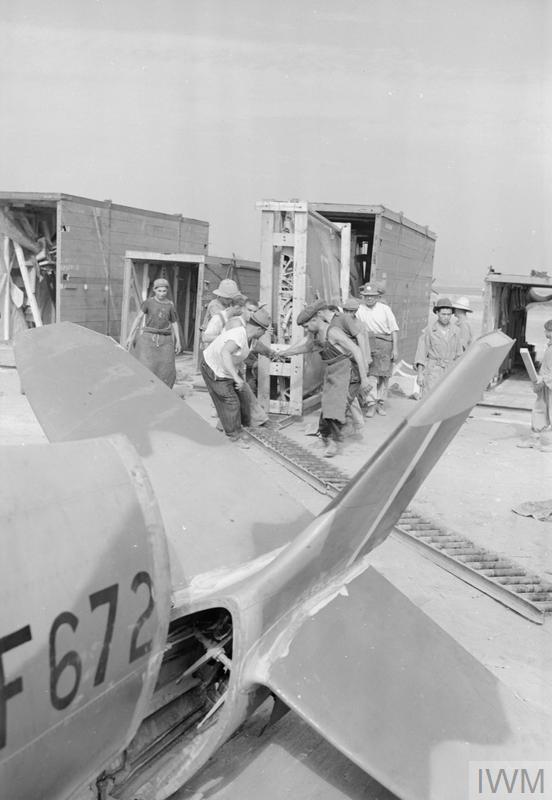
Well, a different take would be that a longer range Spitfire would have hurt the daylight bomber offensive.
My understanding (albeit a little under informed) is that bomber escort was conducted in zones, or waves. The first zone, or wave, was conducted by Spitfires and P-47 ranging our about 250 miles (rough memory here), after that a second zone with P-47's and P-51's out to about 400 miles, and after that P-51's.
The Spitfire was being used in its best range and performance. Trying to extend the range, duplicates the capabilities of an already excellent aircraft (Mustang) and creates a void in the shorter coverage area.
Fighter Command was underemployed in 1943 in daylight, lots of areas to cover but few raids. The advantage of a longer range Spitfire works for insertion cover, it enables airfields further back from the coast to be used for that task. And again no one is trying come up with a second Mustang, rather a second 1943 P-47 range wise.
IIn 1943, the P-47 and P-38 were already in use. The Spitfire and P-47 were well used in the 200 and 400 mile arcs (ok, slightly shorter). Beyond that required a plane with really long range and that was the P-38 and Mustang. ... It seems to me that trying to give a Spitfire that kind of range is, in essence, trying to make it a Mustang.
The P-47 was in use in 1943 but without external tanks until the second half, the P-38 first mission, ignoring the units that went to North Africa from England, was 15 October 1943, first bomber escort on the 20th, it took until 28 December before a second P-38 group flew its first mission. First P-51 mission on 1 December, first escort mission on 5 December. Using first mission date, 3 operational P-47 groups on 13 April 1943, 4 on 12 August, 5 on 9 September, 6 on 14 September, 7 on 15 October, 8 on 13 December, 9 on 22 December.
In April 1943 the 8th Air Force had 6 Heavy Bomber Groups operational to 3 Fighter Groups, or 2 to 1, it was 4 to 1 by end May, 5 to 1 mid July to early August, 4 to 1 mid August, 3.3 to 1 on 9 October before finally dropping to 2.5 to 1 in mid October, it spent early 1944 under this, as low as 2.1 to 1 in late January before climbing to 2.5 to 1 in May and staying around this ratio for the rest of the war. Figures exclude the 9th Air Force fighter units, while the July and August 1943 figures benefit from 3 B-24 groups being in the Mediterranean.
Eaker had a fighter numbers as well as range problem.
The Spitfire VIII with a 90 gallon drop tank, vertical climb, fast cruise from airfield, similar return can make around 300 miles radius after allowances for combat and reserves. Does that make it a Mustang? Add a 33 gallon rear tank and you add another 80 miles to the radius. Now is it a Mustang? Increasingly after mid 1943 and certainly after mid October the 8th stayed within fighter escort range. The record of the P-47 in the 1943 and early 1944 period shows an aircraft matching its range should see a lot of combat. Roger Freeman reports the P-47 radius with an 84 gallon external tank as 280 miles in July 1943, then 325 miles with 108 gallons of external fuel in August then 375 miles with 165 gallons of external fuel in February 1944.
What we do not know is how the P-47 radius was calculated, so we can use the same profile for the Spitfire.
I appreciate your argument about extending the range of the Spitfire in 1942, but I think there are a number of factors working against you. First, I think the engineering to make a LR Spitfire is greater and more involved than adding gas tanks where possible. I'm not an aviation engineer, but from what I was able to read my guess is that you are looking at a fairly substantial redesign of parts of the aircraft to make it sounder that role.
The idea is an increase in 1943 over and above that the mark VIII achieved in 1942. Can you please provide the references make it clear fitting a 33 gallon rear fuselage tank into Spitfire VIII/IX/XVI would require substantial redesign, perhaps with examples drawn by the fitting of 1x75 or 2x33 gallon rear fuselage tanks into the mark XVI and IX in 1944/45 which would presumably have cause more substantial redesign problems?
It is generally agreed the longer range Spitfire did not happen in 1943 partly because no one was asking for it, until mid 1943 the Luftwaffe could generally still be encountered around the front line and while the P-47 was working its bugs out only the Merlin 60 series Spitfires had been shown to match German fighter performance. Result was a great demand for the latest Spitfires. Equipping existing underemployed Fighter Command squadrons with longer ranged fighters would not be a drain on the RAF.
You are adding almost 200lbs of fuel plus the weight of the tanks. over the weight of MK VIII with the existing tanks.
Why didn't they do themselves?
Some of the early MK VIIIs had a fuel cooler added in the port wing root. It may have depended on which engine and when the plane was built.
Some planes had a gun camera in the wing root/leading edge. That seems to have bounced back and forth Between sides?
When the MK VIII was being designed (not when they were built) what was the promised power out put of the Merlin engine?
You can reinforce the wings to handle more weight (if you have the time to do the calculations and the change the production drawings).
And the Spitfire VIII ended up cleared for 1,000 pounds of bombs or about the weight of a 33 gallon rear tank plus 90 gallon external. They actually did do it, in fact more than did it, by putting 2x33 or 1x75 gallon tanks in the IX and XVI rear fuselages, but in the second half of 1944. Here the requirement is 1x33 in the second half of 1943, using things like the results of the December 1942 trials and the use of the 29 gallon rear fuselage ferry tank for the mark V, the one that had less weight forward so was not as able to carry rear fuselage loads.
As for engine power as designed does the same apply to the P-51? After all the D gained over 100 pounds empty and 300 pounds gross, so the D should be predicated on the 1942 Merlin power, since the Spitfire is 1941? Or can both designs do modifications in 1943 and 1944 based on the available engine power at the time? Did the P-51D "reinforce the wings to handle more weight (if you have the time to do the calculations and the change the production drawings)."?
Gun camera location? This is becoming very funny.
The Manual for the Spit says to have no more than 30 Imp gallons in the rear tanks (post war manual does not say 33 IMP, it says 30.) the handling trial from Jan 1945 used the metal covered elevator. I would very hesitant to use that recommendation on a normal MK IX and we do know that not all MK IXs used the same elevators.
You see when you simply post simple to check falsities it is hard to believe anything claimed. Morgan and Shacklady can be checked to show the early 1945 tests used a standard Spitfire that was also given hand made metal covered elevators for *some* of the tests, they made handling better. There were July 1944 tests on a mark VIII with a 75 gallon rear fuselage tank.
The proposal is a 33 gallon rear fuselage tank, the 75 gallon tank would have weighed about 42 pounds more, or 5 to 6 imperial gallons worth, secondly the pair of 33 gallon rear tanks was preferred because of fuel movement in the part filled 75 gallon tank when the aircraft moved. We know you are rather hesitant from your concerns about 1941 power levels, 1942 production numbers, gun camera position, fuel coolers, elevator coverings and the continued insistence on comparing the Spitfire to the Mustang, not the P-47 and a whole lot more negative ideas.
The much vaunted P-51 was used with 55 US gallons (45 Imp) in the rear tank, plus the 180 US (150 imp) gallons in the wing tanks.
Why do you think the P-51 was over rated? The proposed Spitfire with P-47 range has 124 imperial gallons front fuselage and wings, plus 33 imperial gallons rear fuselage, total 157 imperial, 188.5 US Gallons (or 17.444 British Firkins if you are firking around) when entering combat. No one expects the Spitfire to go out as far as the Mustang, even if it had the same drag. They do expect it to go out about as far as the P-47.
Warm up, take-off, and climb to 25,000ft can take a fair amount of fuel and combat allowance of 5 minutes WEP and 15 minutes military can also suck up fuel.
A Mustang with wing tanks and 75 US gallon drop tanks and no rear fuselage was carrying close to 2000lbs of fuel for take off.
A Spitfire needs to lift over 270 Imp gallons of fuel for that weight.
Of course the Spitfire allowances for take off etc. have been given several times, but somehow we need to be told how expensive climb and combat are, for the Mustang plus apparently the Spitfire needs to carry 270 imperial gallons, no idea why. The extra weight of the Mustang would mean maybe a third more fuel to climb to the same altitude as the Spitfire.
Imperial (British) gallons in 1 long ton, 2,240 pounds, 100 octane avgas 315, other grade avgas and motor spirit (petroleum/gasoline MT80) 300, Diesel 259, marine diesel 250, RN oil fuel 238. A Slug is 1 Geepound or 14.594 kilograms, if overweight consider quoting yourself in gee what big pounds, though not sure saying you are so many slugs would work as well, unless knocking back whisky perhaps.
The problem comes with the 300 plus.
You are going to need about 1 imp gallon for every 5 miles you go in and 1 imp gallon for every 5 miles you come out.
350 mile radius is going to need and extra 20 gallons.
And with even a 90imp gallon drop tank you are over the normal max gross weight and may be restricted as to what runways you can use.
As has been pointed out the profile is fast cruise from airfield to return to airfield and 33 gallons adds 80 miles to the combat radius. Add possible problems with runways to the longer range Spitfire what a disaster list.
Well, they did go to 120-123 gallons when they had the chance, but that was one factory while an other factory stayed with 85 and 96 gallon set up.
124 gallons, and 85 gallons.
The question we have been arguing over for over 12 pages is, while you can't equal the Mustang, how close can you get with a plane that was around 77% as heavy when clean (neither using rear tanks)?
The MK VIIIs went to NA/Italy and the Far east because that is where they needed the extra range.
The mark VIII was meant for overseas service, dust filters as standard. And actually much of the last many pages has been about keeping the Spitfire range the same as the P-47 in 1943/44, answer take a slight production hit at Supermarine and use the 1942 data about rear fuselage ferry tanks to fit a 33 gallon tank in the final quarter of 1943, take a bigger production hit at Castle Bromwich to increase fuel tankage to the 124 gallon mark when it switches to Merlin 60 series Spitfires in mid 1943, then later add the 33 gallon tank. The reason it has gone on for so many pages is the continual erasing of the P-47, replaced by the P-51 for comparisons and one of the biggest efforts in a long time to throw everything and anything against an idea considered bad in the hope something sticks.
As the calculations show, the need for 75 or 66 gallons in the rear fuselage was actually close to zero for the missions the RAF did in 1944/45, including escorting Bomber Command to the Ruhr, as by that stage most of the route was in friendly airspace, no need for fast cruise until near the target. The Spitfire 21 was on a different development track and being a 1943 design was not expected to have the reach Germany range, though of course the XIV did it, add the F.21 handling problems and no one was going to increase them with more weight to the rear. The F.22 added a 33 gallon tank, the F.24 2x33.
Which Type of Spitfire did they think they were going to need for the end of the NA campaign and the invasion of Sicily and Italy?
The Italian campaign bogged down and they often didn't make very fast advances making the air war somewhat static and perhaps they weren't getting the supplies of aircraft that they wanted and had to make do with substitutes?
Initially the mark V, which had its troubles with the Bf109G, followed by the mark VIII, but then the Fw190 turned up and the VIII was late. So Fighter Command gave up some of its mark IX as a result. The Italian campaign first bog down was around October 1943, mainly as the Germans did not defend southern Italy against 8th Army, there was a slow advance October to January.
Thanks for an amusing way to spend an hour.
Rough rule of calc for Merlin 60 series is 5mi/gal (as good as cleaner - less drag- Mustang) = 60 gallons for 300 miles at 300mph, plus 30 gal for loiter = 90 gallons internal required to make it back to base.
Spitfire VIII 320 mph 66 gallons per hour consumption. Is loiter in addition to reserves?