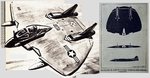
The Navy later thought enough of it to fund Zimmerman's abortive attempt, though for some reason they confused the high drag at low speed-high-A flight with cruise performance. Not true, as proven by the Arup which flew for NACA, and established the utility of the low-aspect ratio planform.
What standard would be used to say they were worth no more than novelty? Good speed and efficiency, safe routine operation put into practice, what more?
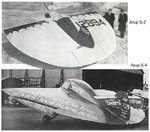
Hoffman moved on after the S-3 was destroyed after being damaged by apparent arson, and another worked with Snyder on the S-4. Hoffman built his for Younghusband, and it was well into successful trials when the fatal crash occurred. A fuel leak and fire isn't a damning statement against the type and concept, nor is market apathy to the Arups. They flew, and did so very well.
First of all, "Good Speed"? I'm not sure how you define good speed, but the Arups were not fast.
The Arup S-1 was slow and uncontrollable.
The Arup S-2, which is the one that was demonstrated for NACA and the military, had a top speed of 97 miles an hour. The S-2 eventually crashed.
The Arup S-3, which had poor flight characteristics was the one that was eventually destroyed by arson.
The Arup S-4 had a top speed of 115 miles an hour - which was not impressive even by 1935 standards.
The Hoffman wing had an impressive speed of 135 miles an hour, but caught fire during a flight and crashed.
Not an impressive track record, to be honest.
Not true by any means that it compared to the Arups. The Arups flew dozens of sorties, several seasons, multiple pilots and were proven. 15p made a handful of hops with only one pilot and was always problematic. Not at all in the same category of proven exhibited performance.
Arup never tried to build tail-less. Most designers of such planes like Fauvel, Cheranovsky and Canova also tried to go tail-less and all eventually resigned to a fin at least because of poor control and stability. The Navy's plane also used fins, and found that the separated elevons hung behind the wing were far better than the tailing edge ailerons or wingtip-flippers of the Arups. (No significant advantage to the out-ward rotating props in the Vought plane, though. Less stability)
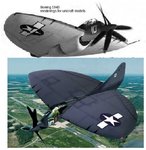
The little Boeing test plane would have been a true study of the Arups, so why doubt that Boeing for the Navy couldn't repeat the usefulness?
The Ford Motor Company, by way of the Stout Metal Aircraft Division, had a great deal of success with aircraft building and the Model 15-P held solid promise, but the War sidelined the project. If the Arups held so much promise, where are they today?
The Vought V-173 had a top speed of 138 miles an hour and had reasonable performance.
The Vought XF5U
never was able to get airborne because of technical problems.
So while the Arup types were viewed by Zimmerman, who went on to design the two types for Vought, there was no physical connection.
To expand a little, the Sach AS-6 was also problematic. So it appears that disc or heel shaped aircraft held little promise HOWEVER, the Ford Model 15-P was a Flying Wing, not a full or half disc planform.
The Boeing 306 concepts were nothing more than just concepts and there's a big, fat book of "Luft '46" concepts that promised a great many things, too.