German Battleships and convoy hunting.

Ad: This forum contains affiliate links to products on Amazon and eBay. More information in Terms and rules

The Iowa class BB's were needed in the Pacific for a variety of reasons.

There was really no use for them in the med.

How do you know the Iowa had bad sea keeping? The typhoons in the pacific had no effect on its sea keeping.
 
I do not like to say this but it is true.

The Iowa was a great sea ship and had better range finders and had greater range because of her 16 inch guns and she had 9 of them. She also had more sicondary guns. Well I must say that with a well oiled engine you can do anything. The German crew were indeed well trained and fought bravely, if you do not have well trained men or brave men you may have the best battleship she will not fight right.

Henk
 
Dear Henk, switch to page 4-7, there is a lot discussed. 16" alone has nothing in favour...there are good guns and there are bad ones. The US 16"/45 and /50 are considered very good ones but so are the 15"/52 of Bismarck. There is only little difference between both guns and while it is true that Bismarck has one gun less, it still has more battery output due to a higher RoF.
The range finders of Iowa (the optical ones) are by far not as good as Bismarcks. I often read people saying so but if you reed the post ww2 comments on german optical rangefinders You will feel very disappointed if You think Iowa was state of the art.
And Iowa wasn´t a sea ship like Bismarck.
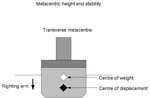
There is a way to find out wy: Metacentric height. You have two metacentric heights: one for transverse and longitudinal (compare the attached picture).
Here are some metacentric heights (GM) for BB:
Richelieu: 9.28 ft
Iowa: 9.26 ft
Yamato: 9.81 ft
Vittorio Veneto: 5.84 ft (ok-only in the calm mediterranean, neglectable)
Howe: 7.32 ft.
Vanguard: 11.12 ft.
Bismarck: 13.48 ft.
The design of german capital ships since pre ww1 were all with great empahsis on a high degree of design stability, as was the Bismarck. In most cases the centre of Bouyoncy is below the centre of weight the height is measured in ft over keel (CoG-CoD=metacentric height). The rule is:
The higher the metacentric height= the stronger the righting arm = more stability. I quote one occasion where two BB of different GM were in the same storm: during Nato maneuvres in the North Atlantic Iowa and Vanguard had same speed and direction, Vanguard suffered 15 degrees worsest list while Iowa suffered 25 degrees. Bismarck had even far more GM and therefor far more stability, in theory it could still prevent capsizing at 61 degrees when all other BB long went submerged! The longitudinal GM of Bismarck was better than Iowa as well. The fine bow of Iowa was a problem at heavy seas:"This shows why the Iowa's were so wet forward; because they had very fine lines, the mass of water displaced by the bows was not great so digging the bows (...in the waters...) in did not displace the center of buoyancy much so little righting arm existed."(compare article of Stuart Blade at the NTB) This is even more important if battledamage caused some flooding because this will always reduce the ships acceptable metacentric height (Counterflooding also will always reduce the GM). This may be a reason why Seydlitz managed to return with 5.500 tons of water during Jutland as it would directly contribut to the survivability of the Bismarcks.
A negaive side effect of this is that the rolling periods will be shorter at heavy seas, this will negatively influence weapon platform. A reason why german designers preferred the three axes stabilized mountings for all but the main artillery gunmounts.
 

Attachments

  • metacentricheight_650.jpg
    metacentricheight_650.jpg
    21.6 KB · Views: 293
Oh yes I agree wiht you that the Bismarck was a better sea ship than the Iowa and on the guns becuase the German gunners was better, lol. The only problems wiht the Bismarck was hes stern design and the stearing wiht the propellers and the AA. That is all, other wise she was great.

My friend bought himself a Bismarck model but he f****ed it up becuase he did not follow the instructions but it gafe me time to study the design of the ship and then I also got the famous book THE DESCOVERY OF THE BISMARCK by Dr Robert Ballard and I learned a lot there. Great book.

I also design ships just for fun by hand, the 3D thing is just still a problem.

Henk
 
The stern design may be weak, agreed. Another possibility is that the welding failed at the very structure, which was already weakened by the torpedo blast. The bow structure of US cruisers wasn´t that good either. There are no recorded problems with the bow structure of US fast battleships, but they haven´t been tested. The stearing with one centreline prop was unstatisfying, agreed. The AA tracked the slow Swordfish too hard, otherwise the Tirpitz AA proved to be a capable AA suite at least for a battleship.
By the way Ballards book was my first on Bismarck, too.
 
The Prinz Eugen also had a weak stern and was forced to be in dry dock for a wile. They improved her bow and never had a problem since.

Yes the Tirpitz had great AA and was a brave ship, the only thing was that it was just sitting around.

Henk
 
Fleet in beeing, this was Tirpitz purpose in Norway.
And yes, Prinz Eugen had to be docked after it suffered a torpedo hit in the stern. I believe Lutzow and Hipper also had some problems with the stern.
Could be that this is a general design weakness of german capital ships.
 
Yes, it was a small fault in the design, but a big one in battle.

Still I love German Designs of Battleships WW1 and WW2.

Henk
 
Haven´t seen any battle related difficulties with the stern. Bismarck´s broke either while sinking or while hitting the ocean surface, Prinz Eugens broke after torpedo impact (but the ship still was able to maneure and keep some own speed), as did Lutzows stern suffered damaged after torpedo impact. That are two CA and RN CA are reputated for sinking after one or two hits. Compared with this it is pretty little damage.
I do personally like german high sea fleet ships. Aesthetically nothing beats Lutzow in ww1. In ww2 my vote would be either Yamato or Richeleieu with a close Washington beeing second (resp. third).
 
There are some, but I will have to check the books. The USS Jeauneu should not been considered as 1 hit. The torpedo exactly hit the same spot where another Long lance weakened the hull in the previous night.
Compare with the british Dido´s (except Argonaut which survived two impacts at the extreme bow and stern), Arethusa and Amphions cruisers. One, sometimes two hits and rapidly capsizing.
The Indianapolis also did not well against two SS torpedo hits in the bow (which isn´t as critical as amidships hits).
 
Interesting question.
At leastone german Submarine surrendered while enreoute to Japan. Beside of other material also fuzes (contact, approximation, time, acustic, magnetic) should be delivered to Japan. Whether or not german magnetic pistols were delivered earlier I don´know, but I too, wouldn´t exclude this possibility. Thanks for the hint!
 
Yes, the stern of the Bismarck broke when she were still on the surface. The German gunners were great and well trained and there ships were ready for action. The Prince of Wales malfunctioned during the battle with the Bismarck when the Hood sunk. The royal navy send her in not even making sure she were in working order.

The captain of the Bismarck was very mad because the admiral did not want to go after the crippled battleship and said they do not have time for naval games.

Henk
 
I wouldn´t be too sure that the stern broke when the ship still was on the surface. At first, all eyewitnesses stated that the ships hull was intact when she capsized (one of them was a leading damage controllofficer of Bismarck, we should credit his statements). Next if we check the Bismarcks debris field the stern remains are too close to the main wreckage to be explained by an early seperation. Indeed it is located at the one end of the earth distortion field caused by the impact of the ship on the seabed. Actually right there, where we expect the ship to hit the ground. We will never know for sure.
Right, PoW was not battle ready but I am convinced she also would suffer turret failures if she had more trial time. The reports from KGV are not much better, at first the radar failed, then sukzessively the quadrupel turrets. A horrible main battery reliability. Most of these problems have been fixed by late 1942/early1943 but the quadrupel mount still made problems and tended to fail under heavy use.
 
Oh, I was so stupid not mentioning it before. When Discovery Channel went back to the Bismarck they found out that the stern did not brake off it just bend downwards. Also they finally found out that she were scuttled by the damage on the hull and not a torpedo's like the Royal Navy said.

I do not know if it is true that the stern just bend downwards, it sure as hell does not look like it.

The men of Bismarck did fight very bravely in the last battle. Lets take how the ship looked when the order came to abandon ship, she had great damage.

The other thing that also caught my attention was that the bridge was not heavily damaged, just the firring control station on top of it was destroyed in the battle, but they did find both and still looks quite good.

The turrets lies upside down, but the armament are still on the ship and can still be seen pointing her guns at the enemy still looking dangerous.

The sad thing is that they scrapped the Tirpitz and not raise her to find out how she works.

Henk
 
Yes, Henk.
However, the Bismarck was badly worked up during her final battle. The bridge is a wreckage, I doubt that anyone there survived the first hour. One of the turrets (Bruno) suffered a magazine or ammo explosion, knocking out the whole unit permanently. Turret A suffered impacts to temporarly knocking out the turret (as did C and D) Only Dora and Anton resumed some fire afterwards. Despite it´s small turret face armor, no shell penetrated a turret face (but some penetrated the turret sides of disabled turrets). There were multiple fires in the secondary and tertiary guns. One 4.1 " magazine below the main armor deck also suffered magazine fire. The whole forward superstructure, except for the unarmored admirals bridge, was repeatedly penetrated and almost each square inch suffered impact, blast or fragmentation damage. The armored weather deck and the upper zitadell armor belt were several times penetrated. The main belt armor was at least four times penetrated. No penetrations of the main armor deck, the sloped belt and the torpedo bulkhead have been recorded so far. According to the surviving damage controll officer the ship suffered some list by local flooding (in order to prevent magazine explosions), extensive fire in the suerstructures and nearly total losses of communication to the vitals above the main armor deck. Below the main armor deck the ships still worked properly. Engines were running, turbines provided electricity, communication and order of work were fine. All survivors were overwhelmed when they left the platform decks and recognized the heavy destructions above the main armor deck.
 
I just once more compared the secondarys of Bismarck and Iowa/South Dakota. It should be noted that Iowas secondarys are completely useless against the Bismarck´s armor scheme. At 18.000 yrds range they would have a very little chance to penetrate the Bismarck´s weather deck (NBL: 1022 fps, striking velocity: 1030 fps at 27.6 degrees obliquity), but the range is limited to 17.850 yrds. No complete penetration of the weather deck is possible. The main armor belt of Bismarck cannot be penetrated by any distance, nor could the turret or Barbette armor suffer penetration (even non penetrating damage seems unreasonable for me, the striking velocity is too slow as is the projectiles weight.). The upper zitadell armor (145 mm) cannot been pierced by any distance over 2.150 yrds, at any distance under 2.150 yrds the shell wouldn´t be effective (Only partly penetration or Navy Ballistic limit, never effective ballistic limit, due to face hardened) in most cases. Not the bridge nor the rangefinders cannot been penetrated by the 5" of Iowa and South Dakota. The inclined 50mm Wh armor at the bow can be penetrated at all distances under 8000 yrds, the stern armor (80 mm) at all distances under 5.700 yrds. No diving shell (including duds) has any chance to penetrate the secondary 20mm torpedo bulkhead. The turrets of the secondary artillery will be safe at distances between 6.000 yrds and 16.800 yrds, the tertiary at distances between 9.000 yrds and 14.000 yrds. On the other side, Bismarcks secondarys have a better range and AP-capabilities and will hurt Iowa and South Dakota much more. In this particulary comparison the US ships secondarys are close to useless against Bismarck.
 
I wish I had the pictures to show you the dammage on the bridge of the Bismarck when they found it in 2000. I think it is on the Hood sociaty's website. One of the survivers said he saw the capitan on the bridge when they abanded ship. He was surprised that it was in such good condition and that the capitan was still alive.

Oh, I wish they would make a modern movie about the Bismarck's story.

Henk
 
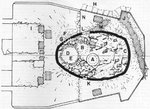
The Bismarcks bridge shows extremely heavy signs of destructions. But this is only the armored ("Gefechtsbrücke") main bridge. There is a secondary bridge and the admirals bridge.The later wasn´t armored and is much less destroyed (the shells just went right through the structure without setting the base fuze of the projectile). At the very short distances of the last battle, no armor can provide immunity (we already discussed the serious matter of non penetrating damage as well) from AP shells.
Compare the attached picture, it is taken from an article of the Naval technical board about the Bismarcks last battle by Thomas G. Webb and shows the recorded impacts on the armored main bridge.
 

Attachments

  • bismarck_bridgedamage_202.jpg
    bismarck_bridgedamage_202.jpg
    54.2 KB · Views: 172

Users who are viewing this thread

Back