German Battleships and convoy hunting. (1 Viewer)

Ad: This forum contains affiliate links to products on Amazon and eBay. More information in Terms and rules

Look at it this way, suppose using the numbers from the Yamato were applied to the Bismark from a single CVE carrying 12 torpedo bombers.

One out of every three torpedo's launched could be expected to hit. Just for this scenario, say only two would hit. Now consider that after attack the planes return back to the CVE for another reload and go back. It wont take time at all for a quite a few torpedo's to have hit it. The same situation happened between the USN and IJN fleet action in the battle of the San Bernardino Straight (in the PI, 1944).

One thing that was proven in the PTO was AAA from the fleets couldnt stop all of the attackers. More than enough got through. Considering that the Bismark would not be operating in a large sized task force with its massed number of guns, I would say not many attackers would be shot down.

Plus, once the Bismark was under torpedo attack, it would have to go into evasive maneuvers which meant it would not be getting closer to the convoy it was hunting. Every hour it was under attack and maneuvering meant other RN and USN forces (air, sea and air) would be getting closer to it.
 
I got your argument.

WW2 records show that the hit percentage compared to started planes was well below 5% as long as the ship is maneuvering. And with 12 torpedo bombers You could expect something between 0.6 and 1.2 hits, that´s not much (esspeccially since the raiders are quite immune) but it might effects the ships range or (to a lower degree) speed. Keep in mind that between 10 and 30% of the air relaised torpedos will fail to detonate properly. Twelve bombers are a good number to deal with by AA fire. I don´t expect that a number of them will be shot down (since US and british planes can sustain much more battledamage than their japanese counterparts) but it will be hard to get a clean shot anyhow. Those twenty torpedo bombers attacking Tirpitz got not a single hit, while none of them was shot down (5 severly damaged), post battle reports showed that AA fire was very effective, so they had to release the torps from longer distance or unfavourable angles. Unless the bravery of the pilots is extraordinary or the will to do suicide (the closer they get on the BB the better the chances to hit and the more effective is AA), which would result in both, more hits and higher loss rates, I see no sense in this tactic from the RN/US point of view (which generally was careful).
A first line Carrier (just like those to attack Musashi&Yamato) would have a better chance to perform effective torpedo runs due to the higher number of planes involved (fighters going to starfe the BB´s AA, Bombers attacking the ship from above while in the same time torpedo planes perform attacks from the sides).
Another concern with CVE is their very limited worth at Beufort 5 or higher. At stage 6 only rarely sortieswere flown. And since the raider always seek bad weather circumstances (ok-planes do have a longer range) and factoring the north Atlantic weather there would be a narrow window for any CVE operations. And those CVE would be very exposed to the raiders once they get contact (which would happen in case they are ordered to stay in convoi formation sooner or later).
However delaying the ship, knowing it´s position and a good deal of teamwork between task forces and CVE will hunt the raiders effectively, hands down.
 
The Bismark was undoubtedly a tough nut to crack and the Homogeneous Armour steel was very robust however it is forgotten that many torpedoes not only used contact exploders but as in the case of the 18inch British Mks carried by the String bags they used the duplex pistol which enabled either contact or proximity detonation this enabled deep setting and there by attacking the weaker parts of vessels namely the keel plates that where much thinner than the well protected sides.
This type of detonation was attempted to be countered by the fitting of degaussing equipment (Magnetischer Eigenschutz) but was limited in effect by the torpedoes only passing within a few feet of the ship as opposed to the considerable distance that magnetic mines operated from sitting on the sea bed as they did.
The best defence that the Bismark had against this type of explosion was as with most navel vessels , multi compartmentation this meant that it would take numerous hits in various areas in order to flood sufficient compartments to cause the ship to founder. I believe the Bismark had in the order of 200 compartments in each of her 4 decks. So even that method of attack was not easy but as was the case in reality although the ship remained afloat, as a fighting unit it had no ability to continue to fight after everything from stem to stern had been raked by enemy shell fire and the gunnery control systems had been destroyed.
 
Yes.
I don´t know how well either magnetic pistols or MES were working, but I suspect that both had disappointing reliabilty prior to 1943 (referring to the replace of magnetic pistols from Victorious and Ark Royal in 1941 as well as the three mine hits at Gneisenau and Schanrhorst during their channel operation[I suspect this were magnetic ones but I don´t know]).
The degree of total compartimentation of Bismarcks hull (including the hulls decks above the normal waterline) is stated with 800, but this figure only tells us how many "spacial units" were there. A torpedo hit usually will cause several "units" to be flooded, so it´s better to take on the main compartimentation (divided by each other with armor grade plates of at least 45 mm thickness), so they are really tough nuts to crack). We do have 23 of those, called Abteilungen, in case of Bismarck (of course each is divided into watertight rooms and sometimes even those are watertight subdivided, too).
The only warship to carry effective bottomprotection was the Yamato-class with it´s 50-80 mm armored hull bottom (which also had enough void cells to contain blast effects). However it wasn´t fully protected, the protection leaves the engine and turbine room blanc, only the main magazines are protected (rarely 20% of the hittable hullsize). While the ship had the highest subdivision known (1174 watertight spacial units, ignoring the void and fuel cells) for any warship, it´s protection was very biased:
The main armor zone covered most of its units (1005) leaving some very large spacial units without any protection in the bow and stern, this is even more worrisome if we factor that almost 35% of the substructure is unprotected by any substantial TDS.
 
trackend said:
The Bismark was undoubtedly a tough nut to crack and the Homogeneous Armour steel

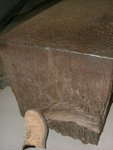
You can go to Kiel, Germany and see one of the Steel Plates from the Bismarck that was just left sitting on the docks after not being used on the ship.
 
Thanks for the post Del I noted that you said the bow and stern where not as robust as the the rest of the Bismark I'm sure this must have been the reason for the stern breaking off when it hit the sea bed as described by Dr Bob Ballard when he located the wreak-site.

I would be interested to visit Kiel Adler Ive only been to Germany twice once on business too Koblenz and once to see the Rhine in flames festival.
I took this shot of a piece of Tirpitz'es belt Armour at Duxford museum last year.
 

Attachments

  • tirpitz_belt_armour_631.jpg
    tirpitz_belt_armour_631.jpg
    46 KB · Views: 334
Yes, I saw it once (am sure it was KCnew). But we don´t know why it is there. Most certainly because the plate was rejected for use on Bismarck (it carries testmarkings).
This is a problem for so many heavy armor plates: One example; For Littorio we extrapolate it´s armor strength from a very single armor plate specimen (which may be rejected for use as well). According to the understanding of armor in Italy (which was the best in prewar times) it is kind of a surprise that this armor has only slightly better quality than japanese ones. But again, it may be wrong to extrapolate from a single plate of unknown source...
 
It really looks like the stern structure was cut of when it hit the sea bed (at around 27-31 kts), agreed. Bow and stern were more fragile but still very tough if we compare them (Iowa, Yamato, North Carolina, South Dakota, the britisch BC and all french BB had no armor enforcement there, Bismarck and Scharnhorsts had 50- mm Wh, but this is still insufficiant to protect from shells or torpedos. The Gneisenau refit should get 80 mm Wh thick bowbelt (which may protect from 6" at long to medium distances). The structure in the bow was much enforced but the stern was weak (Ballard correctly quotes on the stern cut of Prinz Eugen when it was torpedoed there), particularly if we compare this with contemporary designs (the flask like shape of US and Yamato BB turns the stern into a structural very strong but unprotected unit).
 
I just have finished some conceptional studys on Hipper class CA. I always found it strange that they decided to produce 6 of them (Hipper, Blucher, Prinz Eugen, Seydlitz, Lutzow (the later two not finished) instead of some more pocket battleships (Spee, Scheer, Lutzow).
The Hipper class is a lot larger than a pocket battleship but still inferior to ALL major aspects except for max speed:
displacement:

Graf Spee: 16.000 t
Prinz Eugen: 18.400 t.

speed:

Graf Spee: 28,5 kts
Prinz Eugen: 33,5 kts

endurance:

Graf Spee: 17.460 nautic miles / 17 kts (13.500 sm at 20 kts)
Prinz Eugen: 7.200 nautic miles / 20 kts (~ 9.800 sm at 17 kts)

main artillery:
Graf Spee:6 x 11"/52
Prinz Eugen:8 x 8"/60

secondary artillery:
Graf Spee: 8 x 5.9"/55
Prinz Eugen: none

dual purpose:
Graf Spee: 6 x 4.1"/65
Prinz Eugen: 12 x 4.1"/65

torpedos:
Graf Spee: 6 x G7a
Prinz Eugen:12 x G7a

float planes:
Graf Spee: 2 Ar 196
Prinz Eugen: 3 Ar 196

TDS(main torpedo bulkhead):
Graf Spee: 45 mm
Prinz Eugen: 20 mm Ww

belt armor:
Graf Spee: 80 mm (inclined)
Prinz Eugen: 70 mm Wh (80 mm at the magazines)

deck armor:
Graf Spee: 25 mm (45 mm over the magazines)
Prinz Eugen: 12 mm Wh (50 mm over the magazines)

front turret armor:
Graf Spee: 140 mm KC/NC (non cementated)
Prinz Eugen: 105 mm Wh

conning tower:
Graf Spee: 150 mm
Prinz Eugen: 70-105 mm Wh

So at all the ten years older Graf Spee is lighter, better protected, has a longer range and more punch than the new Prinz for a speed loss of 5 kts.
Eventually the Hipper class CA were intended to be CL with 12 5.9" (four triple turrets). The armor scheme fits better with a CL than a CA (esspeccially for its size) if you ask me. With the advantages avaiable in 1938 they should have spared the ressources for the Hipper class in order to lay down four more pocket battleships. At the same displacement (18.400 t.), the ship could still carry six 11" /55 (C34 instead of C28 design, higher elevation and therefor a decent range (42.000 yrds) and punch+ very high cyclic firing rate (17,3 sec. for each gun but usually 19-21 sec. due to triple gun turret design), the removal of 5.9" would allow weight to install 14-18 4.1"/60 dual purpose. Improvements in the engine dep. would make it possible to (nearly) double the poweroutput of the Diesels, so at least 80.000-100.000 SHP are possible (this amount of power is still distributable to the two screw design). An 18.400 t. ship could still make 31 kts and keep its superior range. There are even 800 t. for additional deck armor left (thus approx. 50 mm or 35 mm + 80 mm over magazines)! What do you think?
 
I certainly agree about swapping the 5.9 for additional 4.1 and 37mm, as I have never been a fan of 6in secondary weapons. Personally have yet to find an example of them hitting anything.
I am less confident about increasing the engine output. These were amongst the first large diesels used at sea and to double the output on what was already a highly advanced design could be asking for trouble on the reliability front. They had their fair share of teething problems as it was.
Extra deck protection is never wasted but I think that is as far as I would have taken it.
 
I do personnaly dislike 5.9" as well but I can understand those who say they have their own advantage: better range, more punch (a lot more AP-capabilities).
While the RN was advantageous in introducing 5.25" dual purpose (to be fair it must be said that this gun is of very doubtful use against aircrafts if any), the KM stayed with specialised guns, the more powerful 5.9"/55 against ships (which also was used against low level flying torpedo bombers by Bismarck, Scharnhorst and Gneisenau) and the high velocity, rapid firing 4.1"/65 against aircrafts (which regulerly was used against unarmored sea targets).
I do know of some succesful 5.9" uses against Exeter, Jervis Bay, Achates, Acasta, Glowworm and some transports as well.
Rodneys 6" secondarys did well against Bismarck as did Warspites secondarys against the (harboured) german destroyers in Narvik.
However, the focus on 5.9" even for destroyers is a clear disadvantage in the german design philosophy, no doubt. The 4.1" had only a slightly inferior range, almost the same AP-capabilities at close and very long ranges, a better ballistics and a 50% increased cyclic firing rate beside of the advantage of dual purpose service.
Diesel wasn´t really new, the High sea fleet had designed and build some large Diesels for Sachsen, Großer Kurfürst and Markgraf beside of their use in submarines. Next to the Deutschland class, the Bismarck should originally get Diesels as well and the uncompleted Hindenburgs also had Diesel engines. The H-class Diesel powerplant design was closed in 38, each unit made 14.500 SHP (instead of 6.000 SHP in case of Graf Spee), so there is a lot of power redundance for a power output doubling. The O-class BC had a unit of similar poweroutput but lighter and shorter as well as broader than the "H" -class ones.
It is questionable, if these designs would have been avaiable for these "P" class designs of 1937/38. These designs were much heavier ships (22.000 t.) with a proposed speed of 35 kts (I expect to encompany thecarriers?) and 3 or 4 screw design with 15.000 miles range.
 
Thanks for this. I knew that the Bismark was originally due to get diesel engines and admit I put the fact they were not fitted down to problems with the engine. A case I am afraid of putting two and two together and coming up with five.

I knew the High Seas Fleet had some but considering the fact that they were dropped would indicat that there were some problems with them. These days of course its hard to find a large merchant tanker/ ore ship whatever without one.

Thanks again
 
Didnt those diesel engines emit huge clouds of smoke when they went to full throttle? Makes them easier to find I would imagine.

Just curious though, if they're running diesels, wouldnt they need diesel fuel, which is far more flammable than bunker oil.
 
In opposition to what you might expect, the Diesels have some benfits:
Smoke. Under full power, the Deisel engine can operate completely smoke free (unlike steam), this was demonstrated by Scheer a few times in the indic ocean, when the ship prevented beeing spotted by full power smoke free cruise. The Panzerschiffe had a special device to prevent smoking by heating the exhaust gazes (and therefore burn parzicles), similar but more effective than those used on submarines.
Another advantage is the high efficiancy and economics of those powerplants (Lutzow was the ship with greates operational range: 20.000 nautic miles / 13 kts.).
Diesel fuel is a bit more flammable than oil but not by that much, indeed a temperature is needed, which at all would inflame oil as well. The burning is not that intensive compared to gazoline, avgas and so on.
The spacial dimensions of Diesel engines are also smaller than boiler and turbines, but nethertheless they are heavier (compared to the amount of HP created by them).
The full run from zero is possible in within a minute, unlike turbines which require some 5-13 minutes to do so, fuel is not needed if the powerplant is brought to zero.
The complement can also be reduced, since operating Diesels require far less personal than operating turbines.
Not the least, the ship is more immune, since the great danger of boiler hits (which usually were critical, since they had the potential to rip the ship ) is banned. If a engine room is hit, than ok-you loose power, but the ship cannot blew up (or take further damage due to steam bursts).
Of course there are negative aspects as well:
The Diesels were heavy units compared for their poweroutput,
While beeing much shorter and narrower they require more height than turbines (this was the very reason to skip them from the Bismarck design, because they would need to place the armor deck a level higher (reduced stability, reduced immunity from very close distances, no two deck deep zitadell = much thicker armor thicknesses needed) as they did in case of Lutzwo, Scheer and Graf Spee.
Unlike turbines, the Diesels cannot be overrewed (enforced power) that much (Iowa had 20% design overrew!).
The vibrations and sounds caused by those units were uncomfortable.
The Battleships of the High Sea fleet indeed had some problems with the tech, only two of them eventually had mixed propulsion (Diesel for the middle screw, turbines for the two others), some other already produced units were used in large submarines, but statisfyingly. Concernes were that there were no records how the engine would work under battle circumstances (impacts).
 
Sidestep:
I also digged some more on Okun. His major armor penetration formula is based generally on empirical US tests. The only exception are german armor, for them he refused US results (which were better) and instead used german datas known to him (which had lower figures). The comparability of these results is matter of discussion:

Using Scharnhorsts 11"/55 gun on four armor types I can show the difference (hypothetical impact at 30.000yrds distance)-all datas from Okun´s database on AP-capabilitys of KM armor:

1.) on US class"B" deck armor: 3.1"
2.) on german Wh deck armor: 3.8"

This result would imply a superiority of 22.6% in impact resistance for the US class "B" homogenious armor. Indeed if we check his datas, both armor have the same quality (1.00), the US "B" a better elongation but less Brinell hardeness. Now we take italian, japanese and british armor
into consideration:

3.)on italian homogenious: 3.4"
4.) on japanese homogen.: 3.3"

Concluding these datas, the Wh has the worst resistance of all involved homogenious armor. Datas from Okun imply that italian has a quality factor of 1.0, while the japanese one is somehow less resistant with 0.95. Now if we take US tests into consideration at no time there was a significant advantage of US"B" over german KC new. Under the same circumstances they were rated at about equal in resistance, just giving the US "B" an advantage in less fragmentation. This fits with all I read. And a difference in 20% would imply an advantage comparable to those pre ww1 armors to some late ww2 armors! Hell, this datas are wrong.
Had he used the comparable US results 3.1" would be the estimation in AP-capabilities for this gun and this range on Wh, this fits.
Why is that important? Because if using Bismarcks 15"/52 on Wh deck armor the distance at which penetration may occur shifts further into the 30 Kyrds region....
 
delcyros said:
In opposition to what you might expect, the Diesels have some benfits:
Smoke. Under full power, the Deisel engine can operate completely smoke free (unlike steam), this was demonstrated by Scheer a few times in the indic ocean, when the ship prevented beeing spotted by full power smoke free cruise. The Panzerschiffe had a special device to prevent smoking by heating the exhaust gazes (and therefore burn parzicles)

Cool, that I did not know. I thought the same as sys up there on that. Pretty cool, learn something new every day.
 
Scharnhost did not had Diesel powerplants. So it could be discovered by her smoke. Her powerplant was the high pressure steam turbine powerplant used on many contemporary warships (including Iowa, North Carolina, South Dakota, Yamato, KGV and Richelieu). This powerplant has a more benefitable hp to weight relation and quite a good efficiancy, so it was choosed for the Scharnhorsts (as well as Bismarcks). Unfortunately the tech was somehow new in case of Scharnhorst, so both ships had quite a lot of problems to deal with their engines up to 1940. If we compare the teething problems of Diesel and HPT powerplants I would choose Diesels, anyway. The HPT tech reached eventually maturity in the Bismarck design stage, so we donot have reported problems by Tirpitz or Bismarck considering their powerplants.
All in all Diesels would be a wiser choice esspeccially for the US BB designs, which also depended on a good range but I doubt that this tech was avaiable for them in the necessary development stage.
 
The US capital ships built in the late 30's and in the 40's were using (the then revolutionary and advanced) super heated steam turbines which gave them a very good power to weight ratio. The use of diesels would have been a step backwards.
 

Users who are viewing this thread

Back