The problem is that view becomes unreasonable with any kind of examination, which is why by and large the consensus of aircraft designers during the war was generally to increase the size and weight of their airplanes over pre-existing types, and to increase multi-mission capabilities. The Germans did it with the Bf.109. They did it to an even greater extent with the Fw 190 which had every kind of kit-and-caboodle imaginable made for it; somehow it is regarded as their best fighter during the war in spite of having higher wing loading and lower power to weight than the Bf.109. The IJAAF also did it with the adoption of the Ki-61 and the Ki-84 which were of similar size to most contemporary fighters bar the P-38, or planes built around the R-2800.
Even if we assume that an American Oscar is not our ideal lightweight fighter, why don't we consider what the consequences the US AAC would have faced if the XP-44 had never been re-designed into the P-47? The AAC would have had an exceptionally good short-ranged interceptor armed with 4x machine guns, exceptional climb rate, and exceptional performance at low altitude. It would have also had an even lower fuel fraction than the P-47 with around 220 gallons of fuel in non-sealing tanks while using the same engine. This was the plane that Kartvelli had initially designed before requirements were changed by the "Bomber Mafia" to require higher speeds at high altitude and for increased internal fuel loads. So what does that kind of performance but with 2/3rds the range get you in 1943? Under what circumstances would that aircraft have been better?
It would have been useless in New Guinea; the primary complaint the 5th Air Force had with the P-47 when it arrived was its short range and the lack of a suitable drop tank. It would be able to defend the airfields but it would not be able to perform any kind of meaningful offensive mission. Likewise it would have been just as useless in Europe, but to an even greater extent, due to compromised high-altitude performance. The aircraft would also not have been adaptable to self-sealing tanks without further decreasing its internal fuel fraction, and subsequently it's range.
We can also take a look at Kartvelli's attitude towards bomb racks; according to
 drgondog
 he was quite dismissive of them and called bombs on a fighter airplane "Christmas ornaments." Kartvelli's remarks would have been right at home with the likes of Boyd. It is also quite possible that the decision to allow Republic to develop it's own centerline tank attachment system and forego using standard Army bomb racks in 1942 was driven by Kartvelli's insistence that so equipping the P-47 with them would have ruined the airplanes performance as a fighter aircraft. However linking this decision directly to Kartvelli/Republic is not something I have found any direct evidence of, but we do know his attitude towards the general proposition, and we ultimately know the consequences of this 1942 decision would significantly impact the P-47s potential range in 1943.
Now in regards to the article from Mike Pietrucha that you posted; it is largely irrelevant to this conversation. His point is that the procurement strategy built around fighting the Soviet Union and AirLand Battle somehow allowed us to procure good weapon systems that won Desert Storm, but that the Capability-Based-Planning model has left us in a lurch when it comes to fighting China in the Pacific.
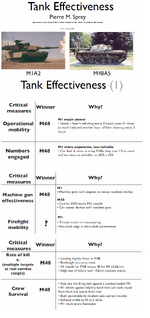
First, the procurement strategy that he is praising, is the same one that Boyd/Sprey spent most of their time fighting against. The force that fought the Gulf-War was one that was extremely antithetical to the arguments that Boyd/Sprey were making at the time. Just in the air-to-air realm, the F-15 was responsible for the majority of the USAFs kills, and the F-16 was relegated to purely ground attacking. The F-16 did not shoot down any Iraqi aircraft during the war. Likewise can be said about similar programs like the M1 Abrams tank and the M2 Bradley Infantry Fighting vehicle which were also singled out by Sprey as "expensive losers" that should have never been purchased in the first place in favor of more M113s and more M-60s. Even in 2007 Sprey was still claiming that the M-48, a medium tank from the Korean War, was a better proposition than the M2A2!
Second, the procurement strategy that he praises is also one that was focused on a land war in Europe, and resulted in adopting weapons with that specifically in mind. At both the junction of both the Advanced Tactical Fighter and the Joint-Strike Fighter, the Pentagon opted for the more conservative two run-off options.
The YF-22 was chosen over the YF-23 in part due to its conventional dogfighting performance via thrust vectoring, and because it was seen as the safer development option considering that Northrop was embroiled with the B-2 at the time and a whole bunch of cost over-runs. At the time, the YF-22 was further along in the development cycle, even though in hindsight it arguably would have been a better aircraft in the present day just due to having around 500 miles additional range on internal fuel.
The X-32 vs X-35 is a slightly different situation; Boeings proposal was centered around being a lot cheaper to produce, but also sacrificed fighter-performance metrics in favor of increased payload and increased range. At the time Boeing did not believe that Lockheed Martin would be successful in development of the goofy pivoting engine to meet the STOVL requirements. In theory the X-32 would have been cheaper than the F-35 but would also have been far less maneuverable; so once again in this case the USAF went with the more conventional of the two options.
However it should be noted that in this criticism of the range of the F-22 and the F-35 that both planes have far and away more range on internal fuel than the F-16 does by around a factor of 2. So if the criticism that the range of the F-22 and F-35 have left us in a lurch in regards to a Pacific conflict are true, then that same criticism would be doubly true to the kind of F-16 centric force that Sprey was still pitching in 2006!
Currently the PLAAF operates around 500 J-20 stealth fighters with missiles that outrange the current AMRAAM by significant margins. It also operates around 800 or so Flanker variants equipped with similar missiles. We also have a general idea of how well these missiles work based on results of Operation Sindoor where the Pakistani Air Force was able to successfully shoot down Indian Rafale fighters from over 100km away; this is in spite of the Rafales supposedly advanced electronic warfare systems and exceptional energy maneuverability characteristics.
Or we can look at the trajectory of the Ukrainian conflict and the actual utility value that has been provided by the F-16 which has been largely limited to intercepting drones and cruise missiles far away from the frontlines. Or likewise the VKS inability to cope with Ukrainian IADS and being relegated to tossing guided glide bombs far behind the front lines and attacks with standoff munitions. Or how both sides have relegated their primary CAS plane, the Su-25, to basically functioning as a high speed MLRS with low-accuracy pitch-up rocket barrages. These operating realities are a direct result of the expensive high technology that Sprey spent his whole entire career opposing.
So in a plausible scenario in the defense of Taiwan...how many pilots are you willing to sacrifice so that the F-16 can finally go win a gunfight? It will certainly beat the pants off of a J-20 in a dogfight...but it has to run a gauntlet of missiles to get there first. With each passing year that gauntlet also gets longer and longer and the number of advanced PLAAF fighters increases.