Greg Spouts Off About P-38 Drop Tanks (4 Viewers)

Ad: This forum contains affiliate links to products on Amazon and eBay. More information in Terms and rules

Well, that's taking it literally, which assumes the same things I said I wasn't advocating. 2:1 losses, in this case, are predicated on a LWF being built to the same standards as the Oscar and the opposition being a P-47.

I've said it already: the USAAF would never have accepted an aircraft built that way.

In what ways would it be different? Look at the entire list of features that Sprey sought to omit from his LWF concept;

No self sealing fuel tanks. No bulletproof glass in the cockpit. Only the minimal required armament to destroy an aircraft. No cockpit armor. No provisions for air to ground capabilities. These are things that himself and Boyd advocated for in their LWF concept.

The USAAF would never accept an aircraft built that way because it's just a way to kill pilots as fast as possible. Pretty much every country during the war logically decided to build increasingly well protected and survivable fighters and at the cost of turning performance.
 
In what ways would it be different? Look at the entire list of features that Sprey sought to omit from his LWF concept;

No self sealing fuel tanks. No bulletproof glass in the cockpit. Only the minimal required armament to destroy an aircraft. No cockpit armor. No provisions for air to ground capabilities. These are things that himself and Boyd advocated for in their LWF concept.

The USAAF would never accept an aircraft built that way because it's just a way to kill pilots as fast as possible. Pretty much every country during the war logically decided to build increasingly well protected and survivable fighters and at the cost of turning performance.
I don't know. I'm not an aircraft designer. The best place to start is the mission.
 
You can "prove" a lot of things if you pick selected examples.
P-47s in New Guinea were being misused to some extent. They were actual a substitute fighter for the P-38s the high command actually wanted.
They wanted something better than the P-39s and P-40s. They weren't going to get P-38s in 1943 or not enough of them and the P-51 was also off the table in 1943 for the Pacific.
P-47D-2s with skinny props and no water injection were not great fighters at under 10,000ft but that is where the B-25s and A-20s were flying and that is where the escorts needed to fly.
Ki-43s did kill P-47s (they were not bullet proof) but what we don't know is how many P-47s came home with 12.7mm hits or how many.
Eight .50s is overkill for the Ki-43. It is overkill for Japanese twin engine bombers.
On one of the Ki-43 vs P-47s the P-47s were flying at about 8,000ft and were bounced from 3,000ft (?) higher. No mention of P-47s speed when bounced (trying to escort twin engine bombers?). Would Vultee P-66s had done better in that situation?
But you don't get to order fighters in Oct based on experience in Sept for delivery in Nov.
Planners are trying to guess 2-3 years ahead in WW II and 5-10 years ahead (or more?) in the 1970s and up.
For modern aircraft electronics often advances faster than airframes. Especially for capabilities vs volume and weight.

F-86D Sabre is a red hearing, It was never supposed to dogfight. It was supposed to stop a very large bomber carrying one or more nuclear weapons. Just damaging the enemy bomber was a failure. And it had to do it at night and/or in clouds.
 
Didn't the USAAC try the lightweight fighter idea with Bell's XP-77?
 
You can "prove" a lot of things if you pick selected examples.
The example was handed to me so I thought about it.

My question is, what might have been achieved with a better-designed aircraft in a similar class to the Oscar? The answer is always the same: no, it's not enough and you need more of this, that or the other, i.e.: capability.

This is not an unreasonable point of view.

What I'm trying to illustrate here is that the difference is surprisingly small, when you consider the capability gap. The P-47 was much faster, much more heavily armed, much better protected, had a radio, an armoured windscreen, a parachute and self-sealing tanks.

So why was it only 2:1 against the Oscar and what might have been added to a lightweight fighter to redress the balance? Where do you stop? Because if you don't draw the line somewhere, you end up with another P-47, which may not be the best choice.

In other words, adding capability is only useful if the situation calls for it.

This article by former Pentagon strategist Col. Mike Pietrucha is focused on modern military applications but the principal is the same. For the record, Pietrucha is not talking about adopting Sprey's ideas. He's talking about building what you need for now and the foreseeable future:


He later ran the OA-X program, which was almost analogous to the LWF program. Here's what he said about a number of assumptions made about it:


Did the USAF take it up? No, of course not.
 
Last edited:
It seems that there is a missing component in the Boyd/Sprey campaign against the Pentagaon, as the Fighter Mafia. Budget was a zero-sum game. The idea that a single role fighter compared to a high-performance multi role weapons system would capture a major component of Congress funded USAF budget was a losing fight from the beginning. The derivative of the LWF program, the F-16, wasn't conceived, nor ever delivered as a focused Mig Killer and its design specs (but not detail design) had already been approved by DoD for the future flyoff against the YF-17. That said, the F-16 was designed and delivered primarily as a low budget F-15, with small radar and limited air to ground - with excellent E-M attributes.

By happy circumstance it had an amazing number of attributes that fit nicely in the matrix envelope of excellent Energy Maneuverability because G-D engineers were conscious of weight and costs. IMO the major points that Sprey/Boyd delivered to the Pentagon (and Congress) was that our Fighter priorities (true) were focused on dual role, namely air superiority and tactical capability (to satisfy or offload Army demands for close air support). Following, it is also true that delivering a fighter that was conceived to be dominant in air performance characteristics, to defeat all other adversaries based solely on visual engagement and combat - was a non-starter. That product had very little applicability in USAF Mission. At that time SAC dominated, but the lessons of Korea (F-80, F-84 vs Mig 15) and Vietnam (F-105, F4 vs Mig 17/19/21) in the air war, were demonstrated.

The ideal market for THEIR version were countries that had zero strategic airpower ambitions but were interested in maximum bang for the buck interceptors defend sovereign airspace. In other words, an Iran or North Vietnam or N/S Korea and didn't have to dilute limited budget to such trivialities as TRIAD, TAC, MATS or ADC components of airframe/mission delivery.

There was zero appetite for the Major features that Sprey and Boyd loudly demanded in front of Congress and Pentagon - and insinuated that opponents of their views were not only stupid but perhaps in the pockets of the military industrial complex. To the latter comment, second hand source from LtG Gordon Graham who was leading the Fighter Selection contingent within the Pentagon. Graham was a close friend of my father, from 355th FG days and one upon which I could call and chat. Gordy relayed to me that Sprey had accused him of being on the take and only the presence of witnesses permitted Sprey's continued existence on this plane. He may have been joking...

My only point in shedding light on this discussion is the defined mission, the cost, the value compared to other choices were always in play. Sprey, Boyd and Stevenson made many assertions and claims without context, only focusing on their world view of a 'pure' air to air fighter.

My personal views are that many great, 'very good but not best in any single comparison', are far greater than many, perfectly delivered (in its time) airframes for a single mission role - with no capacity to grow gross weight and mission expansion. The latter would fill the boneyard in a very short period comparatively as technological improvements were delivered in the near future.

I have respect for Boyd, but very little for either Sprey or Stevenson. For Sprey, acknowledgement of several points of view that I support, but contempt for his delivery style.
 
Maybe now would be a good time to point out that the P-47 was a spin-off of the P-43, which itself was developed from the P-35.

The combined empty weight of those two were less than that of the empty weight of a P-47D.
Also a good time to mention that Republic (or Sprey) never participated in production of a lightweight high-performance interceptor - save the P-47M which was a far cry from Lightweight.
 
Problem, even in 1940/41 WW II, is what do you want your "fighter" to do?
Shoot down enemy fighters or shoot down enemy bombers? Different armament which affects the size/weight of the aircraft.
US was building the B-17/B-24 and had built the XB-15 and XB-19. Depending on a potential enemy to only build smallish twin engine bombers (Sally's or He 111) 2-3 years in future so your light fighters can successfully shoot down large numbers of them is a gamble most planners were not willing to make.
 
Problem, even in 1940/41 WW II, is what do you want your "fighter" to do?
Shoot down enemy fighters or shoot down enemy bombers? Different armament which affects the size/weight of the aircraft.
US was building the B-17/B-24 and had built the XB-15 and XB-19. Depending on a potential enemy to only build smallish twin engine bombers (Sally's or He 111) 2-3 years in future so your light fighters can successfully shoot down large numbers of them is a gamble most planners were not willing to make.
In 1940/41, the nature of aerial warfare was still embedded in prewar mindsets, such as heavy fighter/escort (twins) and dedicated bomber interceptors (turret fighters, anyone?) and the learning curve, which was just starting, would be a very steep effort.
 
The example was handed to me so I thought about it.

My question is, what might have been achieved with a better-designed aircraft in a similar class to the Oscar? The answer is always the same: no, it's not enough and you need more of this, that or the other, i.e.: capability.

This is not an unreasonable point of view.

What I'm trying to illustrate here is that the difference is surprisingly small, when you consider the capability gap. The P-47 was much faster, much more heavily armed, much better protected, had a radio, an armoured windscreen, a parachute and self-sealing tanks.

So why was it only 2:1 against the Oscar and what might have been added to a lightweight fighter to redress the balance? Where do you stop? Because if you don't draw the line somewhere, you end up with another P-47, which may not be the best choice.

In other words, adding capability is only useful if the situation calls for it.

This article by former Pentagon strategist Col. Mike Pietrucha is focused on modern military applications but the principal is the same. For the record, Pietrucha is not talking about adopting Sprey's ideas. He's talking about building what you need for now and the foreseeable future:


He later ran the OA-X program, which was almost analogous to the LWF program. Here's what he said about a number of assumptions made about it:


Did the USAF take it up? No, of course not.

The problem is that view becomes unreasonable with any kind of examination, which is why by and large the consensus of aircraft designers during the war was generally to increase the size and weight of their airplanes over pre-existing types, and to increase multi-mission capabilities. The Germans did it with the Bf.109. They did it to an even greater extent with the Fw 190 which had every kind of kit-and-caboodle imaginable made for it; somehow it is regarded as their best fighter during the war in spite of having higher wing loading and lower power to weight than the Bf.109. The IJAAF also did it with the adoption of the Ki-61 and the Ki-84 which were of similar size to most contemporary fighters bar the P-38, or planes built around the R-2800.

Even if we assume that an American Oscar is not our ideal lightweight fighter, why don't we consider what the consequences the US AAC would have faced if the XP-44 had never been re-designed into the P-47? The AAC would have had an exceptionally good short-ranged interceptor armed with 4x machine guns, exceptional climb rate, and exceptional performance at low altitude. It would have also had an even lower fuel fraction than the P-47 with around 220 gallons of fuel in non-sealing tanks while using the same engine. This was the plane that Kartvelli had initially designed before requirements were changed by the "Bomber Mafia" to require higher speeds at high altitude and for increased internal fuel loads. So what does that kind of performance but with 2/3rds the range get you in 1943? Under what circumstances would that aircraft have been better?

It would have been useless in New Guinea; the primary complaint the 5th Air Force had with the P-47 when it arrived was its short range and the lack of a suitable drop tank. It would be able to defend the airfields but it would not be able to perform any kind of meaningful offensive mission. Likewise it would have been just as useless in Europe, but to an even greater extent, due to compromised high-altitude performance. The aircraft would also not have been adaptable to self-sealing tanks without further decreasing its internal fuel fraction, and subsequently it's range.

We can also take a look at Kartvelli's attitude towards bomb racks; according to drgondog drgondog he was quite dismissive of them and called bombs on a fighter airplane "Christmas ornaments." Kartvelli's remarks would have been right at home with the likes of Boyd. It is also quite possible that the decision to allow Republic to develop it's own centerline tank attachment system and forego using standard Army bomb racks in 1942 was driven by Kartvelli's insistence that so equipping the P-47 with them would have ruined the airplanes performance as a fighter aircraft. However linking this decision directly to Kartvelli/Republic is not something I have found any direct evidence of, but we do know his attitude towards the general proposition, and we ultimately know the consequences of this 1942 decision would significantly impact the P-47s potential range in 1943.

Now in regards to the article from Mike Pietrucha that you posted; it is largely irrelevant to this conversation. His point is that the procurement strategy built around fighting the Soviet Union and AirLand Battle somehow allowed us to procure good weapon systems that won Desert Storm, but that the Capability-Based-Planning model has left us in a lurch when it comes to fighting China in the Pacific.

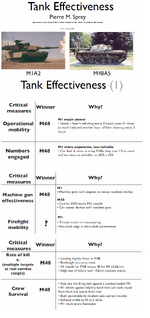
First, the procurement strategy that he is praising, is the same one that Boyd/Sprey spent most of their time fighting against. The force that fought the Gulf-War was one that was extremely antithetical to the arguments that Boyd/Sprey were making at the time. Just in the air-to-air realm, the F-15 was responsible for the majority of the USAFs kills, and the F-16 was relegated to purely ground attacking. The F-16 did not shoot down any Iraqi aircraft during the war. Likewise can be said about similar programs like the M1 Abrams tank and the M2 Bradley Infantry Fighting vehicle which were also singled out by Sprey as "expensive losers" that should have never been purchased in the first place in favor of more M113s and more M-60s. Even in 2007 Sprey was still claiming that the M-48, a medium tank from the Korean War, was a better proposition than the M2A2!

Second, the procurement strategy that he praises is also one that was focused on a land war in Europe, and resulted in adopting weapons with that specifically in mind. At both the junction of both the Advanced Tactical Fighter and the Joint-Strike Fighter, the Pentagon opted for the more conservative two run-off options.

The YF-22 was chosen over the YF-23 in part due to its conventional dogfighting performance via thrust vectoring, and because it was seen as the safer development option considering that Northrop was embroiled with the B-2 at the time and a whole bunch of cost over-runs. At the time, the YF-22 was further along in the development cycle, even though in hindsight it arguably would have been a better aircraft in the present day just due to having around 500 miles additional range on internal fuel.

The X-32 vs X-35 is a slightly different situation; Boeings proposal was centered around being a lot cheaper to produce, but also sacrificed fighter-performance metrics in favor of increased payload and increased range. At the time Boeing did not believe that Lockheed Martin would be successful in development of the goofy pivoting engine to meet the STOVL requirements. In theory the X-32 would have been cheaper than the F-35 but would also have been far less maneuverable; so once again in this case the USAF went with the more conventional of the two options.

However it should be noted that in this criticism of the range of the F-22 and the F-35 that both planes have far and away more range on internal fuel than the F-16 does by around a factor of 2. So if the criticism that the range of the F-22 and F-35 have left us in a lurch in regards to a Pacific conflict are true, then that same criticism would be doubly true to the kind of F-16 centric force that Sprey was still pitching in 2006!

Currently the PLAAF operates around 500 J-20 stealth fighters with missiles that outrange the current AMRAAM by significant margins. It also operates around 800 or so Flanker variants equipped with similar missiles. We also have a general idea of how well these missiles work based on results of Operation Sindoor where the Pakistani Air Force was able to successfully shoot down Indian Rafale fighters from over 100km away; this is in spite of the Rafales supposedly advanced electronic warfare systems and exceptional energy maneuverability characteristics.

Or we can look at the trajectory of the Ukrainian conflict and the actual utility value that has been provided by the F-16 which has been largely limited to intercepting drones and cruise missiles far away from the frontlines. Or likewise the VKS inability to cope with Ukrainian IADS and being relegated to tossing guided glide bombs far behind the front lines and attacks with standoff munitions. Or how both sides have relegated their primary CAS plane, the Su-25, to basically functioning as a high speed MLRS with low-accuracy pitch-up rocket barrages. These operating realities are a direct result of the expensive high technology that Sprey spent his whole entire career opposing.

So in a plausible scenario in the defense of Taiwan...how many pilots are you willing to sacrifice so that the F-16 can finally go win a gunfight? It will certainly beat the pants off of a J-20 in a dogfight...but it has to run a gauntlet of missiles to get there first. With each passing year that gauntlet also gets longer and longer and the number of advanced PLAAF fighters increases.

 

Attachments

  • 1786038887531.png
    1786038887531.png
    186.8 KB · Views: 25
There was zero appetite for the Major features that Sprey and Boyd loudly demanded in front of Congress and Pentagon - and insinuated that opponents of their views were not only stupid but perhaps in the pockets of the military industrial complex. To the latter comment, second hand source from LtG Gordon Graham who was leading the Fighter Selection contingent within the Pentagon. Graham was a close friend of my father, from 355th FG days and one upon which I could call and chat. Gordy relayed to me that Sprey had accused him of being on the take and only the presence of witnesses permitted Sprey's continued existence on this plane. He may have been joking...
You would find this interesting; from Hankins book "Flying Camelot"

"In 1969, Riccioni had coauthored a report recommending the LWF over the F-15, intending to brief it to CSAF General John P. McConnell and his vice chief, General John Meyer, one of the leading aces from the Second World War. Kent spoke to Lieutenant General Otto Glasser, DCS/R&D; both men supported the LWF, but Meyer had made it clear that "he would prefer not to have to listen to the briefing, having been irritated before by the Boyd group and its strident campaign for the LWF," but that if Kent recommended it, Meyer would listen. Kent was concerned because the second half of the briefing "alleges that those who support the F-15 lack a basic understanding of air-to-air combat." Kent told Riccioni he could give the briefing only if he cut out all such material and did not even take the charts from that part of the briefing into the room. Allegedly, almost immediately after the briefing started, Riccioni, who had zero aerial victories to his name, took out the forbidden charts and told Meyer, a fighter pilot with twenty-six victory credits from World War II and Korea, that "a review of the fundamentals of air-to-air combat is necessary." Meyer dismissed Riccioni. Despite Riccioni later apologizing to Kent and mending their friendship, Meyer was so angry that he ordered Riccioni transferred to Korea so that, as Kent recalled, Riccioni "would be in no position to muddy the waters." Riccioni left for Korea in September 1971; until then, he remained at the Pentagon with Boyd, pushing their LWF idea. At least part of the reason for Riccioni's removal was his demeanor and his condescending comments to the vice CSAF, but Riccioni and his associates saw his reassignment as punishment for his views about the LWF."

In regards to the whole idea that Boyd never lost a dogfight, a claim that himself and his fans like to repeat. This pretty flexible relationship to the truth and myth building is something that is pretty common to Boyd and his acolytes from what I can tell.

Stuff like this was a pretty common trend amongst Boyd, who famously never lost a dogfight, and his followers. His time at Nellis was the origin of his nickname "forty-second Boyd,"for claiming that he could defeat anyone in air-to-air combat inside of fortyseconds. Boyd and his followers maintain that he was undefeated. 24 Like
many Boyd stories, the forty-second stories come almost entirely from Boyd himself or his close friends, and there are many claims to the contrary.
Boyd developed a reputation for repeatedly using the same maneuver—the "high-G barrel roll"—as his preferred method for beating opponents. This maneuver, if performed while being chased by an enemy from behind, decreased speed and usually caused the chasing opponent to dart out in front and become vulnerable. The Marine Corps' Major General Hal Vincent claimed that although he did not defeat Boyd, he was able to counter this maneuver by performing a similar maneuver of his own, and eventually the two men came to a draw. Vincent, who was a friend of Boyd's and complimentary of him, said that "no one was better slow speed than John." Vincent clarified: "John was one of the best I ever fought. Although there were others, over the years, in the high speed ACM environment, that I found better." He named the Marine Corps' General Mike Sullivan and Navy F-8 pilot Duane Varner as being "as good or better" than Boyd and explained "there are now [April 2000] several of the top instructors . . . that are better than all of us."

In addition, General Wilbur Creech, later commander of TAC, maintained that he defeated Boyd. 26 Creech claimed that he advised Boyd that the high-g barrel roll would not be effective against skilled opponents. To prove it, Creech alleged that he flew a mock dogfight against Boyd, and that when Boyd attempted his typical maneuver, Creech countered with a roll in the opposite direction, after which "it was a fairly simple matter to place the pipper on John's aircraft." 27 Creech dismissed the whole "forty second" claim as a fabrication: "Boyd carried no such fighter pilot reputation . . . among the instructor cadre. And he simply was not 'called out' by the best fighter pilots from throughout the military as is claimed there simply was no opportunity for that in the FWS mission—or any record of any kind for that." Many other pilots who served or flew with Boyd doubt the truth of the story as well. Whether or not Boyd was "undefeated" is impossible to prove, but it matters little. What is clear is that in his roles as pilot and instructor, and in the ways that he wished others to think of him, stereotypical fighter pilot cultural elements defined his thinking.
 
Last edited:
In the way that the reality of a confrontational situation only becomes defined on the day that you find yourself with a six-shooter versus a gatling-gun nest, the merits of different aircraft weapon platforms in planning can be totally lost by the reality of the situation on the day! This is not to say that comprehensive understanding of possible advantageous attributes and capabilities is totally wasted but, that when the situation of confrontation actually occurs, you might not be equipped with the best option on the day, despite all your previous planning.
Here, the Military will usually try to have more than one iron in the fire to give a range of capability that will mean some of their inventory are better suited on the day to the threat that actually presents itself. So we should not be surprised that some particular aircraft shone when particular situations developed, often even minor attributes would be very important in a particular situation. Nonetheless, it has to be recognised that certain general classes of aircraft do exist and an Air Force should always try to have the best overall equipment. As an example, the Mosquito was a great Night fighter, Photo-Recce, precision Bomber and Pathfinder, even a great interdictor and fighter against heavy aircraft, but, it was never superior to contemporary single engine Fighters in day combat. So, it is a case of horses for courses. Make sure you have good stable of horses!

Eng
 
The problem is that view becomes unreasonable with any kind of examination, which is why by and large the consensus of aircraft designers during the war was generally to increase the size and weight of their airplanes over pre-existing types, and to increase multi-mission capabilities. The Germans did it with the Bf.109. They did it to an even greater extent with the Fw 190 which had every kind of kit-and-caboodle imaginable made for it; somehow it is regarded as their best fighter during the war in spite of having higher wing loading and lower power to weight than the Bf.109. The IJAAF also did it with the adoption of the Ki-61 and the Ki-84 which were of similar size to most contemporary fighters bar the P-38, or planes built around the R-2800.

Even if we assume that an American Oscar is not our ideal lightweight fighter, why don't we consider what the consequences the US AAC would have faced if the XP-44 had never been re-designed into the P-47? The AAC would have had an exceptionally good short-ranged interceptor armed with 4x machine guns, exceptional climb rate, and exceptional performance at low altitude. It would have also had an even lower fuel fraction than the P-47 with around 220 gallons of fuel in non-sealing tanks while using the same engine. This was the plane that Kartvelli had initially designed before requirements were changed by the "Bomber Mafia" to require higher speeds at high altitude and for increased internal fuel loads. So what does that kind of performance but with 2/3rds the range get you in 1943? Under what circumstances would that aircraft have been better?

It would have been useless in New Guinea; the primary complaint the 5th Air Force had with the P-47 when it arrived was its short range and the lack of a suitable drop tank. It would be able to defend the airfields but it would not be able to perform any kind of meaningful offensive mission. Likewise it would have been just as useless in Europe, but to an even greater extent, due to compromised high-altitude performance. The aircraft would also not have been adaptable to self-sealing tanks without further decreasing its internal fuel fraction, and subsequently it's range.

We can also take a look at Kartvelli's attitude towards bomb racks; according to drgondog drgondog he was quite dismissive of them and called bombs on a fighter airplane "Christmas ornaments." Kartvelli's remarks would have been right at home with the likes of Boyd. It is also quite possible that the decision to allow Republic to develop it's own centerline tank attachment system and forego using standard Army bomb racks in 1942 was driven by Kartvelli's insistence that so equipping the P-47 with them would have ruined the airplanes performance as a fighter aircraft. However linking this decision directly to Kartvelli/Republic is not something I have found any direct evidence of, but we do know his attitude towards the general proposition, and we ultimately know the consequences of this 1942 decision would significantly impact the P-47s potential range in 1943.

Now in regards to the article from Mike Pietrucha that you posted; it is largely irrelevant to this conversation. His point is that the procurement strategy built around fighting the Soviet Union and AirLand Battle somehow allowed us to procure good weapon systems that won Desert Storm, but that the Capability-Based-Planning model has left us in a lurch when it comes to fighting China in the Pacific.

First, the procurement strategy that he is praising, is the same one that Boyd/Sprey spent most of their time fighting against. The force that fought the Gulf-War was one that was extremely antithetical to the arguments that Boyd/Sprey were making at the time. Just in the air-to-air realm, the F-15 was responsible for the majority of the USAFs kills, and the F-16 was relegated to purely ground attacking. The F-16 did not shoot down any Iraqi aircraft during the war. Likewise can be said about similar programs like the M1 Abrams tank and the M2 Bradley Infantry Fighting vehicle which were also singled out by Sprey as "expensive losers" that should have never been purchased in the first place in favor of more M113s and more M-60s. Even in 2007 Sprey was still claiming that the M-48, a medium tank from the Korean War, was a better proposition than the M2A2!

Second, the procurement strategy that he praises is also one that was focused on a land war in Europe, and resulted in adopting weapons with that specifically in mind. At both the junction of both the Advanced Tactical Fighter and the Joint-Strike Fighter, the Pentagon opted for the more conservative two run-off options.

The YF-22 was chosen over the YF-23 in part due to its conventional dogfighting performance via thrust vectoring, and because it was seen as the safer development option considering that Northrop was embroiled with the B-2 at the time and a whole bunch of cost over-runs. At the time, the YF-22 was further along in the development cycle, even though in hindsight it arguably would have been a better aircraft in the present day just due to having around 500 miles additional range on internal fuel.

The X-32 vs X-35 is a slightly different situation; Boeings proposal was centered around being a lot cheaper to produce, but also sacrificed fighter-performance metrics in favor of increased payload and increased range. At the time Boeing did not believe that Lockheed Martin would be successful in development of the goofy pivoting engine to meet the STOVL requirements. In theory the X-32 would have been cheaper than the F-35 but would also have been far less maneuverable; so once again in this case the USAF went with the more conventional of the two options.

However it should be noted that in this criticism of the range of the F-22 and the F-35 that both planes have far and away more range on internal fuel than the F-16 does by around a factor of 2. So if the criticism that the range of the F-22 and F-35 have left us in a lurch in regards to a Pacific conflict are true, then that same criticism would be doubly true to the kind of F-16 centric force that Sprey was still pitching in 2006!

Currently the PLAAF operates around 500 J-20 stealth fighters with missiles that outrange the current AMRAAM by significant margins. It also operates around 800 or so Flanker variants equipped with similar missiles. We also have a general idea of how well these missiles work based on results of Operation Sindoor where the Pakistani Air Force was able to successfully shoot down Indian Rafale fighters from over 100km away; this is in spite of the Rafales supposedly advanced electronic warfare systems and exceptional energy maneuverability characteristics.

Or we can look at the trajectory of the Ukrainian conflict and the actual utility value that has been provided by the F-16 which has been largely limited to intercepting drones and cruise missiles far away from the frontlines. Or likewise the VKS inability to cope with Ukrainian IADS and being relegated to tossing guided glide bombs far behind the front lines and attacks with standoff munitions. Or how both sides have relegated their primary CAS plane, the Su-25, to basically functioning as a high speed MLRS with low-accuracy pitch-up rocket barrages. These operating realities are a direct result of the expensive high technology that Sprey spent his whole entire career opposing.

So in a plausible scenario in the defense of Taiwan...how many pilots are you willing to sacrifice so that the F-16 can finally go win a gunfight? It will certainly beat the pants off of a J-20 in a dogfight...but it has to run a gauntlet of missiles to get there first. With each passing year that gauntlet also gets longer and longer and the number of advanced PLAAF fighters increases.

In the 1990's Balkans, F-16's made some very important kills.

Eng
 
Last edited:
What makes you say that the F-35 is a bad fighter? In comparison to the F-15 or the F-16? Is 14 missiles enough air-to-air ordanance?

View attachment 889833

The reason that you don't ever see this configuration is just because it compromises the stealth of the aircraft and is just a fundamental misuse of its capabilities and sheds its largest advantage over 4th and 4.5 Generation fighters. But the capability to festoon it with missiles is a capability that exists.
It's never been operated in that confguratrion as far as I know. If it did, it it wasn't stealthy at all and the range went into the bucket from drag. You could see it with a 1950s radar in an F-86D! Not ideal if you are approaching Flanklers that are armed and ready for you. ROE would still make you close and identify before attacking.
 
It's never been operated in that confguratrion as far as I know. If it did, it it wasn't stealthy at all and the range went into the bucket from drag. You could see it with a 1950s radar in an F-86D! Not ideal if you are approaching Flanklers that are armed and ready for you. ROE would still make you close and identify before attacking.

Why do you think the ROE would be the same as the 1970s?

Non-Cooperative Target Recognition via radar is basically a mature technology at this point. Why does the USAF employ BVR tactics in it's large scale exercises if any kind of real conceivable situation is going to force a visual range dogfight?

It would be just as viable to radar as an F-16C with half the number of missiles and arguably have similar range.

It doesn't operate in that configuration because it's basically a waste of it's stealth abilities. The USAF is buying F-15EX to function as the very overt long range missile truck.
 
Now in regards to the article from Mike Pietrucha that you posted; it is largely irrelevant to this conversation. His point is that the procurement strategy built around fighting the Soviet Union and AirLand Battle somehow allowed us to procure good weapon systems that won Desert Storm, but that the Capability-Based-Planning model has left us in a lurch when it comes to fighting China in the Pacific.
That's exactly the point. You can't consider this without talking about procurement and context.

Winning Desert Storm is an illogical step because the system was designed to defeat the Soviet Union, not an isolated second-tier Middle Eastern power. That much is true. Pietrucha is saying that CBP is being used as a substitute for strategy and strategic thinking.

I'm not putting this here to prove solutions, Squish. I'm putting it here to prompt/ask questions.

The force that fought the Gulf-War was one that was extremely antithetical to the arguments that Boyd/Sprey were making at the time.
So does that mean we shouldn't ask questions? This is why, historically, we learn more from our defeats than we do from our victories. Pietrucha's point was that the United States learnt the wrong lessons from Desert Storm. In fact, if you read enough of his stuff, he makes it very clear that the whole basis for tactical planning is a flawed premise, a scenario that was used after all the major threats had been extinguished. If that's not a case for asking questions then I don't know what is.

Even in 2007 Sprey was still claiming that the M-48, a medium tank from the Korean War, was a better proposition than the M2A2!
What were his reasons? Without any context, of course this looks ridiculous. I don't think he was literally advocating for the M-48.

Currently the PLAAF operates around 500 J-20 stealth fighters with missiles that outrange the current AMRAAM by significant margins. It also operates around 800 or so Flanker variants equipped with similar missiles. We also have a general idea of how well these missiles work based on results of Operation Sindoor where the Pakistani Air Force was able to successfully shoot down Indian Rafale fighters from over 100km away; this is in spite of the Rafales supposedly advanced electronic warfare systems and exceptional energy maneuverability characteristics.
Yeah but the point here was that the missiles could have been fired from anything that could carry them. Control of the electronic battle space was what mattered. The Pakistani J-10 and J-17 fighters didn't even turn on their radar.

The purpose of this wasn't to prove that Sprey's ideas were right. The point was that people need to ask questions, rather that persisting in the time honoured way because there's a belief that it's always worked. Much of what you've written simultaneously validates what I'm saying. My comment that adding capability was not an unreasonable point of view was interpreted as an unreasonable point of view because designers kept adding capability!

With context removed, you can prove anything. That graphic (which I assume you got from Sprey) is one example. Your use of it is another. Both are context-free arguments.

Now, I'm quite sure everyone has had enough of me. I'm not trolling, believe it or not but I can see I'm not getting anywhere.

I'm not defending everything Sprey said either. During the development of the F-35, a whole industry sprang up generating context-free material with which to attack Pierre Sprey. He became a lightning rod for all kinds of Aunt Sally arguments, whataboutism and ultimately, the defence of a system that lives on blind faith and self-evident truths, something Lockheed-Martin did nothing to prevent. It went a lot further than that but I'm not interested in examining the darker side of what happened. That's an aside to this.

He was wrong about the P-47. He was probably wrong about a lot of things. He was not wrong to challenge the status quo.

But if you look at the current situation, it's not hard to see where he was right.

Now let's all be friends and get back to Greg and the P-38.
 
The problem is that view becomes unreasonable with any kind of examination, which is why by and large the consensus of aircraft designers during the war was generally to increase the size and weight of their airplanes over pre-existing types, and to increase multi-mission capabilities. The Germans did it with the Bf.109. They did it to an even greater extent with the Fw 190 which had every kind of kit-and-caboodle imaginable made for it; somehow it is regarded as their best fighter during the war in spite of having higher wing loading and lower power to weight than the Bf.109. The IJAAF also did it with the adoption of the Ki-61 and the Ki-84 which were of similar size to most contemporary fighters bar the P-38, or planes built around the R-2800.

Even if we assume that an American Oscar is not our ideal lightweight fighter, why don't we consider what the consequences the US AAC would have faced if the XP-44 had never been re-designed into the P-47? The AAC would have had an exceptionally good short-ranged interceptor armed with 4x machine guns, exceptional climb rate, and exceptional performance at low altitude. It would have also had an even lower fuel fraction than the P-47 with around 220 gallons of fuel in non-sealing tanks while using the same engine. This was the plane that Kartvelli had initially designed before requirements were changed by the "Bomber Mafia" to require higher speeds at high altitude and for increased internal fuel loads. So what does that kind of performance but with 2/3rds the range get you in 1943? Under what circumstances would that aircraft have been better?

It would have been useless in New Guinea; the primary complaint the 5th Air Force had with the P-47 when it arrived was its short range and the lack of a suitable drop tank. It would be able to defend the airfields but it would not be able to perform any kind of meaningful offensive mission. Likewise it would have been just as useless in Europe, but to an even greater extent, due to compromised high-altitude performance. The aircraft would also not have been adaptable to self-sealing tanks without further decreasing its internal fuel fraction, and subsequently it's range.

We can also take a look at Kartvelli's attitude towards bomb racks; according to drgondog drgondog he was quite dismissive of them and called bombs on a fighter airplane "Christmas ornaments." Kartvelli's remarks would have been right at home with the likes of Boyd. It is also quite possible that the decision to allow Republic to develop it's own centerline tank attachment system and forego using standard Army bomb racks in 1942 was driven by Kartvelli's insistence that so equipping the P-47 with them would have ruined the airplanes performance as a fighter aircraft. However linking this decision directly to Kartvelli/Republic is not something I have found any direct evidence of, but we do know his attitude towards the general proposition, and we ultimately know the consequences of this 1942 decision would significantly impact the P-47s potential range in 1943.

Now in regards to the article from Mike Pietrucha that you posted; it is largely irrelevant to this conversation. His point is that the procurement strategy built around fighting the Soviet Union and AirLand Battle somehow allowed us to procure good weapon systems that won Desert Storm, but that the Capability-Based-Planning model has left us in a lurch when it comes to fighting China in the Pacific.

First, the procurement strategy that he is praising, is the same one that Boyd/Sprey spent most of their time fighting against. The force that fought the Gulf-War was one that was extremely antithetical to the arguments that Boyd/Sprey were making at the time. Just in the air-to-air realm, the F-15 was responsible for the majority of the USAFs kills, and the F-16 was relegated to purely ground attacking. The F-16 did not shoot down any Iraqi aircraft during the war. Likewise can be said about similar programs like the M1 Abrams tank and the M2 Bradley Infantry Fighting vehicle which were also singled out by Sprey as "expensive losers" that should have never been purchased in the first place in favor of more M113s and more M-60s. Even in 2007 Sprey was still claiming that the M-48, a medium tank from the Korean War, was a better proposition than the M2A2!

Second, the procurement strategy that he praises is also one that was focused on a land war in Europe, and resulted in adopting weapons with that specifically in mind. At both the junction of both the Advanced Tactical Fighter and the Joint-Strike Fighter, the Pentagon opted for the more conservative two run-off options.

The YF-22 was chosen over the YF-23 in part due to its conventional dogfighting performance via thrust vectoring, and because it was seen as the safer development option considering that Northrop was embroiled with the B-2 at the time and a whole bunch of cost over-runs. At the time, the YF-22 was further along in the development cycle, even though in hindsight it arguably would have been a better aircraft in the present day just due to having around 500 miles additional range on internal fuel.

The X-32 vs X-35 is a slightly different situation; Boeings proposal was centered around being a lot cheaper to produce, but also sacrificed fighter-performance metrics in favor of increased payload and increased range. At the time Boeing did not believe that Lockheed Martin would be successful in development of the goofy pivoting engine to meet the STOVL requirements. In theory the X-32 would have been cheaper than the F-35 but would also have been far less maneuverable; so once again in this case the USAF went with the more conventional of the two options.

However it should be noted that in this criticism of the range of the F-22 and the F-35 that both planes have far and away more range on internal fuel than the F-16 does by around a factor of 2. So if the criticism that the range of the F-22 and F-35 have left us in a lurch in regards to a Pacific conflict are true, then that same criticism would be doubly true to the kind of F-16 centric force that Sprey was still pitching in 2006!

Currently the PLAAF operates around 500 J-20 stealth fighters with missiles that outrange the current AMRAAM by significant margins. It also operates around 800 or so Flanker variants equipped with similar missiles. We also have a general idea of how well these missiles work based on results of Operation Sindoor where the Pakistani Air Force was able to successfully shoot down Indian Rafale fighters from over 100km away; this is in spite of the Rafales supposedly advanced electronic warfare systems and exceptional energy maneuverability characteristics.

Or we can look at the trajectory of the Ukrainian conflict and the actual utility value that has been provided by the F-16 which has been largely limited to intercepting drones and cruise missiles far away from the frontlines. Or likewise the VKS inability to cope with Ukrainian IADS and being relegated to tossing guided glide bombs far behind the front lines and attacks with standoff munitions. Or how both sides have relegated their primary CAS plane, the Su-25, to basically functioning as a high speed MLRS with low-accuracy pitch-up rocket barrages. These operating realities are a direct result of the expensive high technology that Sprey spent his whole entire career opposing.

So in a plausible scenario in the defense of Taiwan...how many pilots are you willing to sacrifice so that the F-16 can finally go win a gunfight? It will certainly beat the pants off of a J-20 in a dogfight...but it has to run a gauntlet of missiles to get there first. With each passing year that gauntlet also gets longer and longer and the number of advanced PLAAF fighters increases.

Your comments about the YF-22 / 23 above fail to take into a count the fact that the Northrop YF-23 avtually met the specification as it was issued and the YF-22 did not. The "powers that be" at the time, re-wrote the spec to a lower level so the YF-22 could compete, but did NOT give Northrop any time to change the YF-23 to address shortcomings that were inherent due to meeting the stealth specification. They screwed Northrop AGAIN and even likely smiled while doing it.

Another triumph for honest procurement, sorry ... I mean politics as usual.

Don't get me wrong, the F-22 is a very good airpalne. But it didn't meet the original spec and the YF-23 DID.
 
Your comments about the YF-22 / 23 above fail to take into a count the fact that the Northrop YF-23 avtually met the specification as it was issued and the YF-22 did not. The "powers that be" at the time, re-wrote the spec to a lower level so the YF-22 could compete, but did NOT give Northrop any time to change the YF-23 to address shortcomings that were inherent due to meeting the stealth specification. They screwed Northrop AGAIN and even likely smiled while doing it.

Another triumph for honest procurement, sorry ... I mean politics as usual.

Don't get me wrong, the F-22 is a very good airpalne. But it didn't meet the original spec and the YF-23 DID.
The YF-23 did not even have a functioning missile ejector rack and Northrop was up to its eyeballs in B-2 cost overruns. Furthermore the YF-22 was a much more conventional layout, had the thrust vectoring that the USAF had determined was very useful in a close in dogfight, and was considered the much safer procurement option.

You want to know what was pretty corrupt though? How the "Fighter Plane Mafia" wrote a study specifically to more or less illegally funneled money to General Dynamics and Northrop in pursuit of the Lightweight Fighter. And then basically wrote the RFP to pre-select the two planes that they had a hand in designing.
 

Users who are viewing this thread

Back