How capable was the Ki-44? (1 Viewer)

Ad: This forum contains affiliate links to products on Amazon and eBay. More information in Terms and rules

Then about calibration charts: As you point out what you find in flight manuals (PEC's) usually stops far short of the stall speed, which I think is for the simple reason that these are for navigational purposes only, and when it comes to stall, the only thing the pilot needs to know is what he reads off his airspeed indictor. However, extrapolating from the PEC curve, this on the Spitfire looks to be about 15-20 mph lower than if it was calibrated. In addition, and as I see you have already pointed out, calibration in this regime is not linear, to which I think we could add maybe afflicted by large fluctuations, so I would be very vary of any Clmax values derived from calibration of an aircraft's airspeed IAS as for the Hellcat, especially if we have no idea about how the calibration was done.
Due to the nature of deck-landing aircrafts, both the Hellcat and the Corsair have relatively more stall tests than the AAF planes. As I've quoted multiple sources, including three independent testing institutions( NAS Pax, NACA and ARC), especially that the ARC report had give the calibration data at the stall speed, I would believe the Hellcat's power-off CLmax = 1.5 a high confidence, only very few ww2 aircrafts have rich testing data on stalling characteristic than the F4U and F6F.

Also Buno.58310 test by NAS Pax. had provided the non-linear region of calibration in stall region.
1761710200875.png
 
Last edited:
Due to the nature of deck-landing aircrafts, both the Hellcat and the Corsair have relatively more stall tests than the AAF planes. As I've quoted multiple sources, including three independent testing institutions( NAS Pax, NACA and ARC), especially that the ARC report had give the calibration data at the stall speed, I would believe the Hellcat's power-off CLmax = 1.5 a high confidence, only very few ww2 aircrafts have rich testing data on stalling characteristic than the F4U and F6F.

Yes, you have quoted three independent testing institutions but one of those (NACA) seem to place Clmax at 1.36 to 1.39? So based on the evidence presented so far I can't see why 1.5 should be the number we should go with? Especially seeing we have no idea about how they made the calibration (as in how did they arrive at the PEC chart you posted above)? And before anyone says, well NAS Pax are reputable and know what they are doing, well then I think many would say the same about NACA? And yet they seem to come to different conclusions, one says 1.36 to 1.39, and the other 1.5? In addition, if the F6F really did have a Clmax of 1.5 that would put it in a class of its own, since I know of no other WW2 fighter aircraft that has a power off, no flaps Clmax as high as that.
 
Last edited:
Yes, you have quoted three independent testing institutions but one of those (NACA) seem to place Clmax at 1.36 to 1.39? So based on the evidence presented so far I can't see why 1.5 should be the number we should go with? Especially seeing we have no idea about how they made the calibration (as in how did they arrive at the PEC chart you posted above)? And before anyone says, well NAS Pax are reputable and know what they are doing, well then I think many would say the same about NACA? And yet they seem to come to different conclusions, one says 1.36 to 1.39, and the other 1.5? In addition, if the F6F really did have a Clmax of 1.5 that would put it in a class of its own, since I know of no other WW2 fighter aircraft that has a power off, no flaps Clmax as high as that.
The NACA test showed a steady state CLmax = 1.5 for 1.5 seconds before roll-off. Perhaps you misread the value?
1761793314633.png


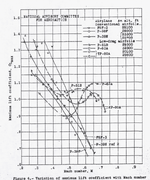
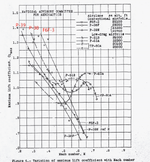
If you are refering to this report then keep in mind these are buffet boundaries, and NACA had pointed several scatter points to be "CLmax 2deg above initial separation". One should distinguish between buffet boundary and stall boundary:
1761789889621.png

This curve is been cited in the report JFC and been specifically quoted as buffet-boundary.
1761789967799.png


Even for the NACA report 1044, the F6F-3 was the one been tested to have the highest lift-coefficient curve, higher than another test planes. Given that it has the largest MAC and largest effective Reynold's number, this isn't surprising. Keep in mind the buffet-boundary of the F6F was cutted off at Mach 0.35, and the conventional airfoil plane should obtain maximum CLmax around Mach 0.2 like the P-39.
1761792961594.png

If you compare it:

P-39 CLmax = 0.95 @ Mach 0.45, F6F-3 CLmax = 1.1 @ Mach 0.45
P-39 CLmax = 1.1 @ Mach 0.35, F6F-3 CLmax = 1.35 @ Mach 0.35 --- Cut off for F6F-3.
Mach effect slope for P-39: -0.15 per Mach 0.1 F6F-3: -0.25 per Mach 0.1


At Mach 0.2:
P-39 CLmax = 1.35 - 1.4 (test value, non-linear increasing near M0.2), assume linear increasing for F6F-3 we should have a power-off CLmax = 1.6 @ Mach 0.2, since the test was made for power-off condition on all 5 propeller driven aircrafts, except for the P-80 which was set to be power-on.

And yet they seem to come to different conclusions, one says 1.36 to 1.39, and the other 1.5? In addition, if the F6F really did have a Clmax of 1.5 that would put it in a class of its own, since I know of no other WW2 fighter aircraft that has a power off, no flaps Clmax as high as that.
If F6F has CLmax 1.36 to 1.39 which would mean the F4U would be less than 1.25 according to the NACA value and basic wing planform theorem, which wouldn't be possible. In addition many WW2 fighter has great CLmax, as I have quoted the P-38 is also at the class of power-off clean CLmax = 1.5. Also, be very careful for using power-off CLmax at stall speed to extrapolate CLmax at optimal flight speed, certain planes with small MAC may get Re effect at critical and rise the CLmax from 1.35 to 1.45 at certain speed/altitude range, as been tested by the NACA, and I believe it is also a reason for the success of FW-190 and P-51:
1761791026659.png

The astonishing MAC = 8.12ft gives F6F very good Re numbers even at very low airspeed and that's why it has very good CLmax and lift-boundary across speed-range, with a non-twisted, clean NACA 230 tapered wing with lambda = 0.5 I am not surprised to see this figure of CLmax = 1.5.

If you want to prove it wrong then you have to cite your source. As I have already did more than 5+ cases from 3 independent institution for the CLmax of F6F. Now it's your turn.
 

Attachments

  • 1761791396759.png
    1761791396759.png
    125.5 KB · Views: 8
  • 1761791502079.png
    1761791502079.png
    131.8 KB · Views: 7
Last edited:
The NACA test showed a steady state CLmax = 1.5 for 1.5 seconds before roll-off. Perhaps you misread the value?
View attachment 853908

If you are refering to this report then keep in mind these are buffet boundaries, and NACA had pointed several scatter points to be "CLmax 2deg above initial separation". One should distinguish between buffet boundary and stall boundary:
View attachment 853902
This curve is been cited in the report JFC and been specifically quoted as buffet-boundary.
View attachment 853903

Even for the NACA report 1044, the F6F-3 was the one been tested to have the highest lift-coefficient curve, higher than another test planes. Given that it has the largest MAC and largest effective Reynold's number, this isn't surprising. Keep in mind the buffet-boundary of the F6F was cutted off at Mach 0.35, and the conventional airfoil plane should obtain maximum CLmax around Mach 0.2 like the P-39.
View attachment 853907
If you compare it:

P-39 CLmax = 0.95 @ Mach 0.45, F6F-3 CLmax = 1.1 @ Mach 0.45
P-39 CLmax = 1.1 @ Mach 0.35, F6F-3 CLmax = 1.35 @ Mach 0.35 --- Cut off for F6F-3.
Mach effect slope for P-39: -0.15 per Mach 0.1 F6F-3: -0.25 per Mach 0.1


At Mach 0.2:
P-39 CLmax = 1.35 - 1.4 (test value, non-linear increasing near M0.2), assume linear increasing for F6F-3 we should have a power-off CLmax = 1.6 @ Mach 0.2, since the test was made for power-off condition on all 5 propeller driven aircrafts, except for the P-80 which was set to be power-on.


If F6F has CLmax 1.36 to 1.39 which would mean the F4U would be less than 1.25 according to the NACA value and basic wing planform theorem, which wouldn't be possible. In addition many WW2 fighter has great CLmax, as I have quoted the P-38 is also at the class of power-off clean CLmax = 1.5. Also, be very careful for using power-off CLmax at stall speed to extrapolate CLmax at optimal flight speed, certain planes with small MAC may get Re effect at critical and rise the CLmax from 1.35 to 1.45 at certain speed/altitude range, as been tested by the NACA, and I believe it is also a reason for the success of FW-190 and P-51:
View attachment 853904
The astonishing MAC = 8.12ft gives F6F very good Re numbers even at very low airspeed and that's why it has very good CLmax and lift-boundary across speed-range, with a non-twisted, clean NACA 230 tapered wing with lambda = 0.5 I am not surprised to see this figure of CLmax = 1.5.

If you want to prove it wrong then you have to cite your source. As I have already did more than 5+ cases from 3 independent institution for the CLmax of F6F. Now it's your turn.

No, I have not misread any values. The 1.5 figure you have chosen to highlight within the red rectangle is a transient. If you read what written about that test is that it says that the pilot continued to control the aircraft through the stall, and if you go back in that histogram to about 3 s in, you can see that the stall begins about there when the saw-tooth values appear. In addition there is a side-slip when the "bump" to 1.5 occurs about 9 s in. In addition, I suggest you look up hysteresis in conjunction to stalls, and you will find that transient values can be significantly higher than the steady state Clmax, just like the "bump" shows.

This whole discussion started with you claiming (which we now have concluded was a baseless claim) that NAS Pax had done a good job in calibration and better than NACA, and now at the end of this discussion we can conclude that we don't actually know how they (NAS Pax) did it.

Finally, I think we are going round in circles now and we will just have to agree to disagree. I have come to understand that you have the firm conviction that the F6F is in a class of its own with a Clmax of 1.5, while I think it is much more plausible that it has a Clmax in the order of what many other aircraft with NACA 230-series airfoils and wing planforms like the F6F had, and which would be in the order of 1.35 to 1.4, just as the attached figure from NACA WR L 717 shows for the F6F.

So with that my participation in this discussion is at an end. And why don't you start another thread if you want to continue to discuss the F6F Clmax? After all, the title of this thread is "How capable was the KI-44?".

NACA report WR L 717 F6F Clmax.jpg
 
No, I have not misread any values. The 1.5 figure you have chosen to highlight within the red rectangle is a transient. If you read what written about that test is that it says that the pilot continued to control the aircraft through the stall, and if you go back in that histogram to about 3 s in, you can see that the stall begins about there when the saw-tooth values appear. In addition there is a side-slip when the "bump" to 1.5 occurs about 9 s in. In addition, I suggest you look up hysteresis in conjunction to stalls, and you will find that transient values can be significantly higher than the steady state Clmax, just like the "bump" shows.
If you look at the figure 4 you will find this is the condition where the pilot hold the control fix during the flow separation. The aircraft will bounce out of the steady-state due to the buffet, separation and rolling-moment if no control input. In other word, Figure 14 only showed the behaviour of initial separation on the F6F aircraft (where CL goes non-linear), instead of showing the CLmax value which was obtained with control input as in Figure 5 that I've quoted.

The saw-tooth value of transverse G value only means a buffet is onset, but not a stall, the test used filtered normal force to derive the time-varying CL so don't worry for roll-off happens < 1G. We are talking about CLmax stall boundary, not a buffet boundary. F6F-3 does have an annoying wide buffet boundary problem which been solved in -5, which I have quoted the buffet boundary from the JFC.

If you do unsteady CFD calculation with time-step 0.0025s, a 1.5 seconds time window would mean a 600 time-step result and can be taken as a steady-state for sure. The NACA tests include the boundary plot above were all done with steady turn, with no fast pitching, so your "instantaneous vortex" theory may work for the P-47 overclaiming case, but not all cases.

If you are comparing F6F with other planes that uses NACA 230 (FW-190, for example), then you've to count the effect for varying MAC ( F6F has 30% larger MAC than FW-190), geometric twist ( the wing of the Hellcat has no twist, while FW-190 has a specific twist optimized for aileron operation). Just looking at the wing profile won't help much.

FW-190 wing twist:
1761817029003.jpeg


A wing twist will reduce the lift and also CLmax, and also a reason for planes using 0 geometric wash-out (P-38, P-40, F6F) to have relatively large CLmax.

This whole discussion started with you claiming (which we now have concluded was a baseless claim) that NAS Pax had done a good job in calibration and better than NACA, and now at the end of this discussion we can conclude that we don't actually know how they (NAS Pax) did it.
At least NACA did sometimes forget to correct the installation error.
1761819555413.png
 
Last edited:
No, I have not misread any values. The 1.5 figure you have chosen to highlight within the red rectangle is a transient. If you read what written about that test is that it says that the pilot continued to control the aircraft through the stall, and if you go back in that histogram to about 3 s in, you can see that the stall begins about there when the saw-tooth values appear. In addition there is a side-slip when the "bump" to 1.5 occurs about 9 s in. In addition, I suggest you look up hysteresis in conjunction to stalls, and you will find that transient values can be significantly higher than the steady state Clmax, just like the "bump" shows.

This whole discussion started with you claiming (which we now have concluded was a baseless claim) that NAS Pax had done a good job in calibration and better than NACA, and now at the end of this discussion we can conclude that we don't actually know how they (NAS Pax) did it.

Finally, I think we are going round in circles now and we will just have to agree to disagree. I have come to understand that you have the firm conviction that the F6F is in a class of its own with a Clmax of 1.5, while I think it is much more plausible that it has a Clmax in the order of what many other aircraft with NACA 230-series airfoils and wing planforms like the F6F had, and which would be in the order of 1.35 to 1.4, just as the attached figure from NACA WR L 717 shows for the F6F.

So with that my participation in this discussion is at an end. And why don't you start another thread if you want to continue to discuss the F6F Clmax? After all, the title of this thread is "How capable was the KI-44?".

View attachment 853930
Take the example fof the P-47D-30 test, the test didn't record CL so I calculated using weight they provided during stall test around 12,400lbs:
A rudder-fixed stall would only produce a clean power-off CLmax ~= 1.21 for the P-47, which is obviously too low for a plane with such a large MAC:

1761822988815.png

The CLmax ~= 1.35 is obtained using control input to obtain the actual stall after the initial roll-off, looks better:
1761823062701.png


Using rudder to correct and approach actual stall is the conventional measure in the stall test, as been quoted still in both reports, the stall in Figure 5/34Conc. was cited as "final stall"/"actual stall".
1761823751687.png

1761823280020.png

One should note the difference between the initial stall and the final/actual stall, because the stall margin is also an important characteristic to be considered and designed.
 
Last edited:

Users who are viewing this thread

Back