I think NAS Patuxent River did very well on calibrating airspeed when testing the Hellcat and the Corsair. If you calculate CLmax according to the stall speed based on IAS listed on the manual, you would get over-stated CLmax since that IAS included pitot installation error (the one particularly affecting F6F showing lower IAS), and the stall may be counted when the wing starts to drop instead of the plane starts to lose altitude (1G stall).
Given values F6F-5 BUNO.58310
mass_kg = 5633*1 # kg
g = 9.81 # m/s^2
rho = 1.225 # kg/m^3
V_kph = 157.78 # km/h
V_f_kph = 136 # km/h
S = 31 # m^2
# Convert velocity to m/s
V = V_kph * (1000 / 3600) # m/s
V_f = V_f_kph * (1000 / 3600) # m/s
# Calculate weight (W = mass * g)
W = mass_kg * g # N
# Calculate lift coefficient (C_L)
C_L0 = (2 * W) / (rho * V**2 * S)
C_L1 = (2 * W) / (rho * V_f**2 * S)
CLmax of F6F-5 Buno 58310 (starboard pylon) power off clean: 1.515, power off landing: 2.039
Given values F6F-3 BUNO.25892
mass_kg = 5154*1 # kg
g = 9.81 # m/s^2
rho = 1.225 # kg/m^3
V_kph = 150.53 # km/h
V_f_kph = 80*1.61 # km/h
CLmax of F6F-3 Buno 25892 power off clean: 1.523, power off landing: 2.080
Hellcats in reduced condition:
F6F-3 BUNO.40164 with 2x20mm cannons: CLmax power off clean: 1.478, power off landing: 1.962 (cannon barrels reduce aerodynamic performance)
F6F-5 BUNO.72731(Full pylons, Rocket racks, airplane not very good condition as 5mph slower than Buno.78467 in same loading configuration):
power off clean: 1.443, power off landing: 1.941 ( reduced aerodynamic performance due to pylons, and reduced airframe&finish)
As for the Corsair:
F3A-1 Buno.04691
mass_kg = 5415*1 # kg
g = 9.81 # m/s^2
rho = 1.225 # kg/m^3
V_kph = 104.5*1.61 # km/h
V_f_kph = 86.5*1.61 # km/h
S = 29.17 # m^2
CLmax of F3A-1 Buno 04691 power off clean: 1.361 power off landing: 1.986
F4U-1 Buno.02155
mass_kg = 5077*1 # kg
g = 9.81 # m/s^2
rho = 1.225 # kg/m^3
V_kph = 101.5*1.61 # km/h
V_f_kph = 83.5*1.61 # km/h
S = 29.17 # m^2
CLmax of F4U-1 Buno.02155 power off clean: 1.353 power off landing: 1.999
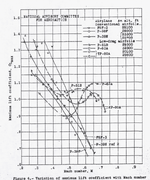
F4U-4 Buno.80765 CLmax power off clean 1.471 power off landing 1.948 (The power-off clean here was tested when plane starts to roll so could be over-stated)
NACA values for F4U-4 still shows 1.37 for power off clean (they called Glide condition), though I think NACA does not doing as accurate as NAS Pax. on calibrating airspeed and measuring these values during test flights:
View attachment 851583
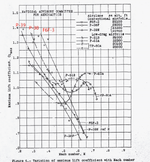
It is still possible that F4U-4 had imporved aerodynamic performance of the wing and thus giving it higher CLmax than the F4U-1, and possbily a reason it was listed to turn tighter than the F4U-1D even though the wing-loading is heavier:
View attachment 851584
Note the tests still involve a lot of uncertainties and errors, an 1-2mph error might incur some significant difference in calculated CLmax, thus I am listing various cases to compare. All stall speeds were calibrated to sea-level.