Hypothetical Curtiss P-36N — A P-40N Returning to Radial Power (1 Viewer)

Ad: This forum contains affiliate links to products on Amazon and eBay. More information in Terms and rules

The R-2000 is an awfully small engine for a successful fighter in 1943.
Depends on what is a "successful fighter"
What matters is the available power at the desired altitude and here the R-2000 is in trouble.

R-2000 without modifications is good for 1100hp at 16,000ft.
Ki-44 engine was good for 1320hp at 17,225ft
But the P-40N's had 1125hp at about 15,000ft.
P-40L (Packard) had 1120hp at 18,500ft.
Soviet M-82FN in a Lag-5 was good for 1450hp at 15,255ft
Even the Ki-43 IIs Ha-115 was good for 980hp at 19,685ft

R-1830 in the F4F-4 was good for 1020hp at 18,900ft but now you have to not only add the second stage but the intercooler/s.
Now we have to ask if the F4F-4 would be a "successful fighter" in the 2nd half of 1943 ;)
 
Depends on what is a "successful fighter"
What matters is the available power at the desired altitude and here the R-2000 is in trouble.

R-2000 without modifications is good for 1100hp at 16,000ft.
Ki-44 engine was good for 1320hp at 17,225ft
But the P-40N's had 1125hp at about 15,000ft.
P-40L (Packard) had 1120hp at 18,500ft.
Soviet M-82FN in a Lag-5 was good for 1450hp at 15,255ft
Even the Ki-43 IIs Ha-115 was good for 980hp at 19,685ft

R-1830 in the F4F-4 was good for 1020hp at 18,900ft but now you have to not only add the second stage but the intercooler/s.
Now we have to ask if the F4F-4 would be a "successful fighter" in the 2nd half of 1943 ;)
The R2000 is 33_litres (2000cu.in). 2000HP out of that is a possibility, given aggressive development. Bristol Hercules engines (39_litres or 2400cu.in) eventually exceeded 2000HP. Maybe a fighter should have been built around that.

Successful WWII liquid cooled engines were as small as 27_litres (1650cu.in) in displacement, although they were more likely to be 34 or 36_litres (2100 to 2200cu.in). There was a lot of clever radiator design going on. The air cooled radials that worked, were bigger. The BMW 801 was 42_litres (2600cu.in). Anybody designing a new fighter in the USA in 1942 would be out of his mind to select anything other than the P&W R2800, 46_litres (2800cu.in).

The success of the 27_litre Merlin engines through mid and late war, was due to their very good superchargers, and access to high octane fuel.

By 1943, the Japanese managed to get their A6M5s up to 350mph on a 28_litre (1700cu.in) radial engine, but they sacrificed armour and other protection to do it, and the R2800 powered American aircraft still were faster.
 
The R2000 is 33_litres (2000cu.in). 2000HP out of that is a possibility, given aggressive development.
Yep, P&W got 2800hp out of the R-2800 by using aggressive development, like throwing out the entire engine (maybe they saved the starter dog) and starting over. New crankcase, new crankshaft, new rods, new cylinders and new heads a lots of other new parts. It was called the "C" series engine. IN WW II it used in the P-47M&N and needed the turbo to hit the 2800hp number. Also needed 72in of MAP and water injection.
P&W started work on the C series engine in 1940. it took until late 1944 for it see service. C Series was also used in the F4U-4, WEP was 2380hp using water injection.
Bristol Hercules engines (39_litres or 2400cu.in) eventually exceeded 2000HP. Maybe a fighter should have been built around that.
eventually was post war and much like the R-2800 C series, about the only they kept was the name. I don't think anybody wanted a Hercules powered fighter in 1946-47.
Anybody designing a new fighter in the USA in 1942 would be out of his mind to select anything other than the P&W R2800, 46_litres (2800cu.in).
People didn't even want to cut metal on a fighter using the Wright R-2600. They might have put it on paper but that was a far as it went.
By 1943, the Japanese managed to get their A6M5s up to 350mph on a 28_litre (1700cu.in) radial engine,
Japanese managed to get a lot more power out of their radial engines in the 20,000ft range. Better/more efficient superchargers?
R-1830 needed two stages and inter coolers to pretty much equal the engines used the A6M3 and A6M5.
In fall of 1942 and early 1943 the US did not know what the Japanese were going to come up with next.
With 20-20 Hindsight we know that they didn't build very may Ki-44s or build a big wing Ki44. We know that the Ki-61 had engine problems from the start. We Know that it took the Japanese 2 years to stick a Kinsei engine into an A6M. Japanese navy mucked up the Radian fighter.
US planners had to make planes for fighting IF the Japanese did not screw up. An R-2000 powered P-40 was not it in 1943. Maybe in 1944 without a lot of development but then what else isn't getting worked on? the R-4360?
 
Yep, P&W got 2800hp out of the R-2800 by using aggressive development, like throwing out the entire engine (maybe they saved the starter dog) and starting over. New crankcase, new crankshaft, new rods, new cylinders and new heads a lots of other new parts. It was called the "C" series engine. IN WW II it used in the P-47M&N and needed the turbo to hit the 2800hp number. Also needed 72in of MAP and water injection.
P&W started work on the C series engine in 1940. it took until late 1944 for it see service. C Series was also used in the F4U-4, WEP was 2380hp using water injection.
Be careful here. However awesome the P47Ms and Ns were, the P47Ds did the hard work of destroying most of the Luftwaffe in 1943. The original R2800s got the job done on the Corsairs and Hellcats.
 
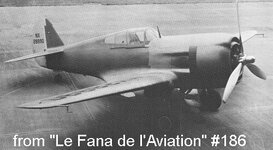
P&W had a Curtiss Model 81A (probably a Tomahawk II airframe) that they modified with a two-stage R-1830. Between July and October 1943 It achieved a top speed of 388mph @ 25,000ft on 1015hp. Speed at sea level was 315mph on 1200hp. Fit and finish were probably some what better than what could be expected from Curtiss and it didn't have combat equipment.

I have it with an R1830-SSC7-G engine making 389mph @ 19,000 ft.
 

Attachments

  • r_f186a.JPG
    r_f186a.JPG
    47.4 KB · Views: 36
Be careful here. However awesome the P47Ms and Ns were, the P47Ds did the hard work of destroying most of the Luftwaffe in 1943. The original R2800s got the job done on the Corsairs and Hellcats.
True but then we can't get to 2800hp and thus 2000hp for the theoretical developed R-2000 engine.
Late P-47Ds got up to 2560-2600hp using water injection and a newer, higher capacity turbo.
1943 R-2800s were limited to 2300hp with water injection when it showed up.
F4U-1s and F6Fs were limited to around 2135-2200hp with water injection.

This means about 1570hp from a similarly developed R-2000. Next question is at what altitude.
If you want to make power at altitude (even 15,000ft) you needed a bigger supercharger than the historical R-2000 but that doesn't take much. The question is how higher do you want to make power? P&W made crappy superchargers until late 1944 and later.
 
I have it with an R1830-SSC7-G engine making 389mph @ 19,000 ft.
P&W got the Hawk 81A-1 airframe In Sept 1940. All the performance numbers I have seen date from the fall of 1942 and the summer/fall of the 1943. I am sure that P&W has/had a lot of records in their files. I doubt it took 2 years to get this airplane flying.
Getting the cowl, intercoolers and exhaust systems all sorted out to give the high-performance figures may have taken a while.
 
Depends on what is a "successful fighter"
What matters is the available power at the desired altitude and here the R-2000 is in trouble.

R-2000 without modifications is good for 1100hp at 16,000ft.
Ki-44 engine was good for 1320hp at 17,225ft
But the P-40N's had 1125hp at about 15,000ft.
P-40L (Packard) had 1120hp at 18,500ft.
Soviet M-82FN in a Lag-5 was good for 1450hp at 15,255ft
Even the Ki-43 IIs Ha-115 was good for 980hp at 19,685ft

R-1830 in the F4F-4 was good for 1020hp at 18,900ft but now you have to not only add the second stage but the intercooler/s.
Now we have to ask if the F4F-4 would be a "successful fighter" in the 2nd half of 1943 ;)
Not to much of a trouble for 1943 and later as the superior FM-2 was begining to emerge.
 
Not to much of a trouble for 1943 and later as the superior FM-2 was begining to emerge.
R-1830 in the F4F-4 was good for 1020hp at 18,900ft.
And the Wright engine in the FM-2 was good for 1000hp at 17,000ft
FM-2 was about 500lbs lighter weight gross clean due to the lighter engine, only 4 guns and a bit less fuel.
If you want to use an unmodified R-2000 engine in the P-40N you have to lighten the plane up by around 500lbs, give or take.
Cooling system in the P-40N was down to 235lbs due to the Aluminum radiator/s and that pretty much cancels out the over 200lb difference between the Allison engine and heavier R-2000 engine.
 
The R-2000 is an awfully small engine for a successful fighter in 1943.
I would believe your argument if you could point me to an operational P-40 variant with more than 1,450 HP. That variant might not have become the best fighter of the war, but it would have been the best of the P-40/P-36 family in terms of power-to-weight ratio.
 
I would believe your argument if you could point me to an operational P-40 variant with more than 1,450 HP.
R-2000 never got WEP. 1450hp was take-off and Military power at 1000ft. Yes, 1000ft with just 3 zeros. That is with zero ram so it lasts a bit higher in climb and several thousand ft higher in hi-speed level flight.

However.
P-40E was rated at 1490hp at 4,300ft using 56in of MAP for WEP.
P-40K was rated at 1325hp for take-off and 1580hp at 2600ft using 60in of MAP.
P-40M&K was rated at 1200hp for take-off and 1410hp at 9,700ft using 57in of MAP.
All three are without ram so they are good for that power several thousand ft higher in hi-speed level flight with RAM.

Pilots manual for the P-40F&L has a misprint on the engine chart. It gives a higher pressure limit for WEP than for take off but lists both at 1300hp in low gear.
In high gear the Merlin engine gives slightly more power over 2000ft higher than the R-2000.
but it would have been the best of the P-40/P-36 family in terms of power-to-weight ratio.
An awful lot depends on the P-40 versions armament and fuel status.
It also very much depends on the altitude as we have seen the R-2000 power falls off very quickly with altitude.
For the P-40F&L the Merlin setup is several hundred pounds heavier than the Allison engine.

The stock (historical) R-2000 engines don't really offer much, if anything over the Allison engines of the time.

Original question is if there was an Allison shortage.
it might have worked, just don't expect increased performance at most altitudes higher than sea level.
 
...

Pilots manual for the P-40F&L has a misprint on the engine chart. It gives a higher pressure limit for WEP than for take off but lists both at 1300hp in low gear.
...
Not exactly a misprint from my point of view.
53 (53.4) in Hg [11-1/2 PSIG] @ 3000 rev/min was original take-off rating. Military rating was 48 (48.2) in Hg [9 PSIG] @ 3000 rev/min for both MS gear [up to 11500 feet] or FS gear [up to 18500 feet].
The values left unchanged when new war emergency rating of 61 in Hg [15-1/4 ... 16 PSIG] was introduced in late 1942, 1540 bhp @ 5000 feet, MS gear, 1420 bhp @ 12000 ft, FS gear.
Best regards,
Yavor
 
I would believe your argument if you could point me to an operational P-40 variant with more than 1,450 HP. That variant might not have become the best fighter of the war, but it would have been the best of the P-40/P-36 family in terms of power-to-weight ratio.
The successful radial engines were bigger than the successful liquid cooled engines. A P40 airframe with an R2000 engine would not be significantly faster than a regular P40. I don't know much about the R2000. There are comments up here that the supercharger was no good. At least the Packard Merlins had better performance at altitude.
 
I don't know much about the R2000. There are comments up here that the supercharger was no good. At least the Packard Merlins had better performance at altitude.
The supercharger wasn't any better or any worse than the supercharger on the R-1830. It is possible that it was the same supercharger?
Basic design brief for the R-2000 when started was to get the same power as the R-1830 using lower grade fuel. Fuel changed a lot between starting design and starting to ship finished engines. To get more power they just used cylinders about 1/4 in (6mm?) larger in diameter. They used the same stoke. Other major change was using plain bearings on the crankshaft and not roller bearings.
Shortage of 100 octane fuel never happened, and the US and Allies could operate transports on 100 octane fuel and the R-2000 benefited from that.
As I have mentioned the later R-2000 was rated at 1450hp at 1000ft. The early one/s (-3,-4, -7) were rated at 1350hp at 2000ft.
R-1830s were rated at 1200hp at 4900ft.
IF you had been able to fully open the throttle of the R-1830 at 1000ft you might have gotten around 1295hp (?). Engine was detonation limited.
There were some late war R-1830s that were rated at 1350hp for take-off and 1350hp at 2000ft while running at 2800rpm instead of 2700rpm.
Among other changes they had new cylinders with forged steel barrels and forged aluminum fin cooling muffs. This was trickle down technology from the R-2800 C series engine.
Transport engines need to make a lot of power for take-off and after climbing to a safe altitude (below altitude needing oxygen) throttle back to 50-75% power for long range cruise.

Plot the power and altitudes given on a chart and see what kind of a pattern they make.
 
The supercharger wasn't any better or any worse than the supercharger on the R-1830. It is possible that it was the same supercharger?
Basic design brief for the R-2000 when started was to get the same power as the R-1830 using lower grade fuel. Fuel changed a lot between starting design and starting to ship finished engines. To get more power they just used cylinders about 1/4 in (6mm?) larger in diameter. They used the same stoke. Other major change was using plain bearings on the crankshaft and not roller bearings.
Shortage of 100 octane fuel never happened, and the US and Allies could operate transports on 100 octane fuel and the R-2000 benefited from that.
As I have mentioned the later R-2000 was rated at 1450hp at 1000ft. The early one/s (-3,-4, -7) were rated at 1350hp at 2000ft.
R-1830s were rated at 1200hp at 4900ft.
IF you had been able to fully open the throttle of the R-1830 at 1000ft you might have gotten around 1295hp (?). Engine was detonation limited.
There were some late war R-1830s that were rated at 1350hp for take-off and 1350hp at 2000ft while running at 2800rpm instead of 2700rpm.
Among other changes they had new cylinders with forged steel barrels and forged aluminum fin cooling muffs. This was trickle down technology from the R-2800 C series engine.
Transport engines need to make a lot of power for take-off and after climbing to a safe altitude (below altitude needing oxygen) throttle back to 50-75% power for long range cruise.

Plot the power and altitudes given on a chart and see what kind of a pattern they make.
The thing I do know about the R2000 is that it powered Douglas DC4s. When Canadair converted these into North Stars, they replaced the R2000s with Rolls Royce Merlin 626s. They also pressurised the fuselage. As far as I can tell, the Canadair North Star is one of the few piston engined airlines with two-stage superchargers.
 
The thing I do know about the R2000 is that it powered Douglas DC4s. When Canadair converted these into North Stars, they replaced the R2000s with Rolls Royce Merlin 626s. They also pressurised the fuselage. As far as I can tell, the Canadair North Star is one of the few piston engined airlines with two-stage superchargers.
The change-over was due in part to Canada, as part of the British Commonwealth, having to pay import duties (taxes) on American P&W engines. They didn't have to pay the taxes on the RR engines.
The North Stars were built new and were not converted from existing DC-4s. Canadair had a contract for a new development of the DC-4 that used some DC-6 parts. Landing gear, cockpit, forward fuselage, etc.
One interesting Canadair aircraft was the Canadair 5, a one-off using P&W R-2800CA15 engines. Performance was very similar to the Merlin powered airplanes. It was delivered to No 415 Transport squadron where it served for 17 years transporting the prime minister, the Queen and other government officials. It was a lot quieter in the cabin.
 

Users who are viewing this thread

Back