Britain had 3 companies, France had two, Germany had 3 and Italy had 2/3. Japan had 3 ? the two major radial engine makers and few minors and the two companies with licensed DB 601s. That may have been duplication.
It depends on what we're counting. Britain have had 2 major and several minor engine companies, with Napier and A-S in-between? Italy 2+2; granted, volume of Italian engines produced was small, bar the indifferent A.74. Japan has 2 companies making their own engines, plus Kawasaki and Aichi making the DB 601As and Nakajima radials under licence, with Hitachi as producer of small engines. Kawasaki was making radials during the whole war, Aichi switched to the meager production of V12s some time in 1941, while phasing out radial engines production.
Now the problem with combining companies in the "interest" of standardization is you are putting all or most of your eggs in one basket. Engine "A" may have been world class but when they tried to scale it up or change the number of cylinders if it doesn't go like they plan you have nowhere else to go. You also can't do competitive bids. The engine company tells the government what the engines will cost.
There was offering of 2 different Nakajima engines before Pearl Harbor, as well as 3 Mitsubishi engines. I don't count the Ha-5 that is being phased out from production.
Both N and M are working on two new engine types from 1942 on, while upgrading the engines that are already in production. So there was a lot of redundancy in case one engine fails.
I have nothing against the DB 601A in 1939-40, even in 1941. However, thinking that in 1942 a 1100-1200 HP V12 will offer an edge over a 1300-1500 HP 14 cyl radial the Japanese companies have experience with, both in design, debugging and production (and with 1500-2000 HP designs in the pipeline) requires a lot of cool aid.
There was no such experience in designing and debugging of V12s in Japan.
With 4 companies producing major radials, Government has a very good knowledge of the actual price of a produced engine.
The Homare fell on it's face. In the US the R-2600 made a good bomber engine but it never made it as a fighter engine. But we had the R-2800 so Wright skated.
Maybe the Japanese had a few too many duplicates but you need at least two companies and each company needs more than one model.
Did Homare really fell on it's face, or the other factors were to blame, like the octan value of Japanese fuel by 1945, and state of Japasese support industry and maintenance? Even if Homare have had it's problems, there was far more to the Japanese engine's problems than just the Homare.
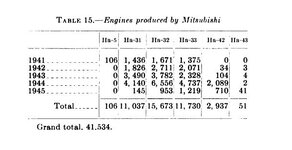
There was certainly two companies designing the radials, plus 2 that can produce them, and there was certainly much more than one model in production. Just by Mitsubishi, in-house production, posted here earlier:
The Japanese did screw up weapons/ammo production. Standardize on the ammo, have more than one company make each caliber, make more than one gun in each caliber if you want but have them use the same ammo.
Agred all the way.
There was like 4 different 20mm ammo types, and several (three?) 30mm types, with the 30 mm barely seeing service. 37mm was okay-ish, if unusable on 1-engined types, while the 40mm was very much
meh.
IJA was also very late on adopting 20mm weapons on their 1-engined fighters.



