Japanese Versus American Victory Claims (6 Viewers)

Dunn's work contains a lot more citations and is a lot more in-depth. This is from keyword searching "ratio" in Southwest Pacific Air War.

View attachment 898970
What I was referring was the recurring trend for researchers to put an aim first that " Allied overclaim was vast and the overall exchange ratio shall be 1:1 even", and based on biased statistics from different sources that are often not able to cover all combat units & losses types, draw the conclusion "Allied victory claims are wildly exaggerated, while Japanese claims are merely inaccurate" from flawed & bias method.

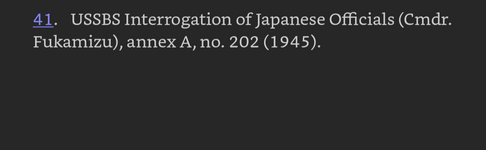
It is clear from this reference, Dunn directly used Japanese wartime propaganda number of 64 as the loss value and said "no reason for Japanese to downplay". Which is an extraordinary assumption, considering Japanese systematically doctor their losses & claim figures to the press after the battle of midway, and peaked at late 1944 which is known as the Daihon-ei Happyou. Using this number for the basis of research is unacceptable and definitely biased.

Further similar narrative done by Dunn can be seen as 193 American claims against 44 Japanese losses from 1–15 January 1944 alongside 170 F6F claims against 35 F6F losses from September–December 1943, then suggests the Hellcat was roughly breaking even with the Zero. He was comparing losses & claims from different times, based on captured Japanese telegram and assumed the overclaiming ratio was constant. One of the example would be the raid on Wake Island, where US claimed 30 A6M destroyed in the air, while actual loss for the Zeros were 18, with 6 Hellcat loss in exchange. Here the overclaim definetely exists, but not so exaggrated as been described in above mentioned works.

Those search narratives tended to draw conclusion first, and then find evidences. The result would be biased.

From the USSBS post-war interrogation and reconstruction, neither those 64 or 44 losses held valid for the Japanese. The true loss number to all causes was around 120 - 130 for Jan 1944, for IJNAF only.
1791789277634.png

Furthermore, as IJAAF systematically destroyed their loss records, most post-war figures were based on pure reconstruction by surviving docs and even pure memory, their accuracy as first-hand sources may be questionable.
1791789619958.png
 
Last edited:
From the book Operation KE, the authors Richard and Dennis Letourneau, point out something interesting.

Overclaiming of air to air kills is normal but during the period covered by the book, that of early 1943 when the Japanese were withdrawing from Guadalcanal, the Americans overall claimed two kills for every actual kill made.

In contrast, the Japanese, Army and Navy, claimed four kills for every actual kill made.

And when non-kill losses are taken into account, the actual number of kills claimed by US pilots is in reality an accurate estimate of enemy losses.

Consider the impact on morale of this situation. In the Battle of Britain the Luftwaffe was assured that the raids of the day before had finished off the RAF, only to have the numbers of Spitfires and Hurricanes seemingly undiminished every day. On one occasion the RAF was indeed tapped out, with all units committed, but a lone WW1 pilot, station commander, attacked a formation headed for his base and they all jettisoned their bombs and ran for home. Of course in that case the the German bombers had missed meeting up with their fighter escort (German fighters and bombers could not talk to each other over the radio but occasionally RAF and German fighters were on the same frequency) and just knew they were going to get their arses well and truly kicked. The appearance of that one Hurricane was seen as conformation of this fear, since there surely had to be a hundred fighters right behind it.

With their massive overclaiming it must have seemed to the Japanese that the Americans had an inexhaustible supply of planes and pilots, which indeed they did, only just not right there and then.

And of course we know that many US aircraft hit by Japanese fire made it safely back to base. In contrast a USMC F4F pilot at the Canal was desperately trying to get the Zeros off a Admiral's PBY and just sprayed .50 cal at them to scare them off. It was years after the war that he found he had shot three Zeros down that day; they were only slightly damaged but in each case probably no more than a single .50 cal round had damaged an engine, punched through an oil line, and caused a fuel leak that prevented the Zeros from making it home.

View attachment 895571View attachment 895573View attachment 895574View attachment 895575
It would help if you could provide dates for each of the combats you mention.


The seminal works to read about the Pacific naval airwar, are Lundstrom's First Team, two volume set and his Black Shoe Carrier Admiral volume.
 
What I was referring was the recurring trend for researchers to put an aim first that " Allied overclaim was vast and the overall exchange ratio shall be 1:1 even", and based on biased statistics from different sources that are often not able to cover all combat units & losses types, draw the conclusion "Allied victory claims are wildly exaggerated, while Japanese claims are merely inaccurate" from flawed & bias method.

It is clear from this reference, Dunn directly used Japanese wartime propaganda number of 64 as the loss value and said "no reason for Japanese to downplay". Which is an extraordinary assumption, considering Japanese systematically doctor their losses & claim figures to the press after the battle of midway, and peaked at late 1944 which is known as the Daihon-ei Happyou. Using this number for the basis of research is unacceptable and definitely biased.

Further similar narrative done by Dunn can be seen as 193 American claims against 44 Japanese losses from 1–15 January 1944 alongside 170 F6F claims against 35 F6F losses from September–December 1943, then suggests the Hellcat was roughly breaking even with the Zero. He was comparing losses & claims from different times, based on captured Japanese telegram and assumed the overclaiming ratio was constant. One of the example would be the raid on Wake Island, where US claimed 30 A6M destroyed in the air, while actual loss for the Zeros were 18, with 6 Hellcat loss in exchange. Here the overclaim definetely exists, but not so exaggrated as been described in above mentioned works.

Those search narratives tended to draw conclusion first, and then find evidences. The result would be biased.

From the USSBS post-war interrogation and reconstruction, neither those 64 or 44 losses held valid for the Japanese. The true loss number to all causes was around 120 - 130 for Jan 1944, for IJNAF only.
View attachment 898976
Furthermore, as IJAAF systematically destroyed their loss records, most post-war figures were based on pure reconstruction by surviving docs and even pure memory, their accuracy as first-hand sources may be questionable.
View attachment 898977


Are you just shoving your argument through ChatGPT or some other LLM? The random bolding of text and use of EM dash screams that this is just a generated response. If that is the case then I see no reason to continue.
 
Are you just shoving your argument through ChatGPT or some other LLM? The random bolding of text and use of EM dash screams that this is just a generated response. If that is the case then I see no reason to continue.
I use llm as search engine and type it myself. I don't know how you been so against llm agent as a tool of research. Which is a topic never related to South Pacific War, or anything should be discussed in this thread.
 
I use llm as search engine and type it myself. I don't know how you been so against llm agent as a tool of research. Which is a topic never related to South Pacific War, or anything should be discussed in this thread.

It definitely reads like you are using it to craft arguments for you and have not really bothered to reference Dunn's book at all and just instead rely on an AI summary of it.

For instance the chart that you linked as somehow a refutation of Dunn's narrative is apparently from the same section of the US Strategic Bombing Survey that he cites in his book? Or are you using a different section of the US SBS that reports Japanese losses purely based on US claims?

The tangent on Wake Island also doesn't have anything to do with my excerpts from Dunn's book either.


Those search narratives tended to draw conclusion first, and then find evidences. The result would be biased.

Like this whole idea seems to be a conclusion you have reached about both authors and both times you have provided "proof" seems to just be an odd unrelated tangent. First trying to link Claringbould and Dunn to the claims of some Japanese author and now to some other anecdote on Wake Island.

Allied victory claims are wildly exaggerated, while Japanese claims are merely inaccurate" from flawed & bias method.

This is not at all the narrative in Dunn's book. He points out multiple times when the Japanese wildly over-claimed their victories even in comparison to the Americans.
 
Last edited:
It definitely reads like you are using it to craft arguments for you and have not really bothered to reference Dunn's book at all and just instead rely on an AI summary of it.

For instance the chart that you linked as somehow a refutation of Dunn's narrative is apparently from the same section of the US Strategic Bombing Survey that he cites in his book? Or are you using a different section of the US SBS that reports Japanese losses purely based on US claims?

The tangent on Wake Island also doesn't have anything to do with my excerpts from Dunn's book either.


Like this whole idea seems to be a conclusion you have reached about both authors and both times you have provided "proof" seems to just be an odd unrelated tangent. First trying to link Claringbould and Dunn to the claims of some Japanese author and now to some other anecdote on Wake Island.


This is not at all the narrative in Dunn's book. He points out multiple times when the Japanese wildly over-claimed their victories even in comparison to the Americans.
The loss figure was reconstructed by the request of GHQ and was included as the supplementary material in No.446, the interrogation of Miyazaki Takashi in Jan. 1946 and was confirmed by IJN Admiral Kusaka.
 
The loss figure was reconstructed by the request of GHQ and was included as the supplementary material in No.446, the interrogation of Miyazaki Takashi in Jan. 1946 and was confirmed by IJN Admiral Kusaka.

So do we think that Dunn did not read the US SBS?
 

Attachments

  • Screenshot_20261012-000737.png
    Screenshot_20261012-000737.png
    33.8 KB · Views: 0

Users who are viewing this thread

Back