Snowygrouch - Thanks for responding and I understand your dilemma. Actually, Kaaden
per se, does not figure in the original question I asked which were solely about the links (if any) between Peenemünde-West and the ME262. Kaaden appeared only when I was asked the reason behind my questions.
But the fact that an expert such as yourself doesn't immediately say, "Mmm...I seem to recall reading something about this," is helpful in itself. I'm not expecting you or anybody else to spend time doing my research for me. Having spent a lot of time researching this matter myself, I took the plunge and decided to ask and give due credit to the experts. Thanks for passing my question to your editor.
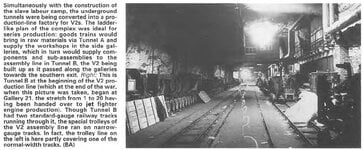
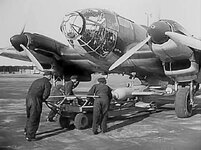
For the record, the only connection I have found is not between Peenemünde-West and the ME262 but between Kaaden and the ME-262. This link is when Kaaden worked at the Mittelwerk underground factory in the Harz Mountains (after December 1944). Kaaden worked on Henschel's production of its Hs-293 rocket-assisted glide-bomb whilst another part of this vast underground factory complex was producing the ME-262 engine:
'From 1943, when the Allied bombing offensive threatened to bring Germany's above-ground industrial
production to a standstill, it became the centre of a whole complex of underground factories, the most
important of which was the Mittelwerk in the Kohnstein mountain, which produced three of Germany's
best-known secret weapons: the V1 flying bomb, the V2 rocket and jet engines for the Me 262 and
Ar 234 fighter.'
'Nordhausen' article in 'AFTER THE BATTLE' magazine No. 101 published in 1998 (page 2).
The same 42 page article later adds more detail:
The Junkers factory in the Nordwerk produced two types of jet engines, the Jumo 004 B-1 and
Jumo 004 B-4 for Me262 and Ar 234 jet fighters respectively. In all, some 1,463 were delivered before
war's end. In addition, in August, it received an order for 8,930 of the well-proven Jumo 213 engine.
Production did not start until late 1944 and by war's end, only some 800 had been completed.
'Nordhausen' article in 'AFTER THE BATTLE' magazine No. 101 published in 1998 (page 24).
And just to finish off this slight diversion for those interested in Jumo 004 B-4 engines...
Projects in the Mittelbau area were planned and overseen bv Special Inspection Staff II, led by
SS-Hauptsturmfiihrer Geissen, with headquarters at Halle. They included:
Project A-5: Eight miles west of Nordhausen, in the natural caves at Uftrungen
near Rottleberode (a protected site since 1922), the Junkers factory at Schönebeck in
April 1944 installed a production line for Jumo 004 B-4 engines. In all, 8,000 square
metres of cave floor were used. A railway line connected the site with the main line at
Rottleberode.
'Nordhausen' article, 'AFTER THE BATTLE' magazine No. 101 published in 1998 (page 30).
This article has more about Junkers jet engine production but I fear it may be
off-piste for this topic. For those wanting a copy of this magazine, it can be bought here:
www.afterthebattle.com/store/magazines/issue-no-101_ID104