Oldest medals still in use.....? (1 Viewer)

Ad: This forum contains affiliate links to products on Amazon and eBay. More information in Terms and rules

Lucky13

Forum Mascot
54,589
39,730
Aug 21, 2006
In my castle....
Which are they?
sCo_chinscratch.gif
 
Here is what I found. George Washington originally implemented the Puple Heart for Military Merit, not being wounded on the battlefiled, so it seems the award originally was just a cloth Purple Heart with Gold embroidery. It was not until many years later that it was reintroduced as a award for being wounded on the battlefield. So the Purple color has nothing to do with injury. Not sure why Purple was chosen.

Here is some info I cut from another web-site with some history of the medal.


The Badge for Military Merit

The original Purple Heart award was instituted by George Washington in 1782 to reward troops for "unusual gallantry" and "extraordinary fidelity and essential service." The award was a purple cloth heart edged in silver braid, and was to be worn over the left breast of the uniform. Only three awards are known to have been issued, of which two are known to exist today.

One of the two known examples of the Badge for Military Merit.

--------------------------------------------------------------------------------

The Modern Award

Pre-WW2 Awards: The Purple Heart as we know it today was reestablished in 1932 to coincide with the 200th anniversary of the birth of George Washington. The original criteria for award of the Purple Heart as published in the War Department Circular No. 6 of February 22, 1932 states that the medal be awarded to anyone serving in the Army who had received combat-related injuries or had received the AEF's Meritorious Service Citation Certificate during WWI, the latter criteria harkening back to the intent of George Washington's "Badge of Military Merit".

Although this awards was retroactive to any soldier wounded from the Civil War on, eligible recipients were required to submit a formal application to the War Department for approval before the issuance of the medal. In 1942 the Army estimated that approximately 186,000 living veterans were eligible to receive a retroactive Purple Heart. Approximately 78,000 retroactive Purple Hearts were awarded between 1932 and 1942.

While the award of the Purple Heart was not authorized by the Navy until 1942, sailors and Marines who had been wounded prior to 1932 were eligible to apply for the medal. While no numbers are available concerning the award to Navy and Marine personnel, approximately 12,000 sailors and Marines were wounded between the Civil War and the Nicaragua Campaign of 1932.
 
The Purple Heart is a heart-shaped medal within a gold border, 1 3⁄8 inches (35 mm) wide, containing a profile of General George Washington. Above the heart appears a shield of the coat of arms of George Washington (a white shield with two red bars and three red stars in chief) between sprays of green leaves. The reverse consists of a raised bronze heart with the words FOR MILITARY MERIT below the coat of arms and leaves. The ribbon is 1 and 3⁄8 inches (35 mm) wide and consists of the following stripes: 1⁄8 inch (3 mm) white 67101; 1 1⁄8 inches (29 mm) purple 67115; and 1⁄8 inch (3 mm) white 67101. As with other combat medals, multiple awards are denoted by award stars for the Navy, Marine Corps, or Coast Guard, or oak leaf clusters for the Army and Air Force.

Elizabeth Will, an Army heraldic specialist in the Office of the Quartermaster General, was named to redesign the newly revived medal, which became known as the Purple Heart. Using general specifications provided to her, Will created the design sketch for the present medal of the Purple Heart. Her obituary, in the 8 February 1975 edition of the Washington Post newspaper, reflects her many contributions to military heraldry.

This from Wiki...

Charles
 
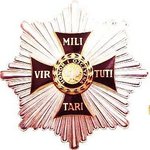
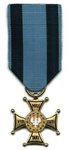
The Order Virtuti Militari (Latin for "For Military Virtue") was created in 1792 and is Poland's highest military decoration for valor in the face of the enemy and one of the oldest military decorations in the world still in use. Some of the heroic actions recognized by an award of the Virtuti Militari are equivalent to those meriting the Commonwealth's Victoria Cross, and the U.S. Medal of Honor. It is awarded either for personal heroism or to commanders for leadership.

Awarded in five classes, the order was created in 1792 by Poland's King Stanisław August Poniatowski. Soon after its introduction, however, the Polish-Lithuanian Commonwealth was destroyed (1795) in the partitions of Poland, and the partitioning powers abolished the decoration and prohibited its wearing. Since then, the award has been reintroduced, renamed and banned several times, with its fate closely reflecting the vicissitudes of the Polish people. Throughout the decoration's existence, thousands of soldiers and officers, Polish and foreign, several cities and one ship have been awarded the Virtuti Militari for valor or outstanding leadership in war. There have been no new awards since 1989.

Source :Virtuti Militari - Wikipedia, the free encyclopedia
 

Attachments

  • Virtuti_Militari_Grand_Cross_Order_Star.jpg
    Virtuti_Militari_Grand_Cross_Order_Star.jpg
    29.2 KB · Views: 404
  • Krzy%C5%BC_Z%C5%82oty_Orderu_Virtuti_Militari_wz_1992.jpg
    Krzy%C5%BC_Z%C5%82oty_Orderu_Virtuti_Militari_wz_1992.jpg
    35.8 KB · Views: 1,473
The US Medal of Honor was instituted during the Civil War and first awarded to members of a Union team of sabotuers who stole a train and rode to Union lines (The 'Great Locomotive Chase' theft). Unfortunately, the commanding officer of the team was a civilian and was not awarded the medal.

Great Locomotive Chase - Wikipedia, the free encyclopedia

Weren't a bunch of those guys shot for stealing that locomotive? Seem to recall they were.
 
This one should look interesting on his uniform!

IMG_20251019_174931.jpg

Former Embassy Stockholm Defense Attaché Col. Ryan Sweeney (center) is presented with the Swedish Royal Order of
the Sword by Swedish Minister of Defense Pål Jonson (left) and Commander Markus Abrahamsson (right),
military advisor for the Department for Security Policy and International Relations at the Ministry of Defense, Sept. 28.

Photo by Freja Ingelstam

svärd.png
 
IMG_20260620_193039.jpg

The Order of the White Eagle (Polish: Order Orła Białego) is the highest honour of the Republic of Poland and formerly
the Second Polish Republic and the Polish–Lithuanian Commonwealth and one of the oldest state decorations in the
world still in use. It was officially instituted on 1 November 1705 by Augustus II the Strong, King of Poland and Elector of
Saxony, and bestowed on eight of his closest diplomatic and political supporters. It has since been awarded to the
most distinguished Poles for their merits and occasionally to the heads of state of foreign countries.

The Order of the White Eagle is attached to an azure sash slung over the left shoulder to the right side. The star of the
Order, formerly embroidered, is worn on the left side of the chest. Unlike other Polish high decorations, the Order of
the White Eagle does not have different classes or crosses.
 
IMG_20260620_194636.jpg

The Royal Order of the Polar Star (Swedish: Kungliga Nordstjärneorden), sometimes translated as the Royal Order of the
North Star, is a Swedish order of chivalry created by King Frederick I on 23 February 1748, together with the Order of the
Sword and the Order of the Seraphim. The Order of the Polar Star is intended as a reward for Swedish and foreign "civic
merits, for devotion to duty, for science, literary, learned and useful works and for new and beneficial institutions".

Its motto is, as seen on the blue enameled centre of the badge, Nescit Occasum, a Latin phrase meaning "It knows no
decline". This is to represent that Sweden is as constant as a never setting star. The Order's colour is black. This was
chosen so that when wearing the black sash, the white, blue and golden cross would stand out and shine as the light of
enlightenment from the black surface. The choice of black for the Order's ribbon may also have been inspired by the
black ribbon of the French Order of St. Michael, which at the time the Order of the Polar Star was instituted was also
awarded to meritorious civil servants. From 1975–2023, the ribbon of the Order was blue with yellow stripes near the
edges (i.e., the national colors, but the reverse of the Order of the Sword's yellow ribbon with blue stripes near the edges).
The black ribbon was reintroduced in 2023 when guidelines to once again award Swedish honours to Swedish citizens
were introduced. Women and clergymen are not called Knight or Commander, but simply Member (Ledamot).
 
IMG_20260620_195510.jpg

The Royal Order of Vasa (Swedish: Kungliga Vasaorden) is a Swedish order of chivalry founded on 29 May 1772 by King
Gustav III. It is awarded to Swedish citizens for service to state and society especially in the fields of agriculture, mining
and commerce.

History
The order was founded on 29 May 1772 by King Gustav III. Its name is derived from the House of Vasa. Membership
was unrestricted by birth or education, as opposed to the other orders which were reserved for nobility, military personnel
or the learned professions. During the union between Sweden and Norway, the Order of Vasa was often awarded to
Norwegians until the Order of Saint Olav was founded in 1847.

Following significant reforms to the Swedish honours system in 1974, the Order of Vasa and the Order of the Sword were
considered dormant and membership in the Order of the Seraphim and the Order of the Polar Star were restricted to
foreigners and, after 1995, the royal family.

In 2019, a parliamentary committee was instructed to establish guidelines on how to re-introduce the Swedish orders,
including the Order of Vasa, into the Swedish honours system and how Swedish citizens again can be appointed to
Swedish orders. The committee presented its findings in September 2021 and the Government presented a bill on
the subject to the Riksdag on 19 April 2022. Following the passage of the bill by a large majority on 19 June 2022, on
20 December 2022, the Swedish Government published a new regulation that repealed the 1974 regulation, and once
again opened the Royal Orders to Swedish citizens again and reactivated the Order of the Sword and the Order of Vasa,
which came in effect from 1 February 2023.

On 21 March 2024, the order was awarded for the first time since 1974 to, among others, the members of ABBA.
 
IMG_20260620_200704.jpg

The Royal Order of Charles XIII (Swedish: Kungliga Carl XIII:s orden) is a Swedish order of merit, founded by King Charles
XIII in 1811.

Membership
The Lord and Master of the Order is the King of Sweden, currently King Carl XVI Gustaf. Membership of the order can
only be conferred on Freemasons of the Protestant faith. The membership of the order comprises:

Thirty lay members and never more than seven non-Swedish members, each holding the XI (highest) degree of the
Swedish Rite of Freemasonry, i.e. either regional heads or national heads.
Three clerical members, invariably priests or bishops of the Church of Sweden.
All princes of the Royal House of Sweden are members from birth, but do not wear the insignia unless they are
Knight and Commander of the Red Cross of the Swedish Order of Freemasons. (Hence the insignia is not worn by
the King nor the Duke of Värmland, who are both Knights of the Order from birth).
Foreign princes of Blood Royal may be admitted as honorary members, if they are also senior Freemasons,
whether of the Swedish Order or another; they are full members of the Order, but do not count towards its
membership limits; Prince Edward, Duke of Kent (United Kingdom) was admitted to the Order on 6 November 2000.
There can never be more than 33 persons who are members at the same time. (Men of royal blood are
automatically members, and do not count as part of the 33 allotted slots).

Insignia and regalia
The insignia consists of a red St George cross, in the centre a white globe with the monogram of the institutor,
two opposite letters C surrounding XIII, in gold. On the reverse the globe has the letter B in gold in an equilateral
black and gold edged triangle. The cross is surmounted by a closed golden crown. The insignia is worn around
the neck in a red ribbon. There is also red breast red cross: the insignia hence is the same as a Commander 1st
Class and recipients rank after the Commanders 1st Class of the Swedish Royal Orders.

The order uses a habit, introduced 1822, and new knights are dubbed.

IMG_20260620_200919.jpg

Ceremonial robes of the Order of Charles XIII
 
IMG_20260620_202607.jpg

The Order of Saint John in Sweden (Swedish: (S:t) Johanniterorden i Sverige [ˈsǎŋkt ʝʊhanˈîːterˌoːɖɛn ˈiː ˈsvæ̌rʝɛ]) is a
Protestant chivalric order. It is a member of the Alliance of the Orders of Saint John of Jerusalem.

It was founded in 1920 in Stockholm, Sweden, as an affiliate of the Evangelical-Lutheran Bailiwick of Brandenburg of
Germany. In November 1946, it was granted a Royal Charter by King Gustaf V as the Johanniterorden i Sverige.
King Carl XVI Gustaf is the current High Patron, and Queen Silvia is the First Honorary Member of the Order.

Medals, honors, and other ceremonial decorations from the Order are officially open to all citizens; however, they are
currently only awarded to members of the House of Nobility, making it a de facto noble order.
 

Users who are viewing this thread

Back