Great topic… My vote >> Plane Vs plane > P-47, but maybe not the N, but the D-25. This plane's range is a bit less than the F4U-4, but in the air, it was the best '47 variant. Fuel in the wings, and the fuselage extension did not benefit the '47's aerobatic performance; although the increased power, fuselage extension (2"), wing air flow improvements did increase its speed. Modification to the T-bolt to N variant was done purely for range; with as little degradation to performance as possible.
I believe the '47 was at the end of its 'design life cycle', jet aircraft not withstanding. The Corsair, was (a) younger (design), it was not an adaptation, or improvement of an earlier design. From a clean sheet it was purposely designed to be fitted with the P&W R-2800, unlike the P-47, whose forbearers were powered by 'smaller' engines, the Corsair was designed to be a carrier aircraft. The limits of prop tech. service aboard carriers forced the gull wing shape ( to it's advantage, as the T-Bolt had a 6" clearance with the four bladed paddles, ones finally fully able to 'transfer' the output probably the best aircraft power plant of the war, the P&W R2800, on take-off/landing). The Corsair had quite an extended development time (maybe the longest, of that period, exceeding even the design life of the Lighting) for a combat fighter aircraft, was in fact superseded (as a carrier fighter) by it's friendly rival the Hellcat which 1st flew a full year after the F4U was ordered into production, which the Corsair never fully replaced in service during WW2. The wing shape of the Corsair is/was its primary advantage, similarly it's primary weakness (it is also the reason I fell in love with WW2 aircraft in the first place). As far as flight characteristics are concerned it's definitely more a weakness than a benefit.
More on topic…
The strength needed to absorb carrier landings, as evidenced by the thicker sheet metal used in the under-fuselage between the wings of the Corsair is mandated by two minor factors unique of the 'gull shape' wing: 1- The 'inverted gull shape' wing shortened the undercarriage length, increasing both the undercarriage's strength (good), its transfer of energy to the airframe (bad), as the 'suspension' has less travel therefore less ability to 'absorb' landing energies (the Corsair had a rep for bouncing) requiring more of the stressed skin of the Corsair to be strengthened against 'flex'. 2-The other factor is one of geometry. An angled wing increases its length at a greater rate than it increases its span, therefore although the Corsair and Jug ( had effectively similar landing gear track wing spans{P-47-D}), the frame of the Corsair needed to be 'reinforced' over a greater length again requiring more of the stressed skin of the Corsair to be strengthened against 'flex'. I believe this light might shed some insight upon claims (I here tell that even the 'Air Force' guys said…) the Corsair may have been a tougher bird.
Within that section of a Jug, under-fuselage between the wings, suspended by an airframe flight rated to +8Gs, with an operating window of 14Gs (the Corsair was rated to +7.3Gs with an operating window of 12.3Gs) are the T-bolts armored fuel cells, armored supercharging plumbing, space for the wheels, covered by sheet metal whose only service is to provide an aerodynamically clean surface, therefore not requiring the strengthening found on the Corsair in this area. Additionally the P-47's airframe was not 'strengthened' to tolerate carrier landing, or 'inverted gull shaped wing' stresses; instead it was 'strengthened' to absorb flight stresses. I believe that it was the toughest bird produced in the USA, not as rigid as an Fw190, or Yak-3.
So, although the skin of the 'Bolt may be thinner in places of similar locations as compared to the Corsair, sometimes the locations are not performing the same tasks.
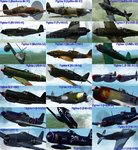
As for the rest of the performance stuff, may I offer here the suggestion of visiting the Best Fighter of WW2 section to download my WW2 fighter comparison tables, which contain, as it happens, both the P-47N F4U-4. A photo shows the rest of the aircraft listed. Hopefully I'll be visiting here again soon.