Pressure Bottle damaged by explosion, from WW2 aircraft? (1 Viewer)

Ad: This forum contains affiliate links to products on Amazon and eBay. More information in Terms and rules

Antoninus

Recruit
4
2
Nov 1, 2006
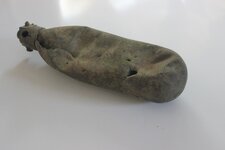
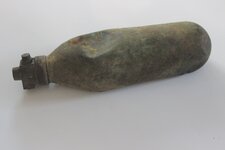
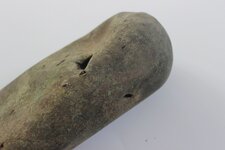
Hallo, this pressure bottle was found in the forest not far from my house in central Germany. It is about 40 cm in length. With the irregular inward bent holes it looks like it was damaged by some kind of explosion. During WW2 a Lancaster I bomber, hit by a nightfighter, exploded above our town and the bottle was still found within the wide area were the wreckage fell. So at first I expected that the bottle was part of this plane.

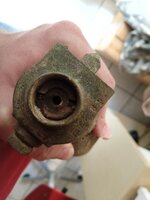
However, there are inscriptions at the top, AM 27/N14 and EW.4. 5., and as far as I could find out it seems to be American made. The notation "27N/14" typically indicates a pressure rating of 27 pounds per square inch (psi) and an NPT (National Pipe Taper) port size of 1/8 inch

Has anyone seen this kind of bottle before or knows the meaning of the second inscription?
 

Attachments

  • Heuberg 001.JPG
    Heuberg 001.JPG
    1 MB · Views: 8
  • Heuberg 002.JPG
    Heuberg 002.JPG
    1.2 MB · Views: 7
  • Heuberg 003.JPG
    Heuberg 003.JPG
    1 MB · Views: 8
  • IMG_20250714_191551.jpg
    IMG_20250714_191551.jpg
    1.2 MB · Views: 9
Welcome to our site.

To answer your question ... IIRC the designation AM 27N/14 (often also written as Stores Ref. 27N/14) is a British Air Ministry (hence the abbreviation AM) catalog number assigned to an aviation fire extinguisher (made of copper or brass) used on board Royal Air Force (RAF) aircraft during World War II and the post-war years. Possible the bottle is a part of the automatic fire suppression systems made by the Graviner firm and installed in each of the engine nacelles

27N - Airborne Fire Fighting Equipment
14 - a part number.
 
Thank you! So this is indeed a part of the Lancaster (LL855). According to eye witness reports one of the engines came down not far away, thus the bottle seems to come from the corresponding nacelle.
 
Thank you! So this is indeed a part of the Lancaster (LL855). According to eye witness reports one of the engines came down not far away, thus the bottle seems to come from the corresponding nacelle.


My pleasure. :)

And yes if the engine hit the ground near the fire extinguisher could be of the nacelle. As memory serves the fire extinguishers were installed at the firewall there.
 
There is an Air Publication poster that shows the engine fire bottle system on the RAF Museum online pages, but the illustration is far too small to be of use.
There appear to be single bottles fitted at each engine, possibly at the firewall or just by the front spar, it is tricky to tell. These bottles were electrically discharged by a pyro on that brass adapter you have. They would be manually operated by a FIRE button for the appropriate engine position.

I will try to attatch the poster but the Museum pic is tiny!

Eng

lancfire389.jpg
 
The Graviner extinguisher was located on the outer (i.e. engine) side of each firewall, on the lower section. Pics I have seen, and actual installations, show this on the outboard side of the engine, and these were operated individually by pressing the (four) covered push-buttons on the starboard side of the main instrument panel.
I have at least one photo of an installation in one of my books, but I'm unable to access them at the moment.
 
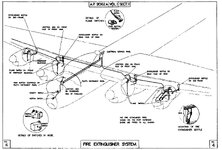
I've found this diagram of the fire extinguisher system. Not the best resolution, but at least everything is decipherable. On all photos of actual aircraft I've seen so far the view is blocked by the other equipment installed around the engine nacelles.
 

Attachments

  • LancasterFireSupression.jpg
    LancasterFireSupression.jpg
    203 KB · Views: 10
Best shots I have, in this case the starboard outer nacelle. Extinguisher is the copper coloured item. On the Lanc Mk. X, two extinguishers were carried in each nacelle and that's probably the case for others as well.

1789598437685.png


1789597305869.png


It should be emphasized that these extinguishers were carried by many other British aircraft, not just Lancasters.
 
Hallo, this pressure bottle was found in the forest not far from my house in central Germany. It is about 40 cm in length. With the irregular inward bent holes it looks like it was damaged by some kind of explosion. During WW2 a Lancaster I bomber, hit by a nightfighter, exploded above our town and the bottle was still found within the wide area were the wreckage fell. So at first I expected that the bottle was part of this plane.

However, there are inscriptions at the top, AM 27/N14 and EW.4. 5., and as far as I could find out it seems to be American made. The notation "27N/14" typically indicates a pressure rating of 27 pounds per square inch (psi) and an NPT (National Pipe Taper) port size of 1/8 inch

Has anyone seen this kind of bottle before or knows the meaning of the second inscription?
From Lancaster IPC:-
1789722259449.png


More info at:- https://www.key.aero/forum/historic-aviation/139959-graviner-fire-extinguishers

1789722339928.png
1789722370115.png
 

Users who are viewing this thread

Back